
Introduction
Forklifts move thousands of tons of material every day in warehouses, factories, ports, and logistics centers. While operators often focus on engines, batteries, and mast systems, the real force behind every lifting and steering movement is the hydraulic cylinder.
Hydraulic cylinders convert hydraulic pressure into mechanical force, allowing forklifts to raise loads, tilt masts, and maneuver in tight spaces. However, not all forklift cylinders perform the same function. Selecting the wrong cylinder can result in reduced lifting performance, hydraulic leaks, premature wear, and even serious safety hazards.
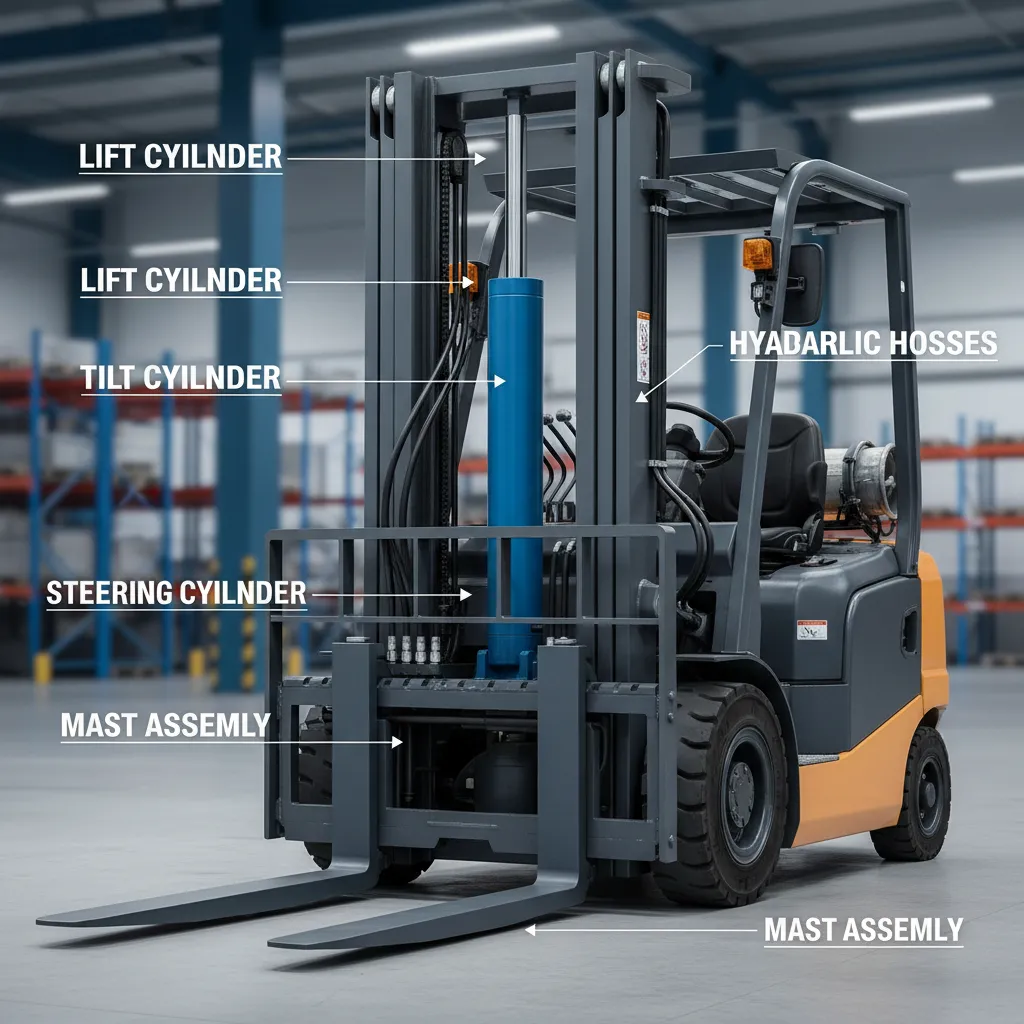
Most forklifts rely on three primary hydraulic cylinder types:
- Lift Cylinders
- Tilt Cylinders
- Steering Cylinders
Each serves a different purpose and uses a specific mounting style, operating principle, and sealing system.
In this guide, you’ll learn:
- The different types of forklift hydraulic cylinders
- How each cylinder functions
- Single-acting vs. double-acting designs
- Key specifications to consider
- Common failure modes
- How to select the correct replacement cylinder
The Three Main Types of Hydraulic Cylinders in a Forklift
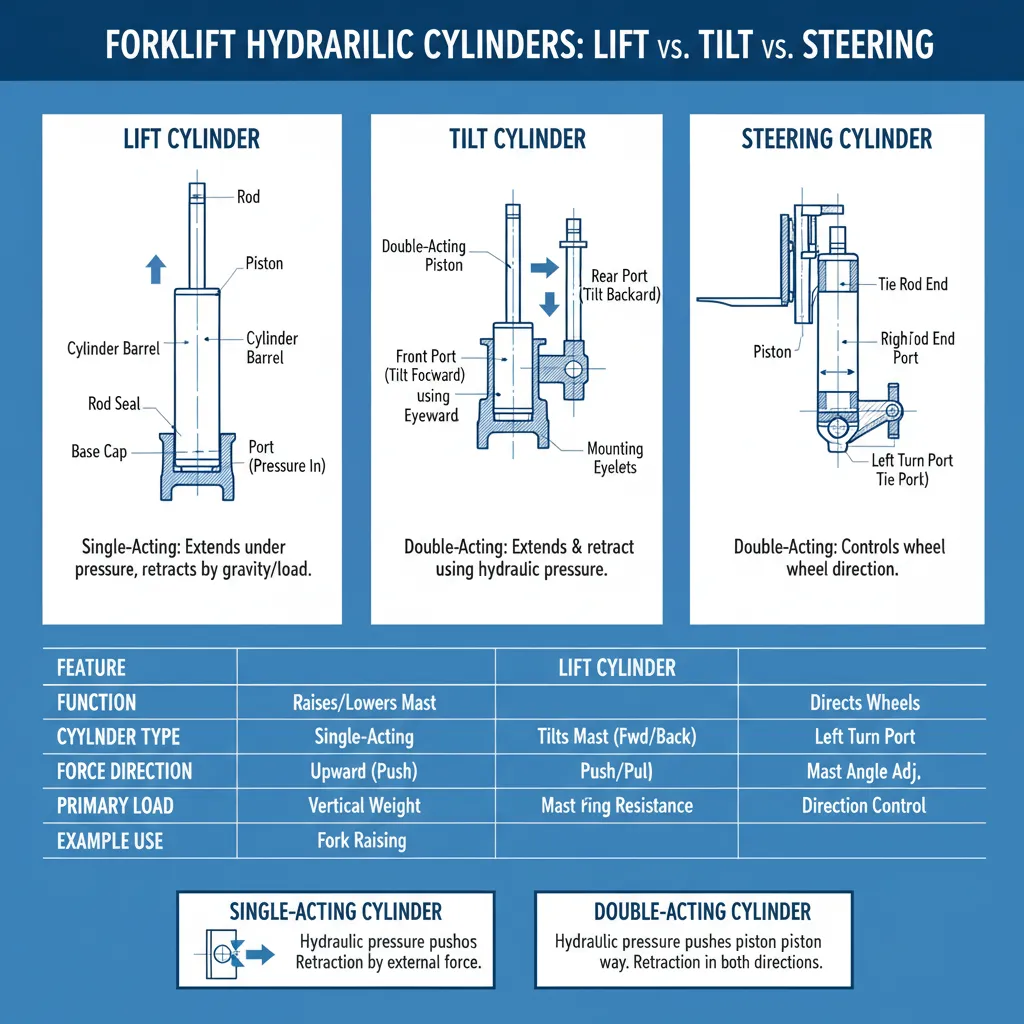
- Lift Cylinder (Main Mast Cylinder)
The lift cylinder is responsible for raising and lowering the carriage and load.
Without the lift cylinder, a forklift cannot perform its primary task—lifting pallets and materials.
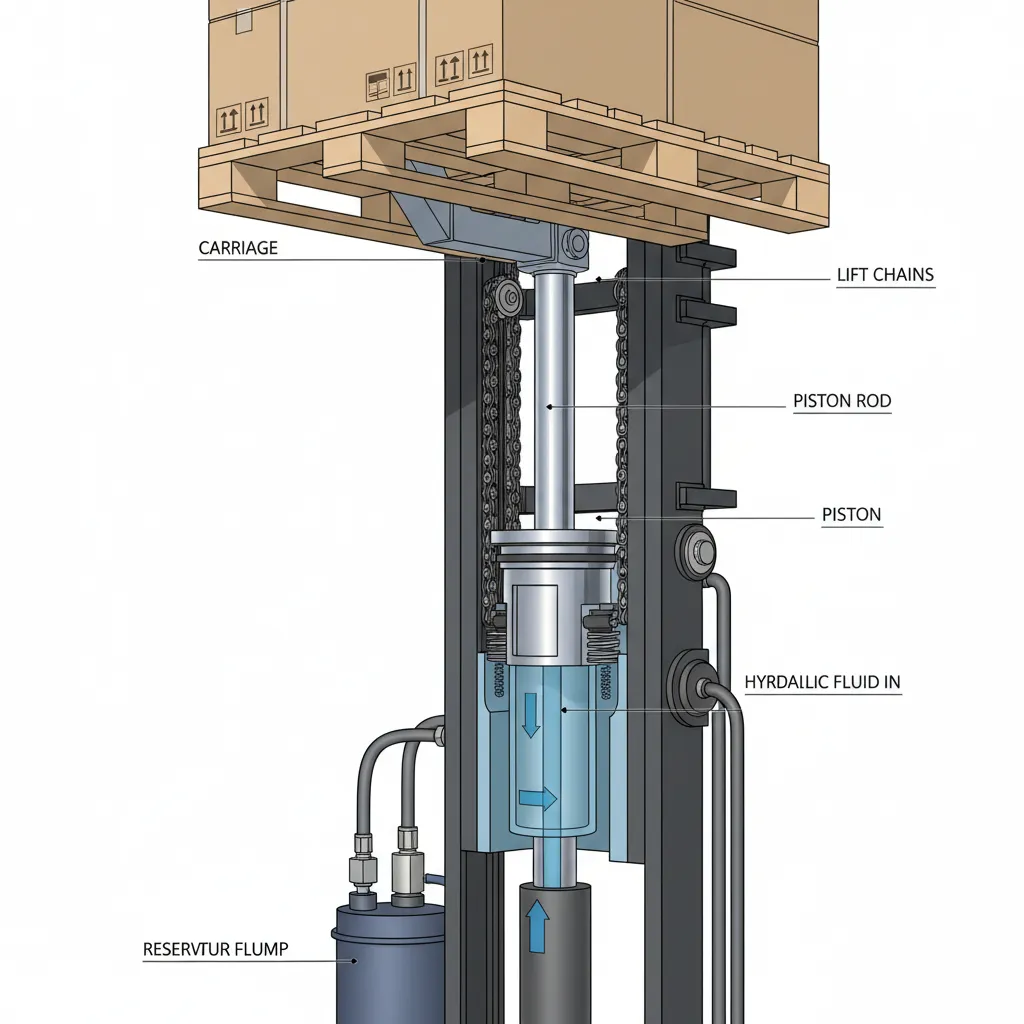
How It Works
Most forklift lift cylinders are single-acting hydraulic cylinders.
Hydraulic pressure extends the cylinder to raise the mast. When lowering, gravity and the weight of the load return the cylinder to its retracted position.
Typical Characteristics
- Single-acting design
- Large bore diameter
- Vertical installation
- Trunnion-mounted
- Available in multi-stage telescopic configurations
Multi-Stage Lift Cylinders
Modern forklifts often use:
- 2-stage masts
- 3-stage masts
- Full free-lift masts
These designs allow greater lifting heights while maintaining compact overall mast dimensions.
Common Applications
- Warehouse forklifts
- Reach trucks
- Counterbalance forklifts
- Container handlers
Visual Identification
Lift cylinders are typically:
- The largest cylinders on the machine
- Mounted vertically
- Located inside or alongside the mast assembly
- Tilt Cylinder
Tilt cylinders control mast angle.
They allow operators to tilt the mast backward for stability and forward for load placement.
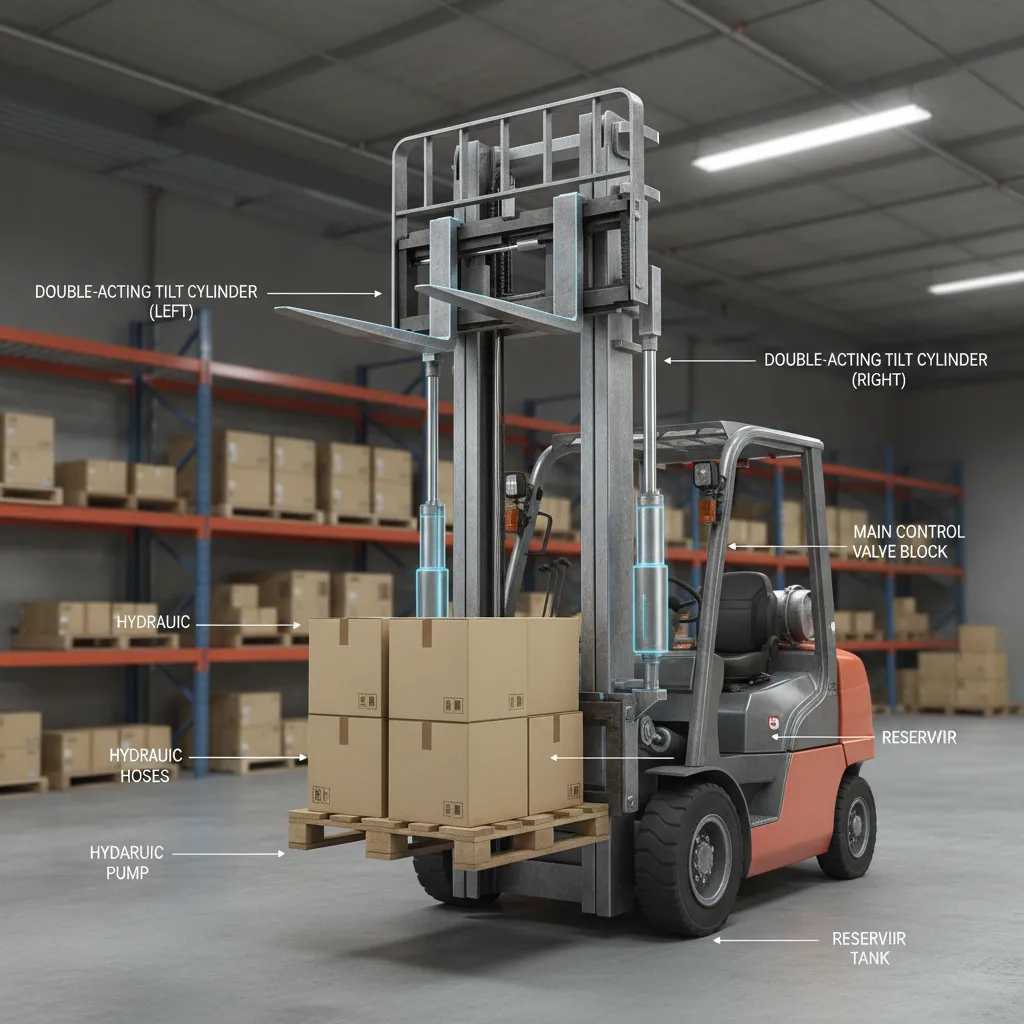
How It Works
Tilt cylinders are almost always double-acting hydraulic cylinders.
Hydraulic pressure controls both extension and retraction, providing precise mast positioning.
Typical Characteristics
- Double-acting operation
- Smaller bore than lift cylinders
- Pin-mounted or clevis-mounted
- Installed in pairs
Why Tilt Cylinders Matter
Proper mast tilt:
- Prevents load spillage
- Improves stability during transport
- Reduces operator risk
- Enhances productivity
Visual Identification
Tilt cylinders are usually:
- Installed on both sides of the mast
- Mounted horizontally or at an angle
- Smaller than lift cylinders
- Steering Cylinder
Steering cylinders control rear-wheel steering on most counterbalance forklifts.
These cylinders provide the maneuverability forklifts are known for.
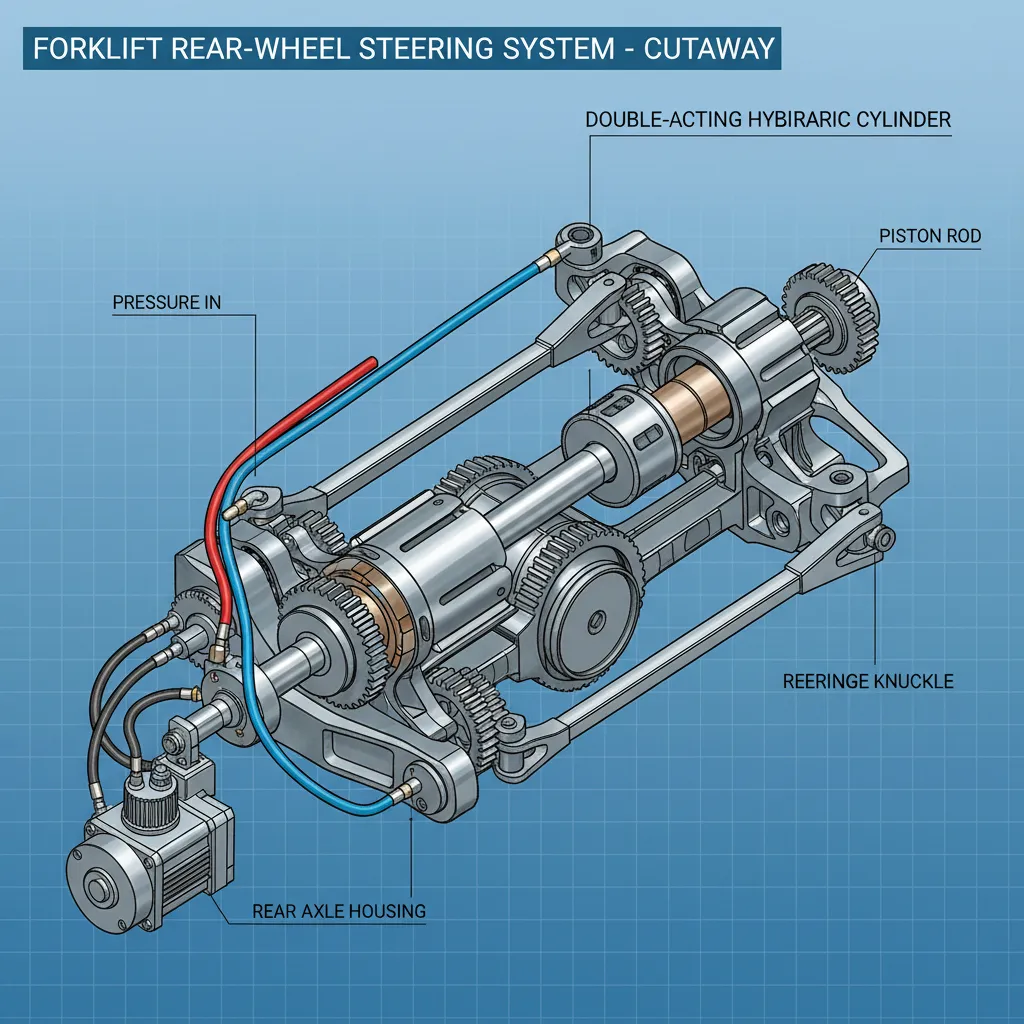
How It Works
Steering cylinders are double-acting cylinders connected to:
- Steering knuckles
- Steering linkage systems
- Steering axle assemblies
Hydraulic pressure moves the piston in either direction to turn the wheels.
Typical Characteristics
- Double-acting design
- Compact dimensions
- High cycle frequency
- Integrated into steering axle systems
Special Requirements
Steering cylinders must provide:
- Fast response
- Smooth operation
- Accurate wheel positioning
- Minimal internal leakage
Visual Identification
Steering cylinders are generally:
- Mounted near the rear axle
- Horizontally positioned
- Smaller than both lift and tilt cylinders
Key Design Characteristics and Terminology
Single-Acting vs. Double-Acting Cylinders
Single-Acting Cylinder
Uses hydraulic pressure in one direction only.
Advantages:
- Simpler design
- Lower cost
- Fewer seals
- Reliable gravity return
Used primarily in:
- Lift cylinders
Double-Acting Cylinder
Uses hydraulic pressure for both extension and retraction.
Advantages:
- Precise control
- Greater safety
- Faster response
- Better positioning accuracy
Used in:
- Tilt cylinders
- Steering cylinders
Common Mounting Styles
Trunnion Mount
Features pivot points welded to the cylinder barrel.
Common for:
- Lift cylinders
- Heavy-duty mast applications
Clevis Mount
Uses a fork-shaped mounting bracket with a pin connection.
Common for:
- Tilt cylinders
Cross-Tube Mount
A welded tube allows pivoting around a pin.
Common for:
- Steering cylinders
- Compact equipment
Flange Mount
Cylinder attaches directly through a flange plate.
Common for:
- Specialized forklift designs
Seal Materials
Hydraulic cylinder seals significantly affect service life.
Polyurethane (PU)
Advantages:
- Excellent wear resistance
- High pressure capability
- Long service life
Nitrile (NBR)
Advantages:
- Good oil resistance
- Cost-effective
- Widely used
Viton (FKM)
Advantages:
- High-temperature resistance
- Chemical resistance
- Extended lifespan in harsh environments
Recommended for:
- Steel mills
- Foundries
- High-temperature warehouses
Bore Size and Rod Diameter
Cylinder force depends on hydraulic pressure and piston area.
The relationship is:
F=P\times A
Where:
- F = Force
- P = Hydraulic Pressure
- A = Piston Area
A larger bore generates greater lifting force, while a larger rod improves buckling resistance and durability.
Quick Comparison Table
| Feature | Lift Cylinder | Tilt Cylinder | Steering Cylinder |
| Primary Action | Lifting | Mast Tilting | Steering |
| Design | Single-Acting | Double-Acting | Double-Acting |
| Mounting | Trunnion | Clevis / Pin | Trunnion / Integrated |
| Orientation | Vertical | Horizontal / Angled | Horizontal |
| Quantity | 1–2 | Typically 2 | Typically 1 |
| Main Failure | Internal seal wear | Bent rod | Internal leakage |
| Typical Load | Very High | Medium | Moderate |
How to Select the Correct Replacement Cylinder
Selecting the right replacement cylinder ensures proper performance and safety.
Step 1: Identify Forklift Information
Record:
- Manufacturer
- Model number
- Serial number
- Mast type
Examples include:
- Toyota
- Hyster
- Yale
- Mitsubishi
- Komatsu
- Crown
Step 2: Determine Which Cylinder Requires Replacement
Identify whether the faulty component is:
- Lift cylinder
- Tilt cylinder
- Steering cylinder
Different cylinder types are rarely interchangeable.
Step 3: Measure Physical Dimensions
Critical dimensions include:
- Retracted length
- Extended length
- Stroke
- Bore size
- Rod diameter
- Pin diameter
- Trunnion spacing
Even small dimensional differences can prevent proper installation.
Step 4: Verify Pressure Rating
Most standard forklifts operate between:
- 2,500 psi
- 3,500 psi
Heavy-duty models may require higher ratings.
Always confirm system pressure before ordering.
Step 5: OEM vs. Aftermarket Cylinders
OEM Advantages
- Guaranteed compatibility
- Original specifications
Aftermarket Advantages
- Lower cost
- Faster availability
- Custom improvements available
A quality aftermarket manufacturer can often provide equal or better performance than the original unit.
Common Failure Modes and Troubleshooting
Lift Cylinder Problems
Slow Lifting
Possible causes:
- Worn piston seals
- Low hydraulic pressure
- Damaged pump
Mast Drifting Down
Possible causes:
- Internal seal bypass
- Control valve leakage
Tilt Cylinder Problems
Bent Rod
Possible causes:
- Excessive forward loading
- Impact damage
- Misalignment
External Oil Leakage
Possible causes:
- Worn rod seals
- Damaged rod surface
Steering Cylinder Problems
Jerky Steering
Possible causes:
- Air in hydraulic system
- Contaminated oil
Poor Steering Response
Possible causes:
- Internal piston leakage
- Worn seals
- Damaged cylinder barrel
Why Custom Hydraulic Cylinders Are Sometimes Necessary
Older forklifts often face replacement challenges because original parts are discontinued.
A custom hydraulic cylinder manufacturer can reproduce:
- Original dimensions
- Mounting configurations
- Bore and rod sizes
- Seal specifications
Custom-engineered cylinders are particularly valuable for:
- Obsolete forklifts
- Specialized warehouse equipment
- High-temperature applications
- Heavy-duty material handling systems
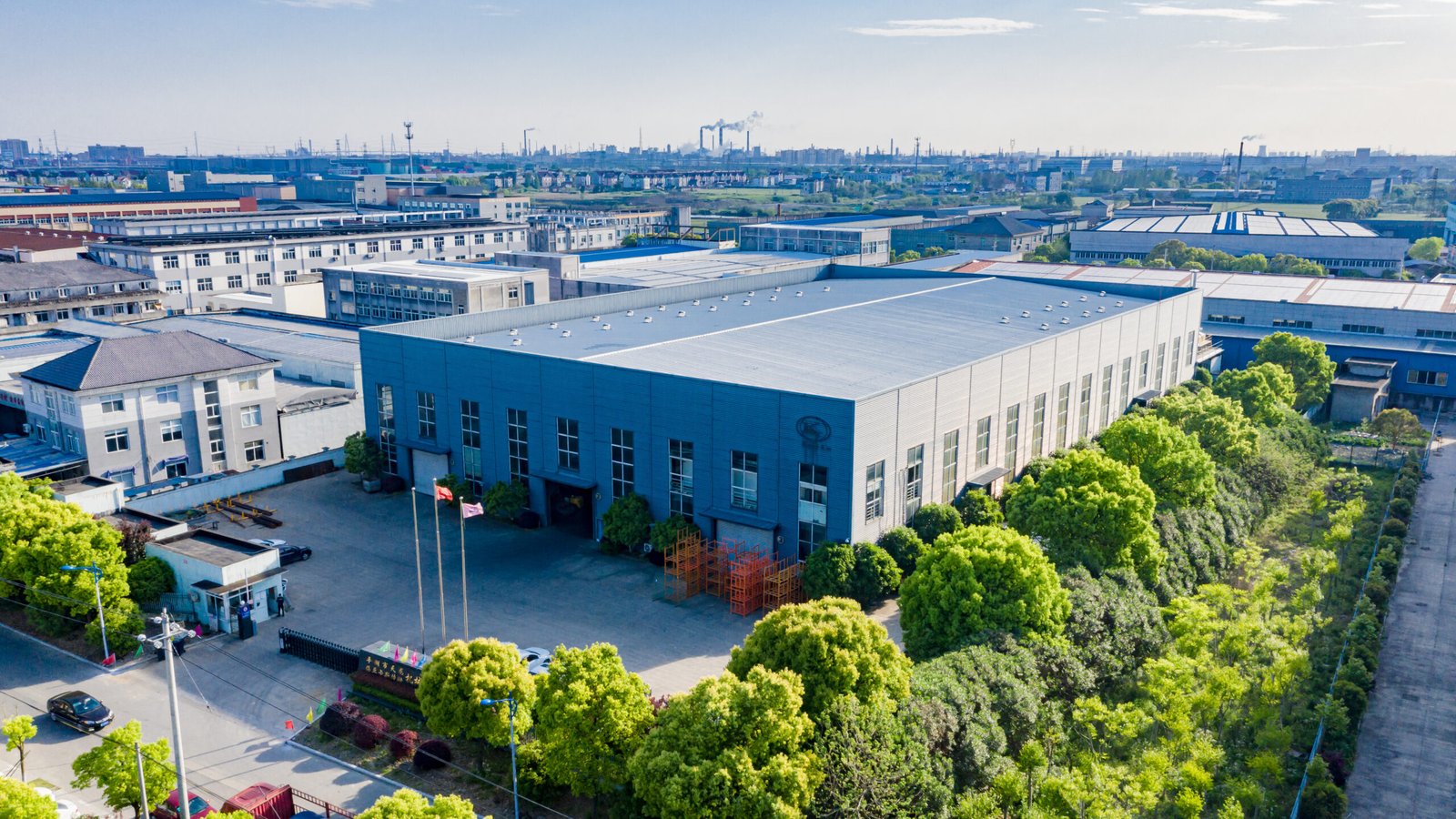
As a professional hydraulic cylinder manufacturer, Toleng Hydraulic supplies OEM and custom forklift hydraulic cylinders designed to match original equipment specifications while improving durability and service life.
Frequently Asked Questions
Can I use a double-acting cylinder for the lift mast?
Generally no.
Forklift lift systems are designed around single-acting cylinders that rely on gravity for controlled lowering. Switching to a double-acting cylinder would require significant hydraulic system modifications.
Are forklift cylinders interchangeable between brands?
Rarely.
Mounting dimensions, stroke lengths, pressure ratings, and mast designs vary considerably between manufacturers.
How long do forklift hydraulic cylinders last?
With proper maintenance, clean hydraulic oil, and periodic seal replacement, forklift cylinders commonly remain in service for more than 10 years.
Can leaking forklift cylinders be repaired?
In many cases, yes.
Seal replacement and rod repair can restore performance if the barrel and piston remain in good condition.
Conclusion
Forklifts depend on three specialized hydraulic cylinders to operate safely and efficiently:
- Lift cylinders for raising loads
- Tilt cylinders for mast positioning
- Steering cylinders for maneuverability
Understanding the differences between these cylinder types helps maintenance teams, fleet managers, and equipment owners select the correct replacement parts and prevent costly downtime.
Whether you need a standard replacement cylinder, a custom-engineered solution, or a seal kit for an existing unit, always verify the cylinder type, mounting configuration, dimensions, and pressure rating before purchasing.

