
Solving Hydraulic Oil Contamination Risks in Sensitive Rubber and Tire Manufacturing Presses Standard Hydraulic Cylinder Manufacturer Guide
High-quality standard hydraulic cylinder manufacturer insights on contamination control specs and ISO certified production for reliable industrial performance.
In modern industrial environments, I have seen how a standard hydraulic cylinder becomes the backbone of reliable motion control systems. Whether it is a rubber molding press or a high-tonnage tire curing machine, hydraulic stability directly determines production quality, cycle time, and equipment lifespan. That is why selecting the right hydraulic cylinder manufacturer is not just a procurement decisionit is a performance decision that impacts the entire production line.
From my experience working with equipment buyers and maintenance teams, I can confidently say that many hydraulic failures trace back not to design flaws, but to inconsistent manufacturing standards. This is where Toleng, as a professional standard hydraulic cylinder manufacturer, stands out by combining precision engineering with strict quality control. We have built our reputation as a quality hydraulic cylinder supplier by focusing on durability, contamination resistance, and repeatable manufacturing accuracy.
A properly designed industrial hydraulic cylinder is more than a mechanical actuatorit is a sealed precision system that must operate under high pressure, fluctuating loads, and often harsh environments. Let me walk through what truly defines a reliable product and manufacturer.
Standard Hydraulic Cylinder Specifications That Define Performance
When I evaluate any standard hydraulic cylinder, I always start with core dimensional and performance parameters. These specifications determine whether a cylinder can integrate smoothly into industrial systems or fail prematurely under load.
Standard bore sizes typically range from 25mm to 320mm (1″ to 12.5″), allowing flexibility across light-duty automation and heavy-duty presses. Stroke lengths vary from 50mm to 3000mm (2″ to 118″), which is critical for applications such as pressing, lifting, and clamping.
Working pressure ratings are another key factor. Most standard cylinder manufacturing lines operate at 16MPa to 25MPa (23203625 PSI), while high-performance designs can reach 35MPa for demanding applications like forging or heavy stamping.
Mounting styles also define integration flexibility. I often recommend verifying compatibility with configurations such as MF, MP, MS, ME, MT, TA, TC, TB, TD, LB, FA, FB, CA, and CB. These standardized mounting options allow hydraulic cylinders to be adapted across a wide range of machinery without redesigning the entire system.
Material selection is equally important. In our hydraulic cylinder factory, piston rods are typically manufactured using hard chrome plated C45, 1045, or 4140 steel. These materials ensure high tensile strength and corrosion resistance. Cylinder tubes are made from honed seamless steel such as ST52, E355, or CK45, which provide excellent dimensional stability under pressure.
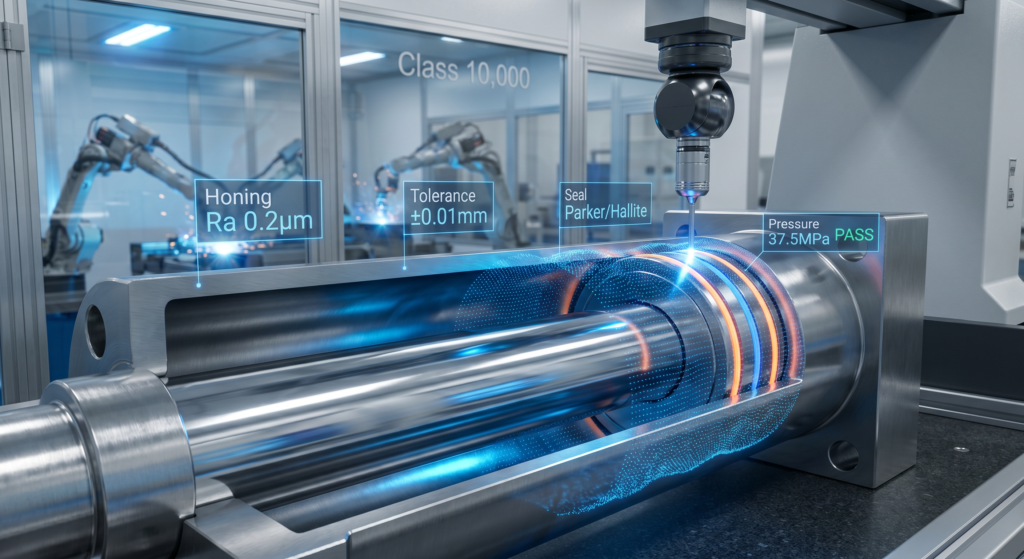
Seal systems are often underestimated but critical for contamination resistance. We use premium sealing brands such as Parker, Hallite, and Merkel or equivalent systems. These seals significantly reduce leakage and extend service life in industrial hydraulic cylinders exposed to continuous cycling.
Precision Manufacturing Quality Standards in Hydraulic Cylinder Factory Production
In standard cylinder manufacturing, precision is everything. I have personally observed that even a 0.02mm deviation in machining can lead to seal failure or pressure loss over time.
At Toleng, CNC machining capabilities maintain tolerances within 0.01mm. This ensures that every hydraulic cylinder manufacturer output meets strict dimensional consistency requirements. After machining, all internal surfaces undergo precision honing to achieve a surface finish of Ra 0.20.4m, which minimizes friction and improves seal lifespan.
Welding quality is controlled through robotic welding systems to ensure repeatability and structural integrity. Manual inconsistencies are eliminated, which is especially important for high-pressure industrial hydraulic cylinders.
Assembly is conducted in a Class 10,000 clean environment. This step is critical because contamination during assembly is one of the leading causes of premature hydraulic failure. Even microscopic particles can damage seals or cause internal scoring.
Every cylinder undergoes rigorous testing before shipment:
- 100% pressure testing at 1.5x working pressure
- Leakage testing with limits 0.05ml/min at rated pressure
- Endurance testing exceeding 500,000 cycles
- Dimensional inspection using CMM measurement systems
This level of validation ensures that every standard hydraulic cylinder leaving our facility meets industrial reliability expectations.
Why Choosing the Right Hydraulic Cylinder Manufacturer Matters
From a procurement perspective, selecting a hydraulic cylinder manufacturer is not just about price. It is about long-term operational stability. I always advise buyers to look deeper into manufacturing transparency and engineering capability.
One key advantage of working with a professional hydraulic cylinder factory like ours is full material traceability. Every batch of steel comes with mill certificates, ensuring compliance and consistency across production.
We also maintain certifications such as ISO 9001:2015, CE, and SGS. These certifications are not just documentsthey represent a structured quality system that governs every step of production.
Another important factor is the balance between in-house manufacturing and outsourcing. A true quality hydraulic cylinder supplier should control machining, welding, assembly, and testing internally. This reduces variability and improves delivery reliability.
Speaking of delivery, standard cylinders typically have a lead time of 715 days, which is a significant advantage for industries with urgent maintenance or production schedules.
We also provide strong technical support. As an experienced custom hydraulic cylinder manufacturer, we assist clients with application engineering, ensuring correct sizing, pressure selection, and configuration for their equipment.
Customization options include:
- Special port locations for complex piping layouts
- Custom rod ends for specific mechanical interfaces
- Integrated sensors for position monitoring
- Corrosion-resistant coatings for harsh environments
These capabilities make OEM hydraulic cylinders adaptable to nearly any industrial requirement.
Applications of Standard Hydraulic Cylinders in Industry
In real-world applications, I have seen standard hydraulic cylinders used across a wide range of industries, each with unique performance demands.
In construction equipment such as excavators, loaders, and bulldozers, cylinders must withstand heavy shock loads and continuous operation. In agricultural machinery like tractors, harvesters, and balers, reliability under dust and temperature variation is critical.
Industrial automation systems rely on precision motion control, especially in presses, conveyors, and lifting platforms. Here, consistency and repeatability are more important than raw force.
Material handling equipment such as forklifts and pallet jacks depend on compact and efficient hydraulic systems for safe lifting operations.
Mobile hydraulics, including trucks, cranes, and aerial work platforms, require cylinders that combine strength with lightweight efficiency and high safety margins.
Across all these applications, industrial hydraulic cylinders must deliver predictable performance under varying loads and environments.
Selection Guide for Choosing the Right Manufacturer
Based on my industry experience, I recommend evaluating suppliers using a structured checklist:
- Verify ISO certification and quality system compliance
- Request material certificates and full test reports
- Inspect machining tolerances and surface finish quality
- Evaluate lead times and technical support responsiveness
- Compare warranty terms (typically 1224 months)
A reliable hydraulic cylinder manufacturer will always be transparent about these aspects and provide documentation without hesitation.
At Toleng, we encourage buyers to browse our standard hydraulic cylinder catalog here:
https://tolenghydraulics.com/standard-hydraulic-cylinder/
We also provide downloadable specification sheets to help engineering teams evaluate compatibility before purchase.
Frequently Asked Questions
What are the standard bore sizes for hydraulic cylinders?
They typically range from 25mm to 320mm depending on application requirements.
How do I verify if a manufacturer is ISO certified?
You can request ISO 9001:2015 certificates and verify issuing bodies through official databases.
What pressure ratings are available for standard cylinders?
Standard designs operate at 1625MPa, with high-pressure options up to 35MPa.
Can standard cylinders be customized?
Yes, a custom hydraulic cylinder manufacturer can modify ports, rod ends, coatings, and sensors.
What is the typical lead time from a manufacturer?
Standard delivery ranges from 7 to 15 days depending on order volume.
How do you test cylinder quality before shipping?
Through pressure testing, leakage testing, endurance cycling, and dimensional inspection.
What mounting styles are considered standard?
Common types include MF, MP, MS, ME, MT

