
Eliminating Stick-Slip Motion: Standard Hydraulic Cylinder Manufacturer Insights for Reliable Material Testing and Simulation Systems
Discover how a reliable standard hydraulic cylinder manufacturer ensures precision, reduced stick-slip motion, and durability through advanced CNC machining, strict ISO 9001 quality control, and OEM customization.
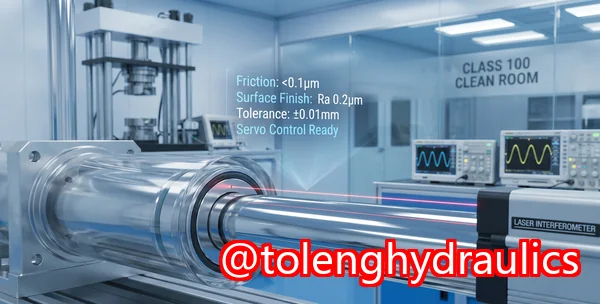
In industrial systems where precision and repeatability matter, I have consistently found that the performance of a standard hydraulic cylinder becomes a defining factor in overall machine reliability. Whether in material testing rigs, simulation systems, or heavy-duty industrial equipment, even small inconsistencies in hydraulic motion can lead to inaccurate results or mechanical inefficiencies.
This is why selecting the right hydraulic cylinder manufacturer is not just a procurement decisionit is a performance-critical engineering choice. A poorly manufactured cylinder can introduce stick-slip motion, leakage, or premature wear, while a high-quality unit ensures smooth force transmission and long service life.
At Toleng, we position ourselves as a professional standard hydraulic cylinder manufacturer, focusing on precision engineering, stable performance, and long-term durability across demanding industrial environments.
Standard Hydraulic Cylinder Specifications for Industrial Applications
In my experience working with OEM clients and engineering firms, one of the first considerations is whether a cylinder’s specifications align with system requirements. A true standard cylinder manufacturing process must offer consistency across dimensions, pressure ratings, and material selection.
Standard bore sizes
We manufacture cylinders with bore sizes ranging from 25mm to 320mm (1″ to 12.5″), covering applications from lightweight automation systems to heavy-duty construction machinery. This range allows engineers to standardize designs while maintaining flexibility.
Standard stroke lengths
Our industrial hydraulic cylinders support stroke lengths from 50mm to 3000mm (2″ to 118″), ensuring adaptability for compact equipment as well as large-scale actuation systems.
Working pressure ratings
-
Standard pressure: 16MPa to 25MPa (23203625 PSI)
-
High-pressure options: up to 35MPa
From my observations, maintaining pressure stability is essential in simulation systems where force feedback must remain consistent under varying loads.
Mounting styles
We offer a comprehensive range of mounting configurations to meet global industrial standards:
MF, MP, MS, ME, MT, TA, TC, TB, TD, LB, FA, FB, CA, CB
This variety ensures compatibility with most OEM machine designs without requiring structural modifications.
Piston rod materials
To ensure strength and corrosion resistance, we use:
-
Hard chrome plated C45
-
1045 medium carbon steel
-
4140 alloy steel
Each material is selected based on load, environment, and cycle frequency.
Tube materials
Our hydraulic cylinder factory uses only honed seamless steel tubes:
-
ST52
-
E355
-
CK45
These materials provide excellent structural integrity and uniform internal surfaces for smooth piston movement.
Seal options
We integrate premium sealing systems from:
-
Parker
-
Hallite
-
Merkel
-
Or equivalent industrial-grade brands
Seal integrity plays a major role in eliminating leakage and minimizing stick-slip behavior in precision applications.
Manufacturing Quality Standards in a Hydraulic Cylinder Factory
A reliable hydraulic cylinder manufacturer must control every step of production. At Toleng, we emphasize in-house manufacturing and strict process control rather than outsourcing critical steps.
CNC machining capabilities
All components are machined with tolerances within 0.01mm. In practice, this level of precision ensures perfect alignment between piston, rod, and barrelreducing friction and improving motion stability.
Honing process
Cylinder tubes undergo precision honing to achieve a surface finish of Ra 0.20.4m. I have seen firsthand how this smooth surface dramatically reduces internal resistance and improves seal life.
Welding standards
We use robotic welding systems to ensure:
-
Consistent weld penetration
-
Uniform bead geometry
-
Reduced human error
This is particularly important in high-pressure cylinders where weld integrity directly affects safety.
Assembly environment
Seal installation and final assembly are completed in a Class 10,000 clean room. This prevents dust contamination, which is a common cause of premature seal failure in hydraulic systems.
Testing procedures
Every cylinder undergoes strict validation before shipment:
-
100% pressure testing at 1.5x working pressure
-
Leakage test: 0.05 ml/min at rated pressure
-
Endurance testing: minimum 500,000 cycles
-
Dimensional inspection using CMM equipment
From my experience, this level of testing is what separates a general supplier from a true quality hydraulic cylinder supplier.
Why Choosing the Right Hydraulic Cylinder Manufacturer Matters
I often tell procurement teams that two cylinders may look identical, but their internal quality can differ dramatically depending on manufacturing standards.
Material traceability
We maintain full traceability for all steel materials, with mill certificates available for every batch. This ensures transparency and compliance in critical industrial applications.
Certifications
A trustworthy hydraulic cylinder manufacturer should always comply with:
-
ISO
Explore Toleng hydraulics Software at: 🔗 https://tolenghydraulics.com/standard-hydraulic-cylinder/

