In ports handling wind power equipment and heavy prefabricated components, challenging sea winds and extreme loads place high demands on lifting machinery. As the core actuation component of a crawler crane, hydraulic cylinders not only determine operational efficiency but are also crucial for ensuring safety and precision.
This article focuses on large crawler cranes, analyzing the essential role of hydraulic cylinders in heavy lifting and exploring how they perform under extreme conditions to meet the stringent requirements of wind turbine installation.
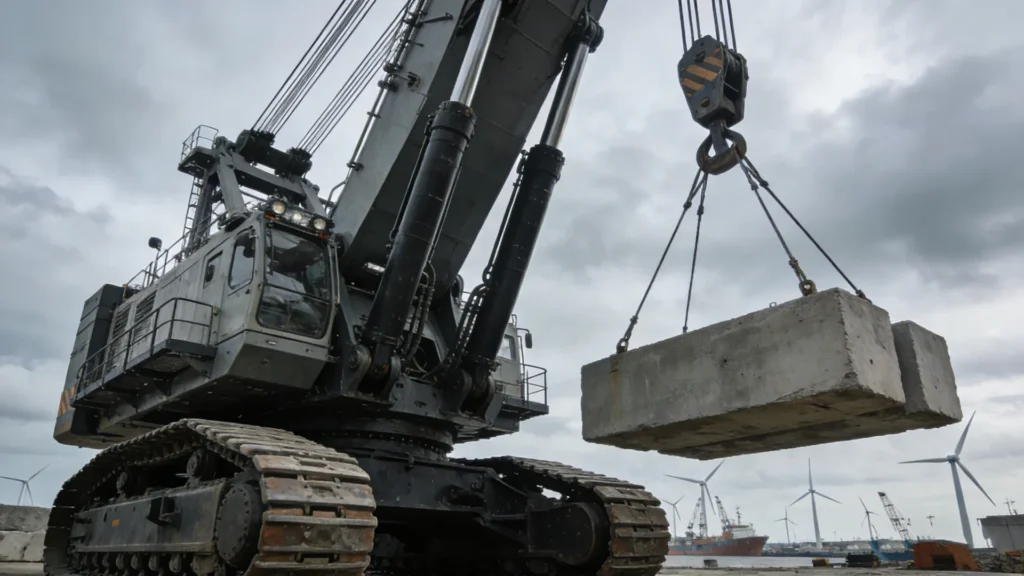
1. Main Boom Control: How Hydraulic Cylinders Achieve “Effortless Heavy Lifting”
In the structure of a crawler crane, two large black main boom cylinders bear the critical task of raising, lowering, and adjusting the angle of the boom.
-
Working Principle: Powered by high-pressure hydraulic fluid extending and retracting the piston, the boom cylinders precisely control the boom’s luffing angle. Even when hoisting wind turbine towers or concrete blocks weighing dozens of tons, operators can achieve millimeter-level inching control.
-
Technical Value: Compared to traditional mechanical drives, hydraulic systems offer higher power density and faster response. This not only eliminates the clumsiness and lag of mechanical transmission but also enables precise in-air positioning and controlled slow descent, significantly improving the continuity and efficiency of port operations.
2. Load Stability and Safety: Preventing Load Sway in Strong Winds
Coastal ports are subject to variable sea winds, causing suspended loads to swing easily during lifting. This presents a significant challenge to the dynamic response capabilities of the hydraulic system.
-
Closed-Loop Control Principle: Modern crawler crane hydraulic cylinders typically integrate counterbalance valves and hydraulic locks. When sensors detect load shift or external disturbances (like wind gusts), the control system instantly adjusts pressure in the cylinder’s chambers, creating a closed feedback loop to rapidly dampen oscillations.
-
Safety Redundancy Design: In the event of an unexpected hydraulic line failure, the cylinder’s built-in locking mechanism activates instantaneously, firmly securing the piston position and preventing boom collapse or load drop. This multi-layered protection is the final safeguard for personnel and equipment on site.
3. Whole-Machine Attitude Adjustment: Creating a “Stable Platform” for Precision Lifting
Beyond boom movement, the overall stability of a crawler crane also relies heavily on its hydraulic systems.
-
Undercarriage & Mobility: Hydraulic travel motors and swing drives enable the crane to maneuver and position flexibly within the confined, component-cluttered spaces of a port.
-
Terrain Adaptability: Independently controlled outrigger cylinders allow the crane to level itself quickly on uneven port surfaces, ensuring the upper turntable remains perfectly horizontal. This provides a stable foundation for the subsequent high-altitude assembly of wind turbine blades, directly guaranteeing installation accuracy.
4. Application Results and Practical Value
-
Precision Breakthrough: Thanks to the precise control of hydraulic cylinders, modern crawler cranes can achieve centimeter-level accuracy during wind turbine installation, effectively preventing damage from equipment collisions.
-
All-Weather Operation Capability: Reliable hydraulic systems empower cranes to operate continuously in wind conditions up to Beaufort scale 6, significantly reducing weather-related downtime and losses.
-
Maintenance and Reliability: Modular cylinder designs facilitate easier on-site seal replacement or borescope inspections, dramatically shortening maintenance downtime and improving port turnaround efficiency.
Conclusion:
For crawler cranes, the hydraulic cylinder has evolved far beyond a simple actuator; it is now an intelligent component integrating force, position, and angle control. In demanding applications like wind power ports, selecting high-quality hydraulic cylinders with ample design margin and sensitive response characteristics is the fundamental guarantee for safe and efficient lifting operations.