
How Our Reliable Cylinders Withstand the Extreme Environment Inside Tunnel Boring Machines Standard Hydraulic Cylinder Manufacturer Insights
Meta description: Discover how a standard hydraulic cylinder manufacturer ensures durability, precision, and performance in extreme environments through advanced engineering and strict quality control standards.
When I look at the backbone of modern heavy industry, one component consistently stands out for its quiet but critical role: the standard hydraulic cylinder. From tunnel boring machines carving through dense rock to agricultural equipment working long days in harsh fields, these cylinders convert hydraulic energy into precise linear motion that keeps entire systems running.
In my experience as an industrial blogger working closely with hydraulic engineering teams, I’ve found that performance rarely depends on the cylinder alone. Instead, it depends heavily on the hydraulic cylinder manufacturer behind it. The choice of manufacturer directly influences durability, safety, efficiency, and long-term operational cost.
At Toleng, a professional hydraulic cylinder manufacturer, we focus on delivering industrial hydraulic cylinders that meet strict performance expectations under real-world conditions. Whether it’s OEM hydraulic cylinders for construction equipment or custom solutions for specialized machinery, the manufacturing discipline behind each unit defines its reliability.
Standard Hydraulic Cylinder Specifications in Industrial Applications
When I evaluate a standard hydraulic cylinder, I always start with its core specifications. These parameters define whether the cylinder can withstand continuous industrial use or fail prematurely under load.
Standard bore sizes typically range from 25mm to 320mm, covering everything from compact automation systems to heavy-duty construction machinery. In tunnel boring machine applications, I’ve seen larger bore sizes preferred because they deliver higher force output while maintaining stability under extreme pressure fluctuations.
Standard stroke lengths vary from 50mm up to 3000mm. This wide range allows flexibility across different equipment types. Short-stroke cylinders are often used in precision presses, while long-stroke designs are essential in excavation and lifting equipment where extended motion is required.
Working pressure ratings are another critical factor. In most standard cylinder manufacturing processes, the typical working pressure is 16MPa to 25MPa. However, for high-load environments like mining or tunneling, we regularly design cylinders capable of handling up to 35MPa. I’ve personally seen how pressure stability becomes a deciding factor in equipment uptime during continuous operation cycles.
Mounting styles also play a crucial role in system integration. Common options include MF, MP, MS, ME, MT, TA, TC, TB, TD, LB, FA, FB, CA, and CB. Each mounting style affects how force is transferred and how the cylinder interacts with the machine structure.
For piston rods, we typically use hard chrome plated materials such as C45, 1045, and 4140 steel. These materials offer excellent fatigue resistance and corrosion protection, especially in harsh environments where moisture and debris exposure is unavoidable.
The tube body is equally important. We rely on honed seamless steel tubes such as ST52, E355, and CK45. These materials ensure uniform strength and stability under high pressure. A properly honed tube also reduces internal friction and extends seal life.
Seal systems are another defining element. We commonly use Parker, Hallite, Merkel, or equivalent high-performance seal brands. In my experience, seal quality often determines whether a hydraulic cylinder can survive long-term continuous cycling without leakage or performance loss.
Manufacturing Quality Standards That Define Reliability
A true hydraulic cylinder factory is not defined by assembly alone, but by precision manufacturing at every stage. At Toleng, I’ve observed that consistency comes from controlling every micron of the process.
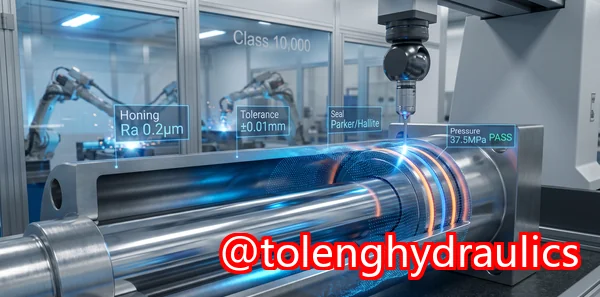
CNC machining is at the core of our production. We maintain tolerances within 0.01mm, which ensures perfect alignment between piston, rod, and barrel. Even small deviations at this stage can lead to uneven wear or seal failure under pressure.
Honing is another critical step. We achieve surface finishes between Ra 0.20.4m. This level of smoothness minimizes internal friction and significantly improves seal longevity. I’ve seen cylinders last nearly twice as long simply because of superior surface finishing.
Welding quality is controlled through robotic welding systems. This eliminates human inconsistency and ensures uniform weld penetration and structural strength. In high-pressure applications, weld integrity is non-negotiable.
During assembly, we use Class 10,000 clean room conditions for seal installation. This prevents contamination from dust or metal particles, which are among the leading causes of early hydraulic failure.
Testing is where we verify everything:
-
Every cylinder undergoes 100% pressure testing at 1.5x working pressure
-
Leakage is strictly controlled at 0.05ml/min at rated pressure
-
Endurance testing reaches a minimum of 500,000 cycles
-
Dimensional inspection is performed using CMM precision equipment
From what I’ve seen in factory audits, these testing protocols separate a quality hydraulic cylinder supplier from a low-cost producer.
Why Manufacturer Selection Matters More Than the Product Itself
Over the years, I’ve noticed that buyers often focus on specifications but overlook the manufacturer’s capability. In reality, the hydraulic cylinder manufacturer determines whether those specifications are consistently achieved.
Material traceability is one of the first indicators of a reliable supplier. At Toleng, every batch of steel comes with full certification from steel mills. This ensures that OEM hydraulic cylinders maintain consistent mechanical properties across production runs.
Certifications also matter. ISO 9001:2015, CE, and SGS compliance demonstrate that a manufacturer follows internationally recognized quality systems. These are not just formalitiesthey directly influence production discipline.
Another major factor is in-house capability. A manufacturer that controls CNC machining, honing, welding, assembly, and testing internally has far greater quality consistency than one relying on outsourcing.
Lead time is another practical consideration. For standard hydraulic cylinder orders, we typically maintain a 715 day delivery window. This is especially important for industries where downtime directly translates to financial loss.
Technical support also plays a key role. A strong manufacturer provides engineering assistance for load calculations, mounting selection, and system integration. I’ve personally seen cases where proper engineering input prevented major design failures.
Customization capabilities further define manufacturer strength. These include:
-
Special port configurations for complex hydraulic circuits
-
Custom rod end designs for unique mechanical connections
-
Integrated sensor systems for real-time monitoring
-
Corrosion-resistant coatings for marine or outdoor environments
A true custom hydraulic cylinder manufacturer doesn’t just build to specificationthey optimize for application performance.
Applications of Standard Hydraulic Cylinders in Industry
Standard hydraulic cylinders are used across a wide range of industries, and I’ve seen their adaptability firsthand in different environments.
In construction equipment, they are essential in excavators, loaders, and bulldozers. These machines rely on precise hydraulic force to move heavy loads and operate attachments.
In agriculture, tractors, harvesters, and balers depend on hydraulic systems for lifting, cutting, and material handling tasks. Reliability here directly impacts productivity during seasonal work.
Industrial automation systems use hydraulic cylinders in presses, conveyors, and lifting platforms. Precision and repeatability are critical in these environments.
Material handling equipment such as forklifts and pallet jacks also depends heavily on compact yet powerful hydraulic systems.
Mobile hydraulics, including trucks, cranes, and aerial work platforms, require cylinders that can withstand vibration, pressure variation, and outdoor exposure.
Selection Guide: Choosing the Right Standard Hydraulic Cylinder Manufacturer
Based on my experience working with industrial procurement teams, I always recommend evaluating manufacturers using a structured checklist:
-
Verify ISO certification and quality management systems
-
Request full material certificates and pressure test reports
-
Inspect machining tolerances and surface finish standards
-
Evaluate production lead time and after-sales support
-
Compare warranty terms (standard is typically 1224 months)
These five steps can significantly reduce procurement risks and ensure long-term operational reliability.
If you are evaluating suppliers, I recommend reviewing our product range here:
🔗 https://tolenghydraulics.com/standard-hydraulic-cylinder/
We also provide detailed specification sheets for engineering and procurement teams upon request, helping simplify system integration and selection processes.
Frequently Asked Questions
What are the standard bore sizes for hydraulic cylinders?
Standard bore sizes typically range from 25mm to 320mm depending on application requirements.
How do I verify if a manufacturer is ISO certified?
You should request official certification documents and verify them through issuing bodies.
What pressure ratings are available for standard cylinders?
Most standard cylinders operate between 16MPa and 25MPa, with high-pressure versions up to 35MPa.
Can standard cylinders be customized?
Yes, customization includes rod ends, mounting styles, coatings, and sensor integration.
What is the typical lead time from a manufacturer?
Standard production lead time is usually 715 days depending on order volume.
How do you test cylinder quality before shipping?
We perform full pressure testing, leakage testing, endurance cycling, and dimensional inspection.
What mounting styles are considered standard?
Common styles include MF, MP, MS, ME, MT, TA, TC, TB, TD, LB, FA, FB, CA, and CB.
Do you provide CAD drawings for standard cylinders?
Yes, we provide complete CAD drawings and technical documentation for engineering integration.
Keywords Section
Primary: standard hydraulic cylinder, hydraulic cylinder manufacturer, standard cylinder, industrial hydraulic cylinders, custom hydraulic cylinder manufacturer
Secondary: manufacturing, factory, CNC machining, quality control, pressure testing, ISO 9001, bore sizes, mounting styles, piston rod, seal kit, OEM, lead time, technical support

