
Hydraulic systems rely on pressure to generate force and motion. Whether you are designing industrial machinery, selecting a hydraulic cylinder, or troubleshooting equipment performance, understanding pressure units is essential. In global hydraulic engineering, the three most common pressure units are PSI, Bar, and MPa.
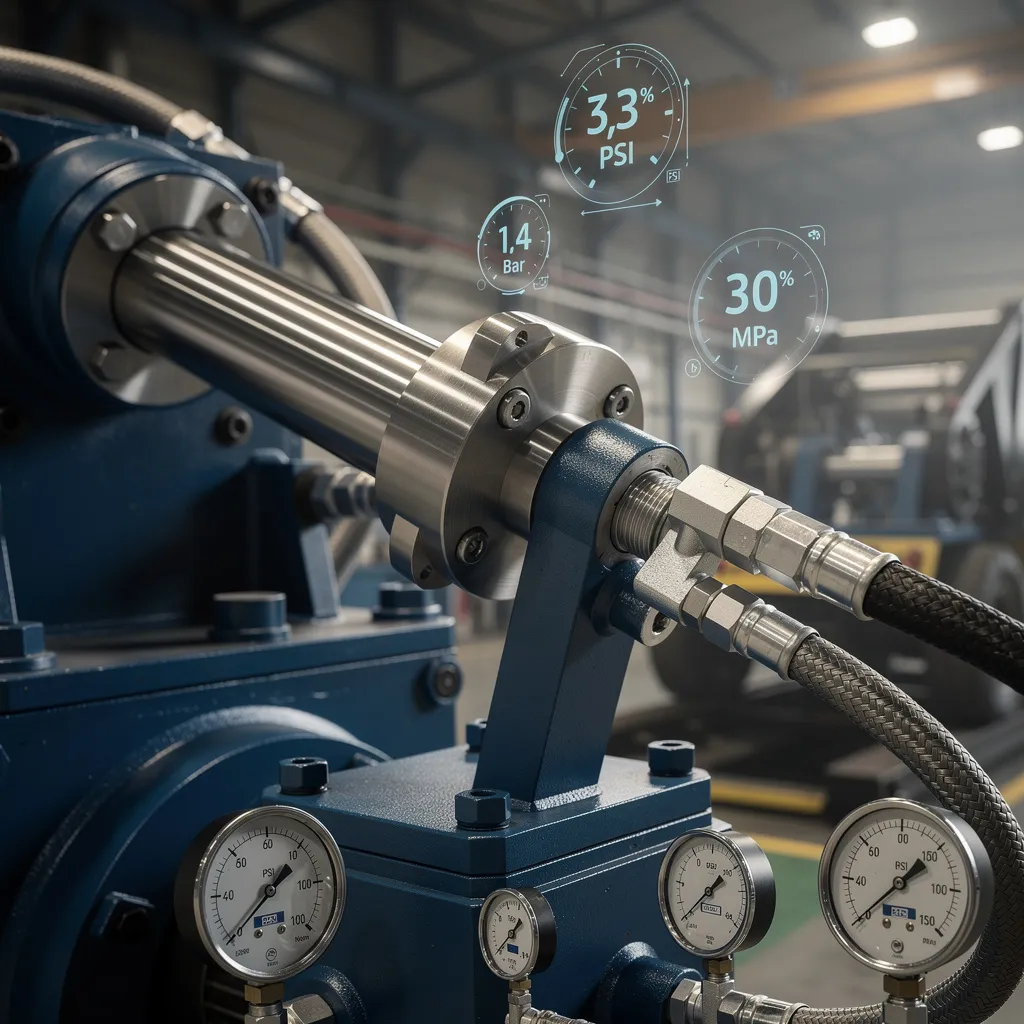
For hydraulic cylinder manufacturers, OEM equipment builders, and maintenance engineers, accurate pressure conversion directly affects cylinder sizing, seal selection, safety factors, and system efficiency.
This guide explains the fundamentals of pressure units from four practical dimensions:
- Core pressure unit definitions
- Engineering conversion formulas
- Industry-specific hydraulic cylinder applications
- Conversion accuracy standards
It is especially useful for professionals working with custom hydraulic cylinders, industrial hydraulic systems, and international equipment specifications.
1. Core Pressure Unit Definitions
What Is Pressure in Hydraulic Systems?
Pressure refers to the force applied over a specific area. In hydraulic cylinders, pressure determines how much pushing or pulling force the cylinder can generate.
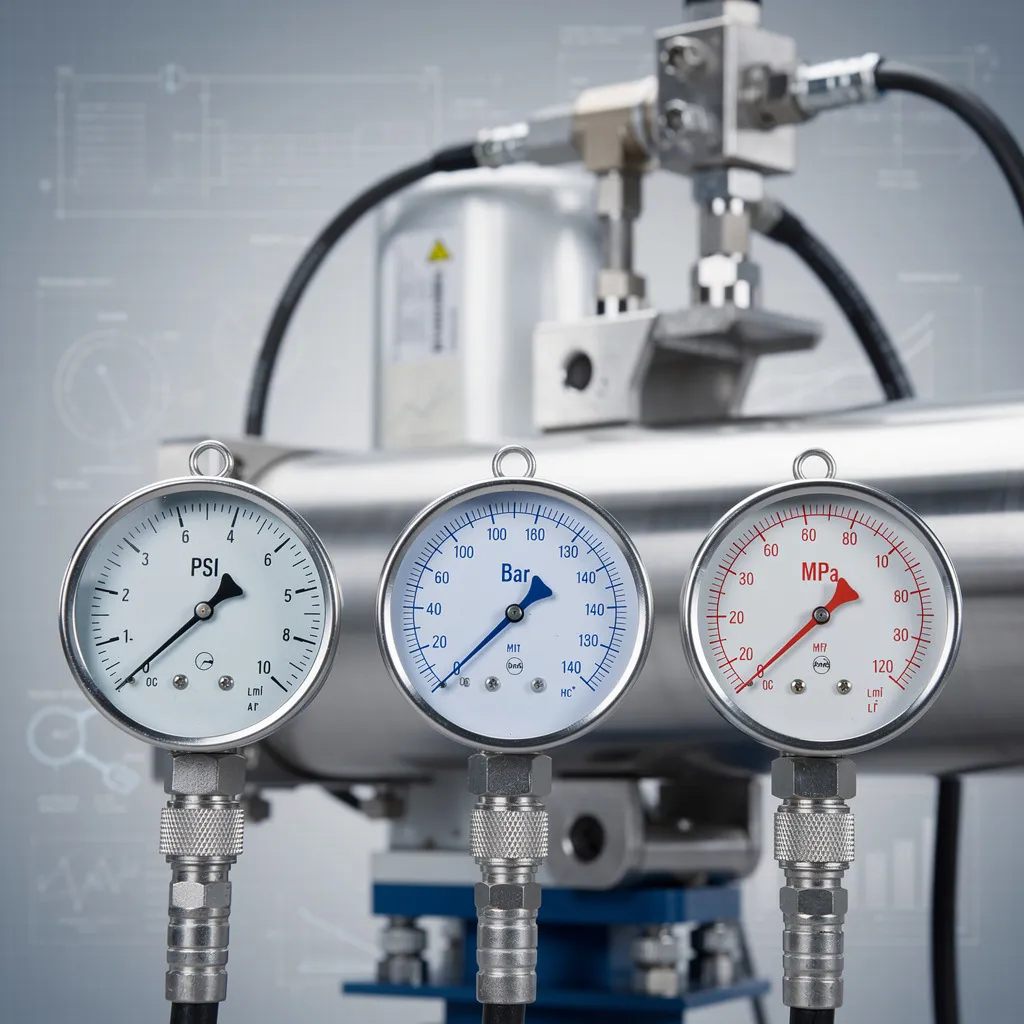
The basic pressure formula is:
P=FAP=\frac{F}{A}P=AF
Where:
- P = Pressure
- F = Force
- A = Area
Higher hydraulic pressure allows a smaller cylinder to generate greater force, which is why pressure ratings are critical in hydraulic cylinder design.
PSI (Pounds per Square Inch)
1 PSI=1 lbf/in21\,PSI=1\,lbf/in^21PSI=1lbf/in2
PSI is primarily used in:
- The United States
- Construction equipment
- Agricultural machinery
- Mobile hydraulic systems
Typical hydraulic cylinder pressure ranges:
- Light-duty cylinders: 1000–1500 PSI
- Standard industrial cylinders: 2000–3000 PSI
- Heavy-duty hydraulic cylinders: 5000+ PSI
For example, many excavator hydraulic cylinders operate around 3000 PSI.
Bar
1 Bar=100000 Pa1\,Bar=100000\,Pa1Bar=100000Pa
Bar is widely used in:
- Europe
- Industrial automation
- Hydraulic power units
- Manufacturing equipment
One Bar is close to atmospheric pressure, making it practical for engineering calculations.
Common hydraulic cylinder ratings include:
- 160 Bar
- 210 Bar
- 250 Bar
- 350 Bar
A 210 Bar hydraulic cylinder is commonly found in industrial presses and material handling systems.
MPa (Megapascal)
1 MPa=1000000 Pa1\,MPa=1000000\,Pa1MPa=1000000Pa
MPa is the SI international standard pressure unit used in:
- Hydraulic engineering
- Technical drawings
- ISO standards
- Custom hydraulic cylinder manufacturing
Typical cylinder operating pressures:
- 16 MPa
- 21 MPa
- 25 MPa
- 35 MPa
In hydraulic cylinder factories, MPa is often preferred because it simplifies engineering calculations and aligns with ISO hydraulic standards.
2. Engineering Conversion Formulas
Accurate unit conversion is essential when hydraulic cylinders are exported globally or integrated into international machinery.
PSI to Bar Conversion
1 PSI=0.06895 Bar1\,PSI=0.06895\,Bar1PSI=0.06895Bar
Example:
3000 PSI ≈ 206.8 Bar
PSI to MPa Conversion
1 PSI=0.006895 MPa1\,PSI=0.006895\,MPa1PSI=0.006895MPa
Example:
3000 PSI ≈ 20.68 MPa
Bar to MPa Conversion
1 MPa=10 Bar1\,MPa=10\,Bar1MPa=10Bar
Example:
210 Bar = 21 MPa
Quick Hydraulic Pressure Conversion Table
| PSI | Bar | MPa |
|---|---|---|
| 1000 PSI | 68.95 Bar | 6.89 MPa |
| 2000 PSI | 137.9 Bar | 13.79 MPa |
| 3000 PSI | 206.8 Bar | 20.68 MPa |
| 5000 PSI | 344.7 Bar | 34.47 MPa |
This table is frequently used by hydraulic cylinder manufacturers when communicating with international OEM customers.
3. Industry-Specific Conversion Scenarios in Hydraulic Cylinders

Construction Equipment Hydraulic Cylinders
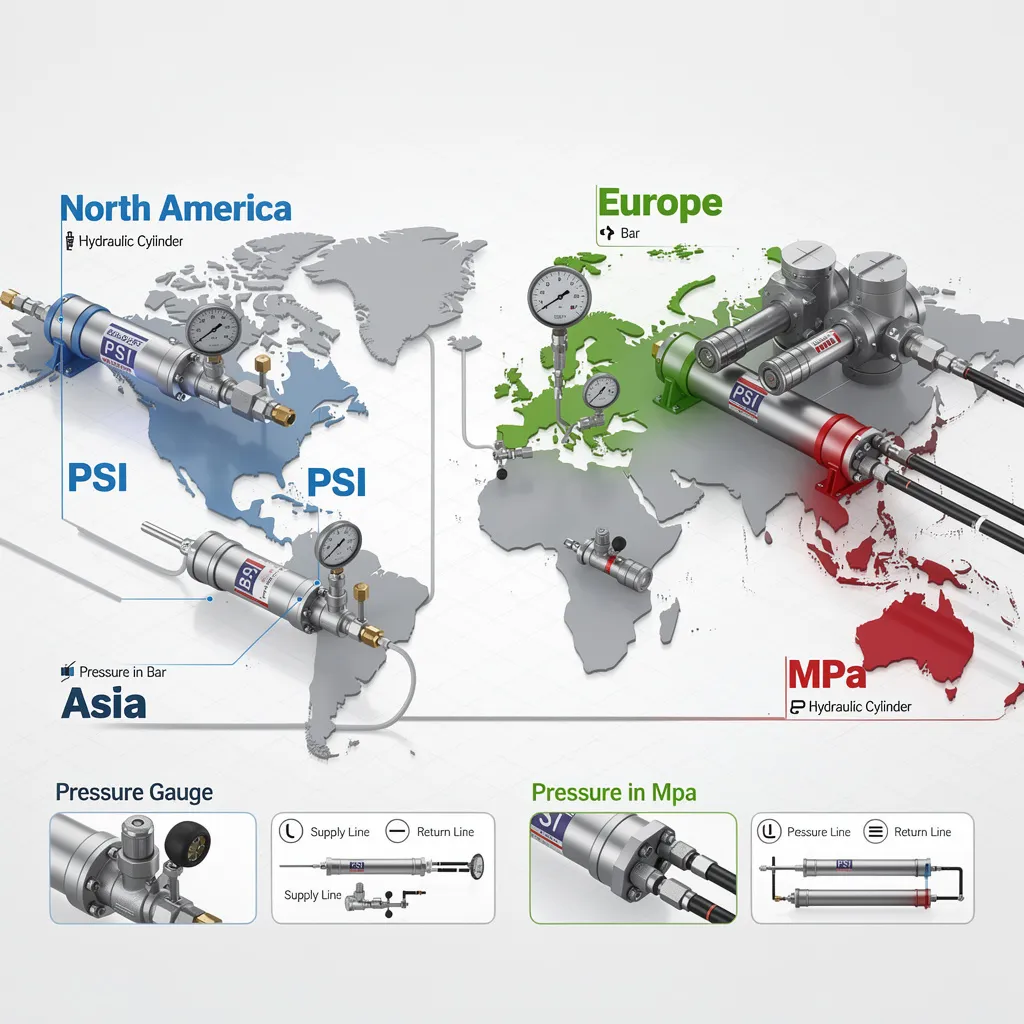
Excavators, loaders, and cranes commonly use PSI in North America and MPa in Asia or Europe.
Example:
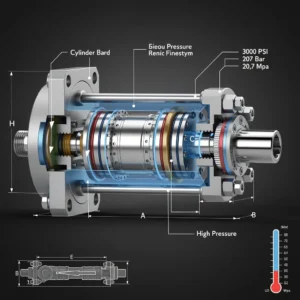
- U.S. specification: 3000 PSI
- European equivalent: 207 Bar
- SI equivalent: 20.7 MPa
Without proper conversion, incorrect cylinder selection may result in:
- Seal failure
- Rod bending
- Reduced lifting force
- Hydraulic leakage
Agricultural Hydraulic Cylinders
Agricultural equipment manufacturers often mix pressure units across regions.
Examples include:
- Tractor steering cylinders
- Hydraulic tipping cylinders
- Combine harvester cylinders
A custom hydraulic cylinder supplier must verify pressure ratings carefully before production to avoid compatibility issues.
Industrial Hydraulic Press Cylinders
Hydraulic press systems usually operate at higher pressures:
- 25 MPa
- 31.5 MPa
- 35 MPa
These systems require highly accurate pressure conversion because small calculation errors can significantly impact cylinder force output.
The cylinder force equation is:
F=P×AF=P\times AF=P×A
Even minor pressure miscalculations may lead to undersized hydraulic cylinders.
Marine and Offshore Hydraulic Cylinders
Marine hydraulic cylinders often follow Bar or MPa standards due to ISO requirements.
Applications include:
- Steering cylinders
- Deck machinery cylinders
- Offshore lifting cylinders
In these environments, pressure accuracy is critical for safety and corrosion-resistant cylinder design.
4. Conversion Accuracy Standards
Why Conversion Accuracy Matters
Hydraulic systems operate under extremely high loads. Incorrect pressure conversion can cause:
- Overpressure damage
- Cylinder deformation
- Premature seal wear
- System inefficiency
- Safety hazards
Professional hydraulic cylinder manufacturers use standardized engineering conversion methods during cylinder design and testing.
Recommended Decimal Precision
| Application | Recommended Precision |
|---|---|
| General industrial use | 1 decimal place |
| Hydraulic cylinder catalogs | 2 decimal places |
| Engineering calculations | 3–4 decimal places |
| High-pressure hydraulic systems | 4+ decimal places |
ISO and International Standards
Most hydraulic cylinder factories follow:
- ISO hydraulic standards
- SI unit standards
- SAE pressure guidelines
This ensures compatibility between hydraulic cylinders, pumps, valves, and seals across global markets.
How Pressure Units Affect Hydraulic Cylinder Selection
When specifying a hydraulic cylinder, pressure units directly influence:
Bore Size Selection
Higher pressure allows smaller bore diameters while maintaining force output.
Seal Design
Seal materials must match operating pressure ranges.
Examples:
- Standard NBR seals for medium pressure
- Polyurethane seals for high pressure
- PTFE seals for extreme pressure applications
Rod Diameter Design
High-pressure hydraulic cylinders require larger piston rods to prevent buckling.
Cylinder Tube Strength
Cylinder barrel wall thickness depends heavily on pressure rating calculations.
A professional hydraulic cylinder manufacturer will typically analyze:
- Working pressure
- Peak pressure
- Shock loads
- Safety factor
before finalizing cylinder production.
Why Hydraulic Cylinder Manufacturers Prefer MPa
Many modern hydraulic cylinder factories use MPa because:
- It aligns with ISO standards
- Engineering calculations are simpler
- International communication is easier
- CAD and hydraulic software commonly use SI units
However, global OEM hydraulic cylinder suppliers must still support PSI and Bar conversions for international customers.
Conclusion
Understanding PSI, Bar, and MPa is fundamental in hydraulic engineering and hydraulic cylinder manufacturing. Accurate pressure conversion ensures:
- Proper cylinder sizing
- Safer hydraulic system operation
- Better seal life
- Improved equipment performance
- International specification compatibility
Whether you are designing a custom hydraulic cylinder, replacing an industrial cylinder, or sourcing OEM hydraulic cylinders globally, mastering pressure unit conversion is essential for reliability and efficiency.
For professional hydraulic cylinder manufacturers like Toleng Hydraulic, precise pressure calculation and international unit compatibility are critical parts of delivering high-quality hydraulic cylinder solutions for global industries.

