
Standard Hydraulic Cylinder Mounting Types
Explore standard hydraulic cylinder mounting types, specifications, and quality standards. Learn how to choose a reliable hydraulic cylinder manufacturer.
Standard hydraulic cylinders are the backbone of countless industrial systems, delivering the controlled force required to move, lift, and position heavy loads with precision. From construction equipment to automated production lines, these components are critical to operational efficiency. In my experience working closely with equipment buyers and engineers, I’ve seen how the choice of a hydraulic cylinder manufacturer can directly influence performance, reliability, and long-term maintenance costs.
A poorly manufactured cylinder can lead to leakage, premature wear, and even system failure. On the other hand, a well-engineered standard hydraulic cylinder ensures consistent operation under demanding conditions. That’s why partnering with a professional manufacturer like Toleng makes a difference. With deep expertise in standard cylinder manufacturing and strict quality control, we focus on delivering durable, high-performance solutions tailored to industrial needs.
Standard Hydraulic Cylinder Specifications
When evaluating a standard hydraulic cylinder, understanding its core specifications is essential. These parameters determine whether the cylinder can meet the operational demands of your application.
Bore Sizes and Stroke Lengths
A typical standard hydraulic cylinder offers bore sizes ranging from 25 mm to 320 mm. This wide range allows flexibility for both light-duty and heavy-duty applications. Smaller bores are commonly used in compact machinery, while larger bores provide the force required for heavy industrial equipment.
Stroke lengths usually vary from 50 mm to 3000 mm, depending on the application. For example, in a recent project involving a material handling system, we selected a 125 mm bore cylinder with a 1200 mm stroke to achieve optimal lifting height without compromising stability.
Working Pressure Ratings
Pressure capability is another critical factor. Most industrial hydraulic cylinders operate within 16 MPa to 25 MPa, which covers the majority of applications. For more demanding environments, high-pressure options up to 35 MPa are available.
From my perspective, it’s always better to choose a cylinder with a slight pressure margin. This ensures longevity and reduces the risk of fatigue failure under fluctuating loads.
Mounting Styles
Mounting configuration plays a major role in how force is transmitted and how the cylinder integrates into your equipment. Common standard mounting styles include:
-
MF (Front flange)
-
MP (Rear pivot)
-
MS (Side lug)
-
ME (Front clevis)
-
MT (Trunnion)
-
TA, TC, TB, TD (various trunnion and pivot types)
-
LB (Foot mounting)
-
FA, FB (Flange variations)
-
CA, CB (Clevis types)
Each mounting style serves a specific purpose. For instance, trunnion mounts are ideal for applications requiring angular movement, while flange mounts provide rigid support for linear force applications.
Materials: Piston Rod and Tube
Material selection is fundamental to durability. A quality hydraulic cylinder manufacturer uses:
-
Piston rods: Hard chrome plated C45, 1045, or 4140 steel
-
Cylinder tubes: Honed seamless steel such as ST52, E355, or CK45
The chrome plating on piston rods enhances corrosion resistance and reduces friction, extending seal life. I’ve seen cases where inferior rod materials led to scoring and seal damage within monthssomething easily avoided with proper material selection.
Seal Options
Seals are often overlooked but are critical for preventing leakage and maintaining efficiency. Reliable manufacturers offer seal kits from globally recognized brands such as:
-
Parker
-
Hallite
-
Merkel
High-quality seals ensure consistent performance even under high pressure and temperature variations.
Manufacturing Quality Standards
The difference between an average and a high-quality standard hydraulic cylinder lies in the manufacturing process. Precision, cleanliness, and rigorous testing are non-negotiable.
CNC Machining Precision
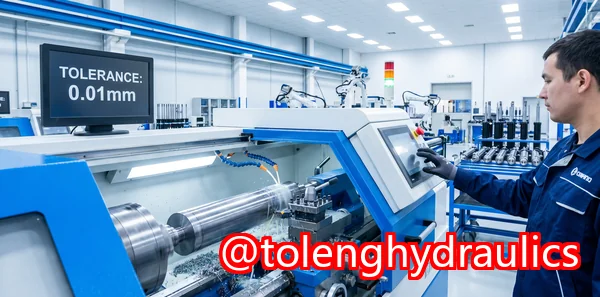
Modern standard cylinder manufacturing relies heavily on CNC machining. High-end factories maintain tolerances within 0.01 mm, ensuring perfect alignment between components.
In our production line, we’ve found that even minor deviations can lead to uneven wear or internal leakage. Precision machining eliminates these risks.
Honing Process
Cylinder tubes undergo a honing process to achieve a surface finish of Ra 0.20.4 m. This ultra-smooth surface minimizes friction and ensures optimal seal performance.
A properly honed tube not only improves efficiency but also significantly extends the service life of the cylinder.
Welding Standards
Robotic welding is increasingly used in advanced hydraulic cylinder factories. It ensures consistent weld quality and structural integrity.
Manual welding can introduce variability, but robotic systems deliver repeatable resultsespecially important for high-pressure applications.
Clean Assembly Conditions
Seal installation must be performed in controlled environments. A Class 10,000 clean room prevents contamination that could damage seals or internal surfaces.
I’ve personally observed how dust particles can cause micro-leaks in hydraulic systems. Clean assembly conditions are not a luxurythey’re a necessity.
Testing Procedures
A reliable quality hydraulic cylinder supplier conducts comprehensive testing before delivery:
-
100% pressure testing at 1.5 working pressure
-
Leakage testing: 0.05 ml/min at rated pressure
-
Endurance testing: Minimum 500,000 cycles
-
Dimensional inspection using CMM equipment
These tests ensure that every cylinder meets performance and safety standards before reaching the customer.
Why the Manufacturer Matters
Choosing the right hydraulic cylinder manufacturer is just as important as selecting the right specifications.
Material Traceability
Top manufacturers provide full traceability for raw materials, including mill certificates. This ensures that every component meets required standards.
In one project, a client avoided a major failure simply because we could trace and verify the steel batch used in production.
Quality Certifications
Certifications such as ISO 9001:2015, CE, and SGS indicate a structured quality management system. They’re not just labelsthey reflect consistent processes and accountability.
In-House Capabilities
A factory with in-house machining, honing, welding, and assembly offers better control over quality and lead times. Outsourcing critical processes often leads to inconsistencies.
Lead Time Advantages
Standard cylinders should be readily available. A professional manufacturer typically delivers within 715 days, helping you avoid costly downtime.
Technical Support
Engineering support is often underestimated. A knowledgeable team can help optimize cylinder selection, reducing costs and improving performance.
Customization Options
Even standard cylinders often require minor modifications. A capable custom hydraulic cylinder manufacturer can provide:
-
Special port locations
-
Custom rod ends
-
Integrated sensors
-
Corrosion-resistant coatings
This flexibility allows standard designs to meet unique application requirements.
Applications for Standard Hydraulic Cylinders
Standard hydraulic cylinders are used across a wide range of industries:
-
Construction equipment: Excavators, loaders, bulldozers
-
Agricultural machinery: Tractors, harvesters, balers
-
Industrial automation: Presses, conveyors, lifting systems
-
Material handling: Forklifts, pallet jacks
-
Mobile hydraulics: Trucks, cranes, aerial platforms
In my experience, the versatility of industrial hydraulic cylinders makes them indispensable. Their standardized design simplifies maintenance and replacement, reducing operational downtime.
Conclusion: How to Choose the Right Manufacturer
Selecting a reliable hydraulic cylinder factory doesn’t have to be complicated. I recommend focusing on these five key factors:
-
Verify ISO certification and quality management systems
-
Request material certificates and detailed test reports
-
Inspect machining tolerances and surface finish quality
-
Evaluate lead times and after-sales support
-
Compare warranty terms (standard range: 1224 months)
Taking the time to assess these aspects will help you avoid costly mistakes and ensure long-term performance.
Browse our standard hydraulic cylinder catalog: 🔗 https://tolenghydraulics.com/standard-hydraulic-cylinder/
You can also request a downloadable specification sheet to explore detailed technical data and configuration options.
FAQ
1. What are the standard bore sizes for hydraulic cylinders?
Standard bore sizes typically range from 25 mm to 320 mm, covering both light and heavy-duty applications.
2. How do I verify if a manufacturer is ISO certified?
Ask for certification documents and verify them through official certification bodies or audit reports.
3. What pressure ratings are available for standard cylinders?
Most standard cylinders operate between 16 MPa and 25 MPa, with high-pressure options up to 35 MPa.
4. Can standard cylinders be customized?
Yes, many manufacturers offer customization such as port locations, rod ends, and coatings.
5. What is the typical lead time from a manufacturer?
For standard hydraulic cylinders, lead times are usually between 7 and 15 days.
6. How do you test cylinder quality before shipping?
Testing includes pressure testing, leakage checks, endurance cycling, and dimensional inspection.
7. What mounting styles are considered standard?
Common styles include MF, MP, MS, ME, MT, TA, TC, TB, TD, LB, FA, FB, CA, and CB.
8. Do you provide CAD drawings for standard cylinders?
Yes, most professional manufacturers provide CAD drawings to support engineering and integration.
Keywords Section
Primary Keywords: standard hydraulic cylinder, hydraulic cylinder manufacturer, standard cylinder
Secondary Keywords: manufacturing, factory, CNC machining, quality control, pressure testing, ISO 9001, bore sizes, mounting styles, piston rod, seal kit, OEM, lead time, technical support

