
Standard Hydraulic Cylinder Sizes Guide
Learn how to select a high-quality standard hydraulic cylinder and reliable manufacturer. Explore sizes, specs, testing standards, and performance factors.
Standard hydraulic cylinders are the backbone of countless industrial systems. From heavy construction equipment to precision automation lines, these components convert hydraulic energy into controlled mechanical force. In my experience working closely with equipment buyers and engineers, the performance of a hydraulic system often comes down to one critical decision: choosing the right hydraulic cylinder manufacturer.
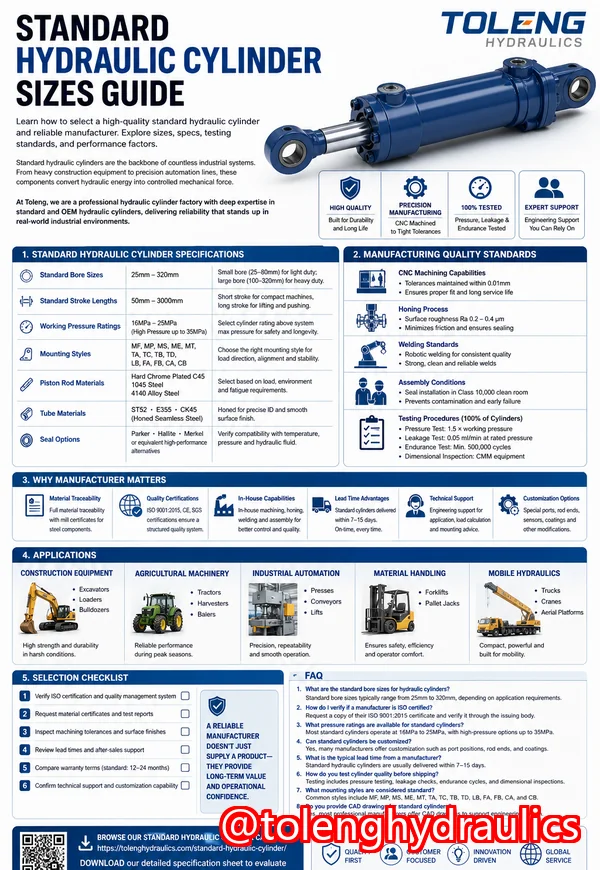
A poorly manufactured cylinder can lead to leakage, downtime, and costly repairs. On the other hand, a well-built standard hydraulic cylinder ensures long service life, consistent performance, and operational safety. That’s why I always emphasize manufacturer selection as a key factornot just product specs on paper.
At Toleng, we position ourselves as a professional hydraulic cylinder factory with deep expertise in standard cylinder manufacturing and OEM hydraulic cylinders. Our focus is not just on meeting specifications, but on delivering reliability that stands up in real-world industrial environments.
Standard Hydraulic Cylinder Specifications
When selecting a standard hydraulic cylinder, understanding the core specifications is essential. These parameters determine compatibility, efficiency, and durability in your application.
Standard Bore Sizes
Standard hydraulic cylinders are typically available in bore sizes ranging from 25mm to 320mm. Smaller bores (25mm80mm) are often used in light industrial automation or agricultural attachments, while larger bores (100mm320mm) are common in construction and heavy machinery.
I’ve seen many procurement teams overlook bore sizing precision. Even a small mismatch can result in insufficient force output or unnecessary energy consumption. Always calculate force requirements based on pressure and bore diameter.
Standard Stroke Lengths
Stroke lengths generally range from 50mm to 3000mm. Short strokes are suitable for compact machinery, while longer strokes are required for lifting, pushing, or tilting applications.
From a manufacturing standpoint, maintaining straightness and surface finish over long strokes is challenging. This is where a quality hydraulic cylinder supplier stands apart.
Working Pressure Ratings
Most industrial hydraulic cylinders operate within 16MPa to 25MPa, with high-pressure options reaching 35MPa.
In real-world applications, I recommend selecting a cylinder with a safety margin above your system’s maximum pressure. For example, if your system runs at 20MPa, a cylinder rated at 25MPa ensures better longevity and safety.
Mounting Styles
Standard mounting configurations include:
-
MF (Front Flange)
-
MP (Rear Pivot)
-
MS (Side Mount)
-
ME (Eye Mount)
-
MT (Trunnion)
-
TA, TC, TB, TD
-
LB, FA, FB, CA, CB
Each mounting style influences load distribution and alignment. For instance, trunnion mounts (MT) are ideal for applications requiring pivot motion, while flange mounts (MF) provide rigid support.
Piston Rod Materials
High-quality piston rods are typically made from:
-
Hard chrome plated C45
-
1045 steel
-
4140 alloy steel
The choice depends on load, environment, and fatigue requirements. In corrosive environments, additional coatings or stainless options may be necessary.
Tube Materials
Cylinder tubes are usually manufactured from honed seamless steel such as:
-
ST52
-
E355
-
CK45
The honing process ensures precise internal dimensions and smooth surfaces, which are critical for sealing performance.
Seal Options
Reliable sealing systems are essential to prevent leakage. Common seal brands include:
-
Parker
-
Hallite
-
Merkel
-
Equivalent high-performance alternatives
I always advise clients to confirm seal compatibility with operating temperature, pressure, and fluid type.
Manufacturing Quality Standards
A standard hydraulic cylinder may look simple externally, but its performance depends heavily on manufacturing precision and quality control.
CNC Machining Capabilities
Top manufacturers maintain machining tolerances within 0.01mm. This level of precision ensures proper fit between components, reducing wear and extending service life.
In one project I worked on, switching to a manufacturer with tighter tolerances reduced seal failure rates by over 30%.
Honing Process
Cylinder tubes are honed to achieve a surface roughness of Ra 0.20.4m. This smooth finish minimizes friction and ensures optimal sealing.
Welding Standards
Robotic welding is widely used in advanced hydraulic cylinder factories. It ensures:
-
Consistent weld quality
-
Reduced human error
-
Improved structural integrity
Manual welding may still be used for custom designs, but consistency is key.
Assembly Conditions
Seal installation should occur in a Class 10,000 clean room environment. Contamination during assembly is one of the leading causes of early cylinder failure.
Testing Procedures
A reliable hydraulic cylinder manufacturer performs rigorous testing, including:
-
100% pressure testing at 1.5 working pressure
-
Leakage testing: 0.05ml/min at rated pressure
-
Endurance testing: minimum 500,000 cycles
-
Dimensional inspection using CMM equipment
At Toleng, we treat testing as a non-negotiable step. Every cylinder must pass before it leaves the factory.
Why Manufacturer Matters
Choosing the right custom hydraulic cylinder manufacturer goes far beyond comparing prices.
Material Traceability
A trustworthy manufacturer provides full material traceability, including mill certificates for steel components. This ensures consistency and accountability.
Quality Certifications
Look for certifications such as:
-
ISO 9001:2015
-
CE
-
SGS
These indicate a structured quality management system.
In-House Capabilities vs Outsourcing
Manufacturers with in-house machining, honing, welding, and assembly offer better control over quality and lead times.
Outsourcing may reduce costs, but it often introduces variability.
Lead Time Advantages
Standard cylinders should typically be delivered within 715 days. Delays often indicate inefficiencies or reliance on external suppliers.
Technical Support
A quality hydraulic cylinder supplier provides engineering support, including:
-
Application analysis
-
Load calculations
-
Mounting recommendations
I’ve seen projects saved by early-stage engineering input from experienced manufacturers.
Customization Options
Even standard hydraulic cylinders often require slight modifications:
-
Special port locations
-
Custom rod ends
-
Integrated sensors
-
Corrosion-resistant coatings
A flexible manufacturer can adapt standard designs to meet specific requirements.
Applications for Standard Cylinders
Standard hydraulic cylinders are used across a wide range of industries.
Construction Equipment
-
Excavators
-
Loaders
-
Bulldozers
These applications demand high and durability under harsh conditions.
Agricultural Machinery
-
Tractors
-
Harvesters
-
Balers
Reliability is critical during peak farming seasons.
Industrial Automation
-
Presses
-
Conveyors
-
Lifts
Precision and repeatability are key.
Material Handling
-
Forklifts
-
Pallet jacks
Smooth operation ensures safety and efficiency.
Mobile Hydraulics
-
Trucks
-
Cranes
-
Aerial platforms
These systems require compact yet powerful hydraulic solutions.
Conclusion: Selection Guide
Choosing the right standard hydraulic cylinder manufacturer is a strategic decision. Based on my experience, here’s a practical checklist:
-
Verify ISO certification and quality system
-
Request material certificates and test reports
-
Inspect machining tolerances and surface finishes
-
Review lead times and after-sales support
-
Compare warranty terms (standard: 1224 months)
A reliable manufacturer doesn’t just supply a productthey provide long-term value and operational confidence.
Browse our standard hydraulic cylinder catalog: 🔗 https://tolenghydraulics.com/standard-hydraulic-cylinder/
Download our detailed specification sheet to evaluate your next project with confidence.
FAQ
1. What are the standard bore sizes for hydraulic cylinders?
Standard bore sizes typically range from 25mm to 320mm, depending on application requirements.
2. How do I verify if a manufacturer is ISO certified?
Request a copy of their ISO 9001:2015 certificate and verify it through the issuing body.
3. What pressure ratings are available for standard cylinders?
Most standard cylinders operate at 16MPa to 25MPa, with high-pressure options up to 35MPa.
4. Can standard cylinders be customized?
Yes, many manufacturers offer customization such as port positions, rod ends, and coatings.
5. What is the typical lead time from a manufacturer?
Standard hydraulic cylinders are usually delivered within 715 days.
6. How do you test cylinder quality before shipping?
Testing includes pressure testing, leakage checks, endurance cycles, and dimensional inspections.
7. What mounting styles are considered standard?
Common styles include MF, MP, MS, ME, MT, TA, TC, TB, TD, LB, FA, FB, CA, and CB.
8. Do you provide CAD drawings for standard cylinders?
Yes, most professional manufacturers offer CAD drawings to support engineering design.
Keywords Section
Primary: standard hydraulic cylinder, hydraulic cylinder manufacturer, standard cylinder
Secondary: manufacturing, factory, CNC machining, quality control, pressure testing, ISO 9001, bore sizes, mounting styles, piston rod, seal kit, OEM, lead time, technical support

