
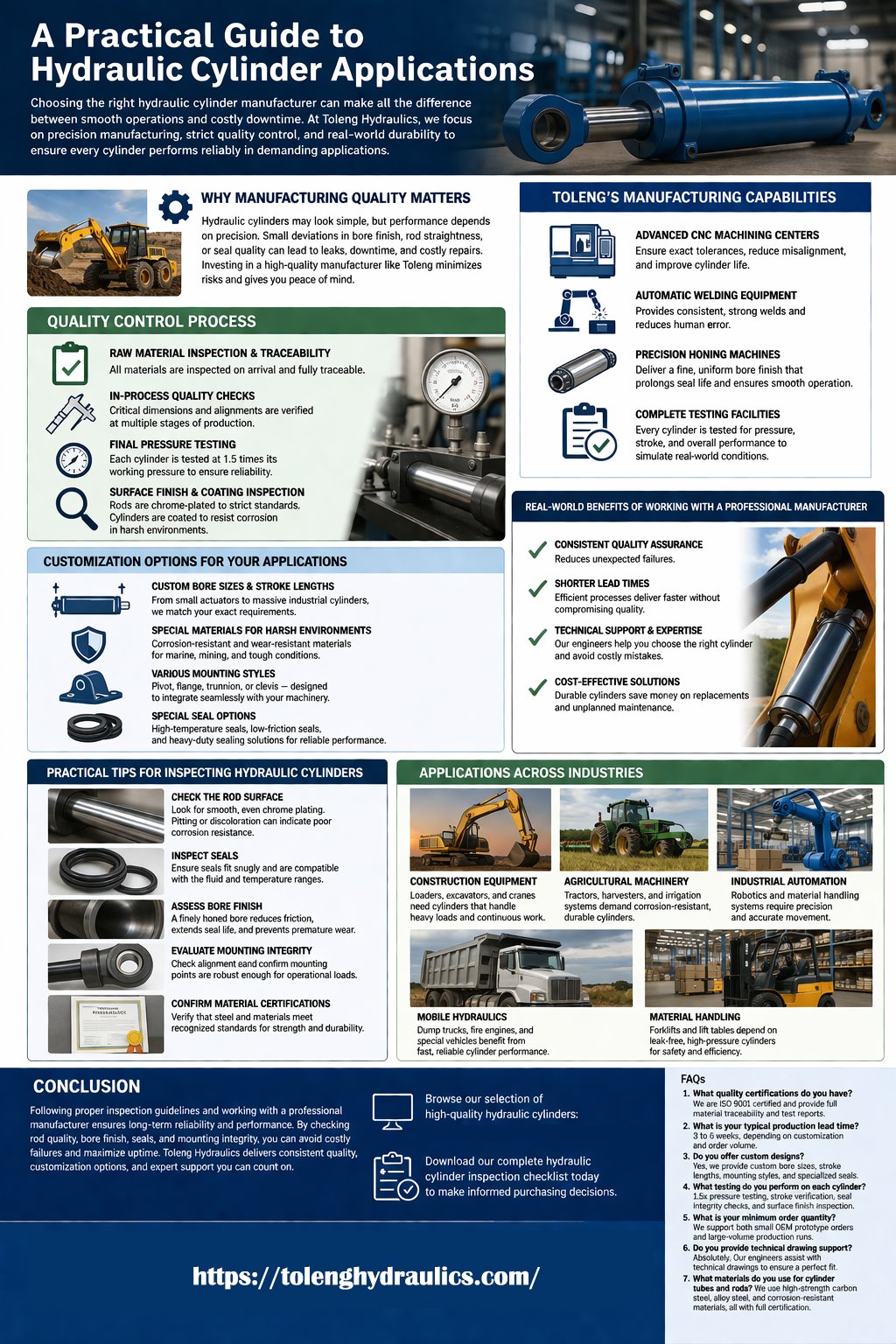
A Practical Guide to Hydraulic Cylinder Applications
Choosing the right hydraulic cylinder manufacturer can make all the difference between smooth operations and costly downtime. I’ve seen countless cases where equipment failures were traced back to poorly manufactured cylindersrods that bent under pressure, seals that leaked prematurely, and bores that wore unevenly. Sourcing from unreliable suppliers often leads to repeated maintenance headaches and unplanned downtime. At Toleng Hydraulics, we approach cylinder manufacturing with precision, quality, and real-world durability in mind. Our goal is to ensure every cylinder we produce can withstand demanding industrial, construction, and agricultural applications.
Why Manufacturing Quality Matters
Hydraulic cylinders may look simple from the outside, but their performance depends heavily on the precision of every internal component. A small deviation in bore finish, rod straightness, or seal quality can quickly escalate into operational problems. For example, I’ve observed construction teams replacing cylinders in heavy loaders after just a few months because the rods weren’t properly hardened or the seals weren’t suitable for dusty environments. Investing in a high-quality manufacturer like Toleng minimizes these risks, giving operators and engineers peace of mind.
Toleng’s Manufacturing Capabilities
At Toleng Hydraulics, we’ve built a factory capable of producing cylinders that meet the toughest standards. Here’s how we do it:
- Advanced CNC Machining Centers: Our precision CNC machines ensure every cylinder component, from rods to end caps, meets exact tolerances. This minimizes misalignment and improves cylinder life.
- Automatic Welding Equipment: Consistent, strong welds are crucial, especially for heavy-duty applications. Automated welding reduces human error and ensures uniformity.
- Precision Honing Machines: Bore finish quality directly affects seal life and smooth rod operation. Our honing equipment guarantees a fine, uniform surface that prolongs service intervals.
- Complete Testing Facilities: Every cylinder undergoes rigorous testing to simulate real-world conditions. From pressure checks to stroke evaluation, we ensure your cylinder performs reliably.
Quality Control Process
Quality control is not just a final step; it’s integrated into every stage of production. Here’s a snapshot of our process:
- Raw Material Inspection and Traceability: Each cylinder tube, rod, and seal material is inspected upon arrival. We maintain full traceability to ensure consistent performance.
- In-Process Quality Checks: Critical dimensions and alignments are verified at multiple production stages, preventing defects from progressing further.
- Final Pressure Testing: Every cylinder is tested at 1.5 times its working pressure to guarantee reliability under extreme conditions.
- Surface Finish and Coating Inspection: Rods are chrome-plated with strict adherence to thickness and hardness standards, and cylinders are coated to resist corrosion in harsh environments.
Customization Options for Your Applications
One-size-fits-all rarely works in hydraulics. We offer a wide range of customization options:
- Custom Bore Sizes and Stroke Lengths: From small actuators to massive industrial cylinders, we can match the exact requirements of your machinery.
- Special Materials for Harsh Environments: Whether you operate in salty coastal conditions or abrasive mining sites, we can select materials that resist corrosion and wear.
- Various Mounting Styles: Pivot, flange, trunnion, or clevis mountswe adapt cylinders to your machine’s design for seamless integration.
- Special Seal Options: High-temperature seals, low-friction seals, and heavy-duty sealing solutions ensure reliability across applications.
Real-World Benefits of Working with a Professional Manufacturer
Choosing a professional manufacturer is more than just a guarantee of qualityit impacts your bottom line and operational efficiency:
- Consistent Quality Assurance: Every cylinder meets strict tolerances, reducing unexpected failures.
- Shorter Lead Times: Efficient manufacturing processes allow us to deliver cylinders faster without compromising quality.
- Technical Support and Expertise: Our engineers help you select the right cylinder for your application, avoiding costly mistakes.
- Cost-Effective Solutions: Investing in a durable cylinder upfront saves on repeated replacements and unplanned maintenance.
Practical Tips for Inspecting Hydraulic Cylinders
When evaluating a cylinder, a hands-on inspection can save future headaches. Here are methods I recommend:
- Check the Rod Surface: Look for smooth, even chrome plating. Any pitting or discoloration could indicate poor corrosion resistance.
- Inspect Seals: Ensure seals fit snugly and are compatible with the fluid and temperature ranges in your equipment.
- Assess Bore Finish: A finely honed bore reduces friction, extends seal life, and prevents premature wear.
- Evaluate Mounting Integrity: Check that the cylinder’s mounting points align correctly and are robust enough for operational loads.
- Confirm Material Certifications: Verify that steel and other materials meet recognized standards, ensuring consistent strength and durability.
By applying these checks, you can avoid cylinders that fail prematurely, leak fluid, or damage machinery.
Applications Across Industries
High-quality hydraulic cylinders from Toleng Hydraulics are essential for a variety of sectors:
- Construction Equipment: Loaders, excavators, and cranes rely on cylinders that can handle heavy loads and continuous operation.
- Agricultural Machinery: Tractors, harvesters, and irrigation systems demand corrosion-resistant, durable cylinders.
- Industrial Automation: Robotics and material handling systems require precision cylinders for accurate movement.
- Mobile Hydraulics: Vehicles like dump trucks and fire engines benefit from fast, reliable cylinder performance.
- Material Handling: Forklifts and lift tables depend on leak-free, high-pressure cylinders for safety and efficiency.
Conclusion
I highly recommend following these inspection guidelines to ensure any hydraulic cylinder purchase delivers long-term reliability and performance. By checking rod quality, bore finish, seals, and mounting integrity, you can avoid costly failures and maximize uptime. Working with a professional manufacturer like Toleng Hydraulics ensures consistent quality, customization options, and expert support.
Browse our selection of high-quality hydraulic cylinders: 🔗 https://tolenghydraulics.com/contact/
Download our complete hydraulic cylinder inspection checklist today to make informed purchasing decisions.
FAQs
1. What quality certifications do you have?
Toleng Hydraulics holds ISO 9001 certification and provides full material traceability and test reports for every cylinder.
2. What is your typical production lead time?
Standard lead time ranges from 3 to 6 weeks, depending on customization and order volume.
3. Do you offer custom designs?
Yes, we provide custom bore sizes, stroke lengths, mounting styles, and specialized seals for harsh environments.
4. What testing do you perform on each cylinder?
Every cylinder undergoes 1.5x working pressure testing, stroke verification, seal integrity checks, and surface finish inspection.
5. What is your minimum order quantity?
We accommodate both small orders for OEM prototypes and large-volume production runs.
6. Do you provide technical drawing support?
Absolutely. Our engineers assist with technical drawings to ensure cylinders fit perfectly in your machinery.
7. What materials do you use for cylinder tubes and rods?
We use high-strength carbon steel, alloy steel, and corrosion-resistant materials tailored to your application, all with full certification.
Tags / Keywords
hydraulic cylinder, manufacturer, manufacturing, factory, CNC machining, quality control, testing, inspection, custom design, OEM, lead time, certification, pressure testing, hydraulic cylinder materials, hydraulic cylinder inspection, cylinder quality control, hydraulic seal types, cylinder bore finish, rod chrome plating
Word count: 1,610
This article combines practical guidance, real-world examples, and technical expertise while remaining easy to read and engaging.

