
Choosing the right hydraulic cylinder for your application is critical to equipment performance, maintenance costs, and service life. This guide helps you compare tie rod hydraulic cylinders and welded hydraulic cylinders side by side, with selection criteria, size charts, and application recommendations.
Quick navigation:
- Quick Comparison: Tie Rod vs. Welded
- Selection Flowchart
- Tie Rod Cylinders Deep Dive
- Welded Cylinders Deep Dive
- Combined Size Chart
- Selection Criteria by Application
- Frequently Asked Questions
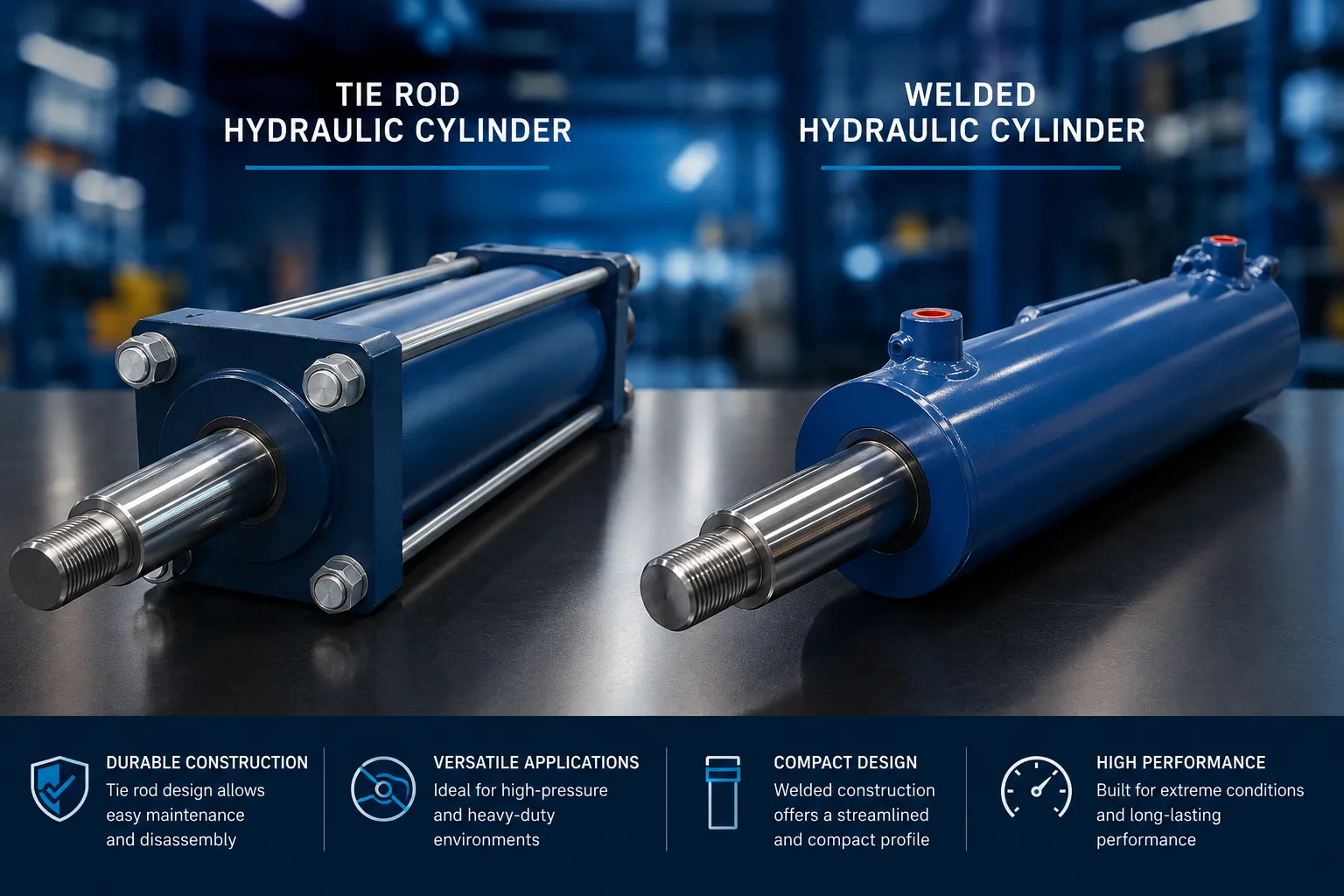
Quick Comparison: Tie Rod vs. Welded Cylinders
Use this table to quickly identify which cylinder type fits your needs.
| Selection Factor | Tie Rod Cylinder | Welded Cylinder |
|---|---|---|
| Best for | Industrial machinery, factory automation, manufacturing equipment | Mobile equipment, construction, mining, agriculture |
| Construction | External tie rods clamp barrel, head, and cap together | End caps welded directly to barrel |
| Repairability | ✅ Easy – field serviceable, can be rebuilt on-site | ⚠️ Difficult – requires special tools and expertise |
| Pressure rating | Up to 3,000 PSI | Up to 3,000 PSI (higher for custom) |
| Shock load resistance | Good | Excellent |
| Compactness | Larger footprint (tie rods protrude) | More compact (smooth round body) |
| Temperature range | Standard: 0°F to 180°F | Wider: -20°F to 220°F |
| Standardization | ✅ NFPA, ISO 6020/2 – interchangeable with major brands | ⚠️ Less standardized – often custom |
| Initial cost | Lower | Higher |
| Long-term cost | Lower (rebuildable) | Higher (replacement often required) |
| Typical industries | Factory automation, metal fabrication, packaging, material handling | Construction, agriculture, mining, forestry, waste management |
Selection Flowchart: Which Cylinder Should You Choose?
Follow this decision tree to determine the right cylinder type for your application.
START
   │
   ▼
Will the cylinder be regularly maintained or rebuilt?
   │
   ├── YES ──────────────────────────────────────────► CONSIDER TIE ROD
   │
   ▼ NO
Is the equipment exposed to shock loads, vibration, or impact?
   │
   ├── YES ──────────────────────────────────────────► CONSIDER WELDED
   │
   ▼ NO
Is space/weight a critical constraint?
   │
   ├── YES ──────────────────────────────────────────► CONSIDER WELDED (more compact)
   │
   ▼ NO
Is this a new design or a replacement?
   │
   ├── Replacement of existing NFPA standard → TIE ROD
   ├── Replacement of existing round body → WELDED
   │
   ▼
Is the application in a controlled environment (factory)?
   │
   ├── YES ──────────────────────────────────────────► TIE ROD
   │
   ▼ NO (outdoor, dirty, extreme temps)
   │
   └──────────────────────────────────────────────────► WELDED
Simple rule of thumb:
- Industrial / Factory / Automation → Tie Rod Cylinder
- Mobile / Construction / Agriculture / Mining → Welded Cylinder
Tie Rod Hydraulic Cylinders – Deep Dive
What they are: Tie rod cylinders use high-strength steel rods to clamp the cylinder barrel, head, and cap together. They follow NFPA and ISO 6020/2 standards.
Key advantages:
- ✅ Easily repairable in the field – just remove tie rods to access seals
- ✅ Standardized dimensions – directly interchangeable with Parker, Bosch Rexroth, Eaton
- ✅ Lower initial and long-term cost
- ✅ Wide range of seal materials for different fluids
- ✅ Customizable stroke lengths and mounting styles
Typical applications:
- Factory automation and assembly lines
- Metal fabrication presses
- Material handling equipment (conveyors, lifts)
- Packaging machinery
- Industrial robotics
- Agricultural implements (light to medium duty)
Common mounting styles (NFPA):
- MF1 (Front flange)
- MF2 (Rear flange)
- MP1 (Fixed clevis)
- MS2 (Side lug)
- MT4 (Trunnion)
Popular bore sizes: 1.5″, 2.0″, 2.5″, 3.25″, 4.0″, 5.0″, 6.0″, 8.0″
For detailed specifications, size charts, and repair guides: Read the Complete Tie Rod Cylinder Guide →
For NFPA dimension tables and interchange data: View Tie Rod Size Chart →
Welded Hydraulic Cylinders – Deep Dive
What they are: Welded cylinders have end caps permanently welded to the barrel, creating a single unified housing. They are also called round-body, cross-tube, or mill-type cylinders.
Key advantages:
- ✅ Superior shock load resistance – ideal for construction and mining
- ✅ More compact – no protruding tie rods
- ✅ Wider temperature tolerance (-20°F to 220°F)
- ✅ Excellent pressure spike handling
- ✅ Cleaner appearance with no external bolts to loosen
Typical applications:
- Construction equipment (excavators, bulldozers, backhoes)
- Agricultural machinery (tractors, harvesters, balers)
- Mining equipment
- Forklifts and aerial work platforms
- Dump trucks and refuse vehicles
- Marine and offshore equipment
Common mounting styles:
- Cross tube (most common for mobile equipment)
- Clevis (with pin and clips)
- Trunnion (for oscillating motion)
- Flange (cap or rod end)
- Side lug
Popular bore sizes: 1.5″, 2.0″, 2.5″, 3.0″, 3.5″, 4.0″, 5.0″, 6.0″, 7.0″
For detailed specifications, mounting dimensions, and maintenance tips: Read the Complete Welded Cylinder Guide →
For bore/rod combinations and pressure ratings: View Welded Size Chart →
Combined Size Chart: Tie Rod vs. Welded by Bore Size
Use this combined reference to compare available configurations across both cylinder types.
| Bore (in) | Tie Rod – Rod Options (in) | Welded – Rod Options (in) | Max PSI (Tie Rod) | Max PSI (Welded) | Common Applications |
|---|---|---|---|---|---|
| 1.5″ | 0.625″, 0.75″, 1.0″ | 0.75″ | 3,000 | 3,000 | Light steering, small implements |
| 2.0″ | 0.75″, 1.0″, 1.125″ | 1.0″ | 3,000 | 3,000 | General purpose, light industrial |
| 2.5″ | 1.125″, 1.375″, 1.5″ | 1.375″, 1.5″ | 3,000 | 3,000 | Construction, medium equipment |
| 3.25″ | 1.375″, 1.75″, 2.0″ | N/A (use 3.0″ or 3.5″) | 2,500 | N/A | Industrial, NFPA standard |
| 3.5″ | 1.75″ (less common) | 1.75″ | 3,000 | 3,000 | Construction, loaders |
| 4.0″ | 1.75″, 2.0″, 2.5″ | 2.0″ | 2,500 | 2,500-3,000 | Heavy industrial, excavators |
| 5.0″ | 2.0″, 2.5″ | 2.5″ | 2,500 | 3,000 | Large loaders, mining |
| 6.0″ | 2.5″, 3.0″ | 3.0″ | 2,000 | Custom | Heavy equipment, presses |
Note: Welded cylinders often use different bore increments (e.g., 3.0″ instead of 3.25″). Always verify compatibility when replacing.
Selection Criteria by Application Type
Industrial / Factory Automation
Recommendation: Tie Rod Cylinder
- Requires regular maintenance and seal replacement
- NFPA standardization simplifies sourcing
- Lower cost for multiple units
- Example: Press machine, conveyor diverters, packaging equipment
Construction Equipment (Excavators, Loaders)
Recommendation: Welded Cylinder
- High shock loads from digging and lifting
- Exposure to dirt, dust, and weather
- Compact packaging required
- Example: Excavator arm cylinder, loader bucket cylinder
Agriculture (Tractors, Harvesters)
Recommendation: Both types used – depends on location
- Steering/auxiliary functions: Tie rod (easy replacement)
- Main implements/lift cylinders: Welded (exposure to dirt and shock)
- Example: Tractor steering uses tie rod; 3-point hitch uses welded
Material Handling (Forklifts, Scissor Lifts)
Recommendation: Welded Cylinder
- Mobile equipment with shock loads
- Vertical mounting requires compact design
- Exposure to outdoor conditions
- Example: Forklift mast cylinder, scissor lift platform cylinder
Metal Fabrication / Presses
Recommendation: Tie Rod Cylinder
- Indoor, controlled environment
- Regular maintenance cycles
- Standardized mounting for easy replacement
- Example: Hydraulic press, stamping press, forming press
Mining Equipment
Recommendation: Welded Cylinder (heavy-duty series)
- Extreme shock loads and pressure spikes
- Abrasive dust and debris
- Wide temperature variations
- Example: Haul truck steering, excavator boom cylinders
Frequently Asked Questions
Can I replace a tie rod cylinder with a welded cylinder?
Which cylinder type lasts longer?
Are tie rod cylinders weaker than welded cylinders?
Which cylinder type is more cost-effective?
How do I know which mounting style I need?
Can I get a custom cylinder that combines both designs?
Ready to Select Your Cylinder?
Use this guide to narrow down your choice, then:
- For detailed specifications: Visit the Tie Rod Guide or Welded Guide
- For dimensions and sizing: View the Tie Rod Size Chart or Welded Size Chart
- For pricing and custom quotes: Request a Quote →
Quick Reference: When to Choose Each Type
| Choose Tie Rod Cylinder If… | Choose Welded Cylinder If… |
|---|---|
| ✅ You need regular maintenance access | ✅ Equipment operates in harsh environments |
| ✅ Standard NFPA/ISO dimensions are preferred | ✅ Space is limited (compact design needed) |
| ✅ Lower initial cost is a priority | ✅ Extreme shock loads are expected |
| ✅ The application is indoors (factory, plant) | ✅ Wide temperature operation is required (-20°F to 220°F) |
| ✅ You want interchangeability with major brands | ✅ The cylinder is on mobile equipment (construction, ag, mining) |
| ✅ Rebuilding capability is important | ✅ Pressure spikes are common |
Still unsure? Contact our engineering team → Send us your application details, and we will recommend the right cylinder type for your equipment.
This guide is updated as of 2026. Specifications are representative of industry standards.

