
How Are Hydraulic Cylinders Made? A Step-by-Step Manufacturing Guide
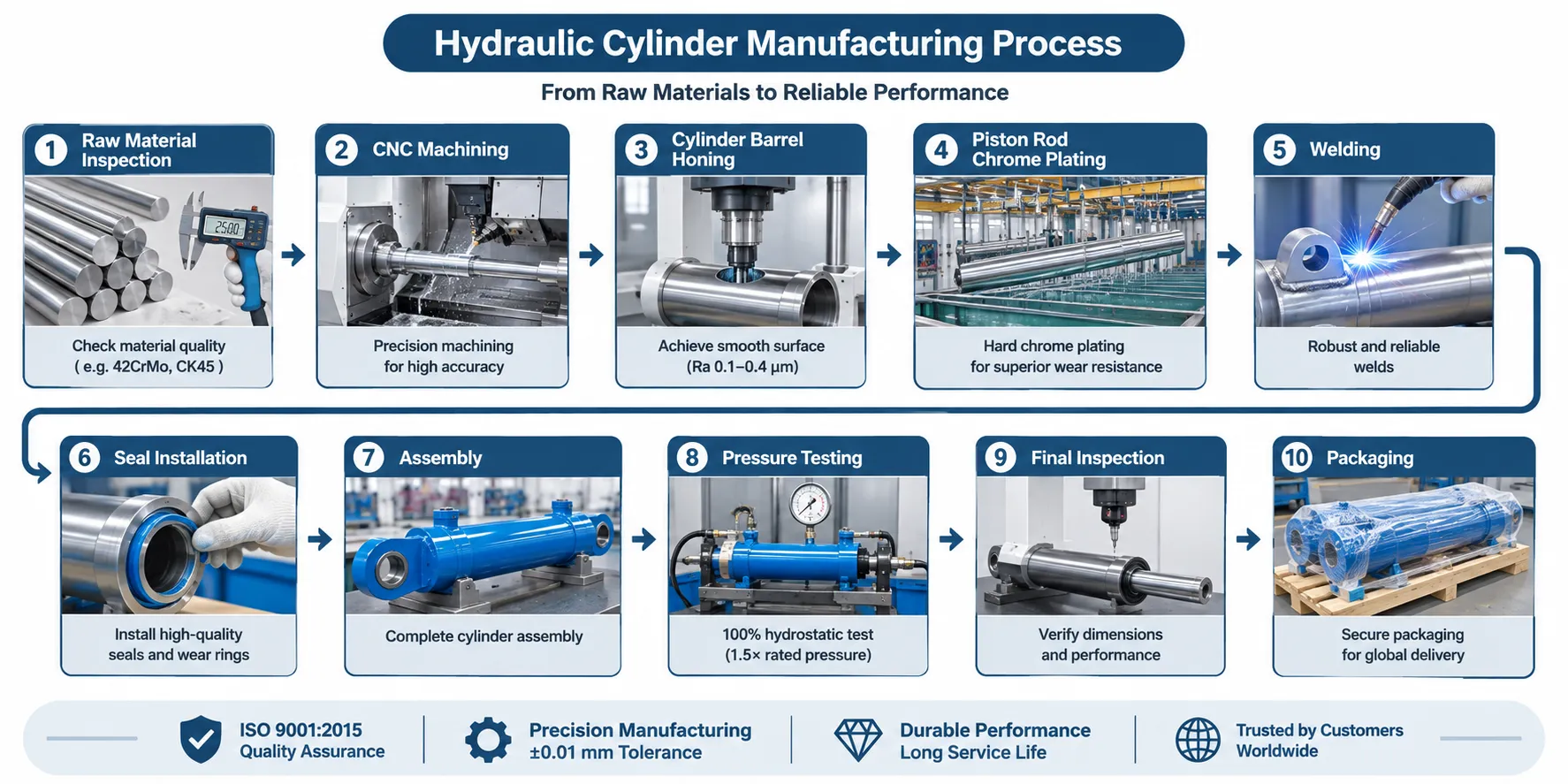
Hydraulic cylinders are essential components in construction machinery, agricultural equipment, industrial presses, dump trucks, and many other hydraulic systems. They convert hydraulic energy into controlled linear motion, allowing machines to lift, push, pull, tilt, and move heavy loads.
But how are hydraulic cylinders made?
The manufacturing process involves much more than machining a steel tube and installing a piston. It requires careful material selection, precision machining, cylinder tube honing, piston rod surface treatment, welding, seal installation, assembly, and pressure testing.
Each manufacturing stage affects the cylinder’s strength, dimensional accuracy, sealing performance, and service life.
In this guide, we explain how hydraulic cylinders are made, from raw material inspection to final quality testing. We also examine the main manufacturing processes, materials, and quality control procedures used by professional hydraulic cylinder manufacturers.
How Hydraulic Cylinder Manufacturing Starts
Hydraulic cylinder manufacturing starts with engineering requirements and product specifications.
Before production begins, the manufacturer must understand how the cylinder will operate, what loads it needs to handle, and how it will connect to the machine.
Important design considerations include:
- Bore diameter: Determines the piston area and contributes to the cylinder’s output force.
- Piston rod diameter: Affects rod strength, buckling resistance, and load capacity.
- Stroke length: Defines the distance the piston rod travels.
- Working pressure: Determines the pressure rating and structural requirements.
- Mounting configuration: Determines how the cylinder connects to the equipment.
- Operating environment: Influences material selection, sealing systems, and surface protection.
- Operating conditions: Includes cycle frequency, side loading, temperature, and contamination exposure.
For custom hydraulic cylinders, manufacturers may work from engineering drawings, physical samples, or equipment specifications.
The design is reviewed before production to confirm that the dimensions, materials, mounting arrangement, and performance requirements are suitable for the intended application.
Hydraulic Cylinder Components
To understand how hydraulic cylinders are manufactured, it is helpful to know their main components.
A typical hydraulic cylinder consists of several precision-engineered parts.
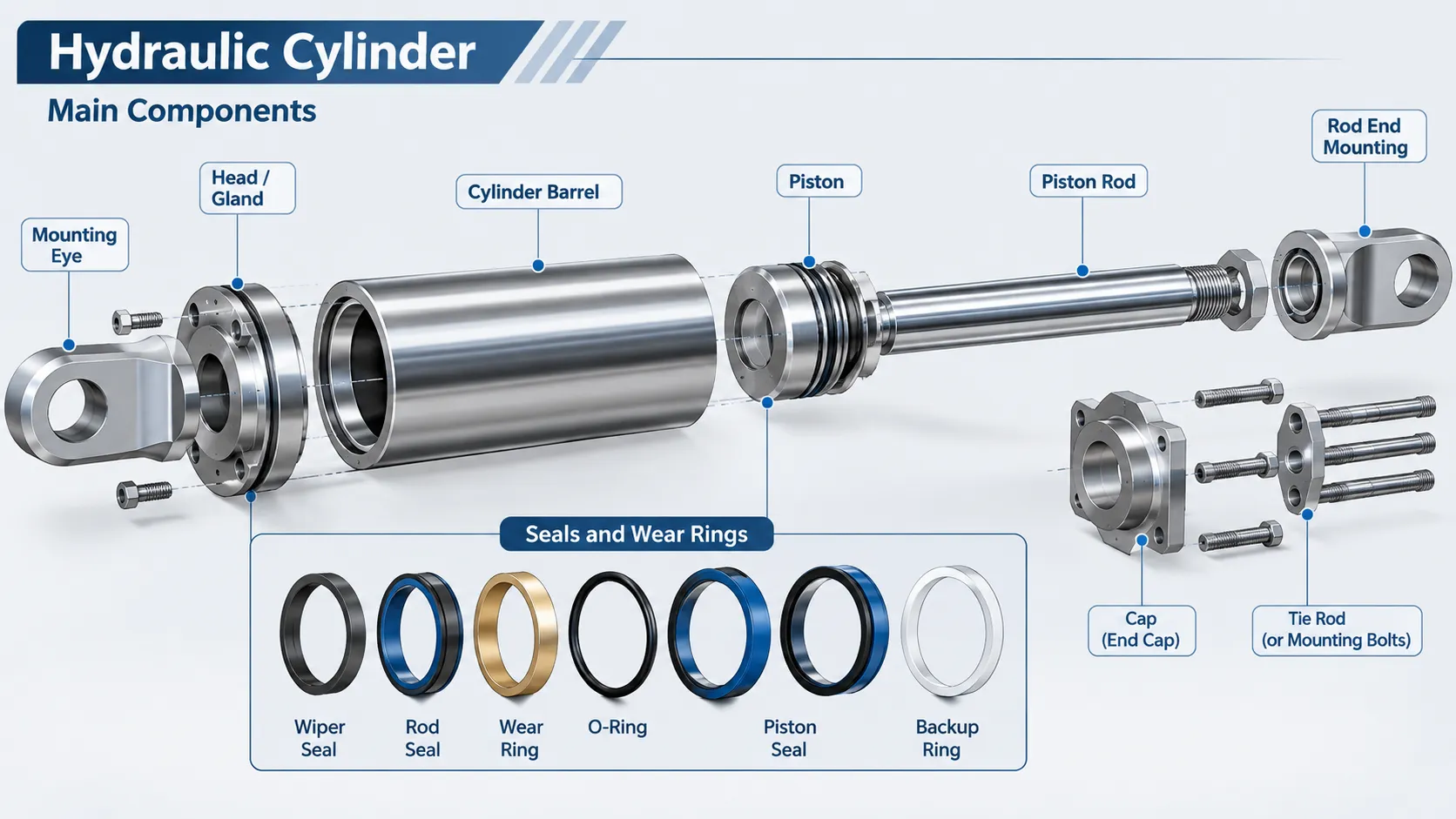
1. Cylinder Barrel
The cylinder barrel is the main pressure-containing body. It provides the internal surface along which the piston moves.
The inside diameter must be accurately machined and finished to support smooth piston movement and reliable sealing.
2. Piston
The piston separates the two working chambers inside the cylinder. Hydraulic pressure acting on the piston generates linear force.
Piston dimensions and seal grooves must be manufactured accurately to prevent excessive internal leakage.
3. Piston Rod
The piston rod transfers force from the piston to the external equipment.
It must withstand tensile and compressive loads while maintaining an appropriate surface finish to protect the rod seals.
4. Cylinder Head and Gland
The cylinder head or gland guides the piston rod and houses important sealing components.
It also helps retain the rod assembly within the cylinder.
5. Seals and Wear Rings
Hydraulic seals prevent fluid leakage between moving and stationary components. Wear rings guide the piston and rod assembly and help reduce metal-to-metal contact.
6. Mounting Components
Mounting components connect the cylinder to the machine. Common configurations include clevis mounts, flange mounts, trunnion mounts, and cross-tube mounts.
The exact component arrangement depends on the cylinder design.
Step 1 — Raw Material Inspection
The first manufacturing stage is raw material inspection.
Hydraulic cylinders operate under pressure and mechanical loads, so the quality of the materials directly affects product reliability.
Common materials include:
- Carbon steel for cylinder barrels and structural components.
- Seamless or suitable precision steel tubing for cylinder barrels.
- Medium-carbon steel for piston rods.
- Alloy steel for components requiring higher mechanical strength.
- Stainless steel for applications requiring additional corrosion resistance.
During incoming inspection, manufacturers may check:
- Material specifications and certificates.
- Chemical composition, where required.
- Mechanical properties.
- Material dimensions.
- Surface condition.
- Straightness and visible defects.
Material traceability is also important for OEM production. Keeping material records helps manufacturers identify the source and specifications of components used in production.
Using appropriate materials at the beginning of the process helps reduce manufacturing defects and supports consistent product quality.
Step 2 — CNC Machining
After material inspection, the raw materials are prepared for machining.
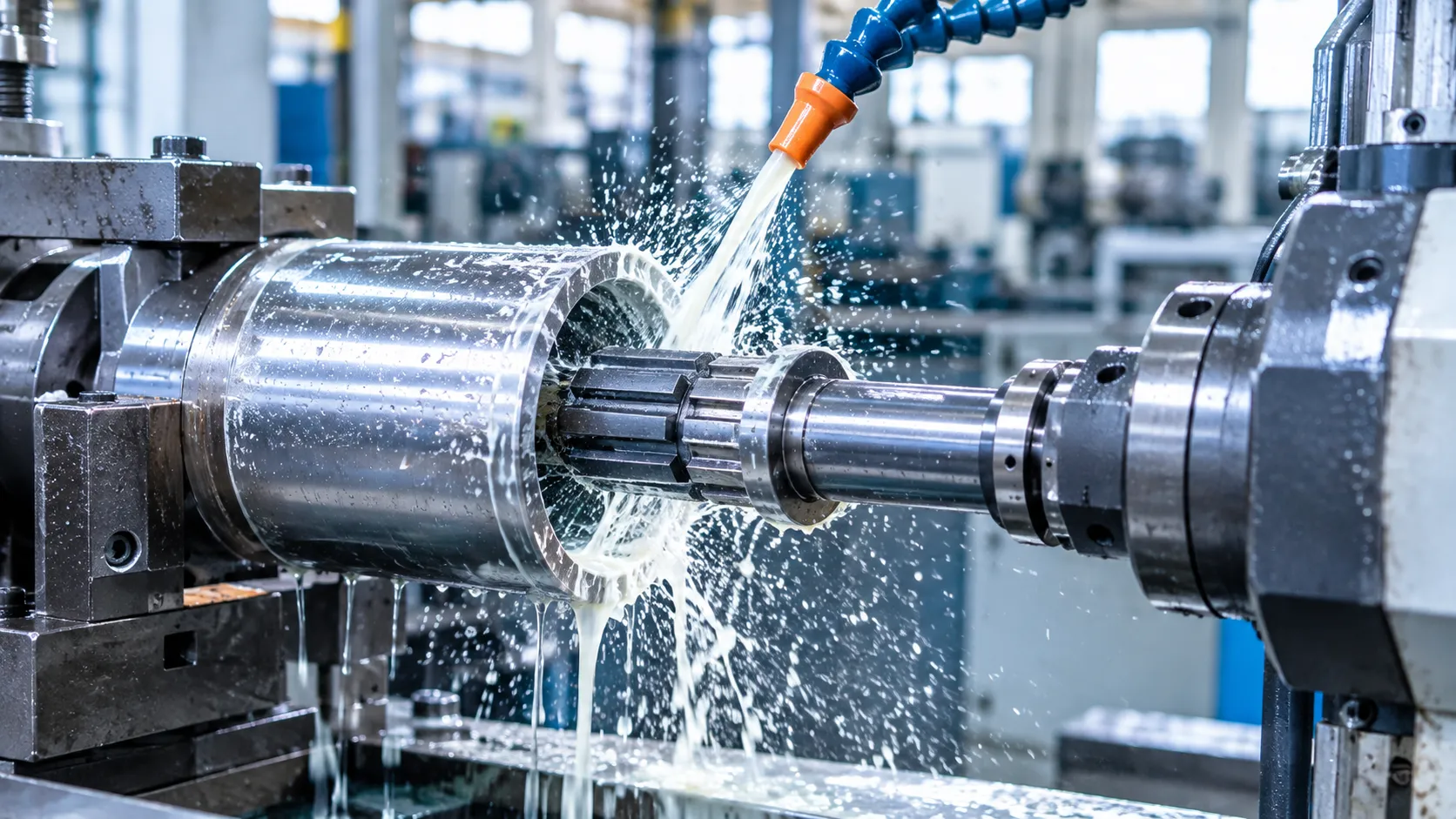
CNC machining is widely used to manufacture hydraulic cylinder components that require accurate dimensions and consistent geometry.
Typical machined components include:
- Piston rods.
- Pistons.
- Cylinder heads.
- Glands.
- End caps.
- Mounting components.
CNC turning, milling, drilling, and threading may be used depending on the component design.
For example, piston rods require accurately machined diameters, threads, and connection features. Piston and gland components require carefully controlled dimensions to ensure proper fit and seal installation.
Dimensional accuracy at this stage is important because errors in machining can affect assembly clearance, sealing performance, and cylinder operation.
Step 3 — Cylinder Tube Honing
Cylinder tube honing is one of the most important processes in hydraulic cylinder manufacturing.
The internal surface of the cylinder barrel must provide a suitable running surface for the piston seals.
Honing removes small machining irregularities and improves the internal surface finish and dimensional accuracy.
The honing process helps control:
- Internal bore diameter.
- Bore roundness.
- Bore straightness.
- Surface roughness.
- Internal surface consistency.
A properly finished cylinder bore helps reduce excessive seal wear and supports smooth piston movement.
The required bore tolerance and surface finish depend on the cylinder design, seal specifications, and operating conditions.
Honing quality is especially important in cylinders that operate at high pressures or perform frequent working cycles.
Step 4 — Piston Rod Machining
The piston rod is another critical component in hydraulic cylinder manufacturing.
It transfers mechanical force from the piston to the external load and must withstand repeated movement under operating conditions.
Piston rod manufacturing typically includes:
- Cutting the steel bar to the required length.
- CNC turning to achieve the specified diameter.
- Machining threads and connection features.
- Straightness and dimensional inspection.
- Preparing the surface for subsequent treatment.
The rod diameter, straightness, and surface condition must meet the engineering requirements.
A poorly manufactured rod can cause uneven seal wear, leakage, excessive friction, or premature component failure.
Step 5 — Induction Hardening
Some hydraulic cylinder piston rods undergo induction hardening to improve surface hardness and wear resistance.
Induction hardening uses electromagnetic heating followed by controlled quenching to harden the surface layer of the steel.
The process can improve resistance to surface wear and mechanical damage while maintaining a tougher core.
However, induction hardening is not required for every hydraulic cylinder rod. Its use depends on the rod material, design requirements, operating environment, and specified surface properties.
When required, manufacturers must control the hardening depth, surface hardness, and dimensional changes associated with the heat treatment process.
Step 6 — Chrome Plating
Hard chrome plating is a common surface treatment for hydraulic cylinder piston rods.
The piston rod repeatedly passes through the cylinder gland and rod seal during operation. Its surface must therefore provide suitable wear resistance, corrosion protection, and sealing performance.
Hard chrome plating helps improve:
- Surface hardness.
- Wear resistance.
- Corrosion resistance.
- Resistance to surface damage.
- Long-term sealing surface performance.
Before plating, the rod surface must be properly prepared.
The plating process must be controlled to achieve the specified coating thickness and surface quality.
Chrome plating is especially important for hydraulic cylinders used in construction machinery, agricultural equipment, transportation systems, and other demanding environments.
The required coating specifications depend on the application and engineering requirements.
Step 7 — Precision Grinding and Polishing
After surface treatment, the piston rod may undergo precision grinding and polishing to achieve its final dimensions and surface finish.
This stage is important because the rod seal operates directly against the piston rod surface.
An unsuitable surface finish can increase friction, damage seals, or cause premature leakage.
Precision grinding and polishing help control:
- Final rod diameter.
- Surface roughness.
- Roundness.
- Straightness.
- Surface consistency.
The final surface finish must be compatible with the selected rod seal material and sealing design.
For this reason, piston rod surface quality should be treated as an important part of the overall sealing system rather than simply an appearance requirement.
Step 8 — Welding and Component Assembly
Welding and mechanical assembly prepare the cylinder components for final integration.
The exact manufacturing sequence depends on whether the cylinder is a welded design, tie-rod design, or another construction type.
Welding
Welding is commonly used in welded hydraulic cylinders to join structural components such as the barrel, end caps, and mounting elements.
The welding process must be controlled to ensure adequate joint strength and dimensional stability.
Important inspection points include:
- Weld appearance.
- Weld consistency.
- Joint alignment.
- Distortion control.
- Required weld quality verification.
Mechanical Assembly
After the required machining and fabrication operations, the cylinder components are prepared for assembly.
This may include:
- Installing the piston onto the rod.
- Securing the piston using the specified connection method.
- Preparing the cylinder head and gland.
- Checking component dimensions.
- Preparing mounting and connection features.
Tie-rod cylinders use a different construction method. Their end covers are typically secured by tie rods rather than by welding the end structure to the barrel.
The manufacturing process must therefore follow the requirements of the specific cylinder design.
Step 9 — Seal Installation
Seals are essential for controlling hydraulic fluid leakage and maintaining pressure inside the cylinder.
Before assembly, manufacturers select seals according to the cylinder design, operating pressure, temperature, fluid compatibility, and movement requirements.
Common hydraulic cylinder sealing components include:
- Piston seals: Prevent fluid from passing between the piston and cylinder bore.
- Rod seals: Prevent hydraulic fluid from leaking along the moving piston rod.
- Wiper seals: Help prevent dirt, moisture, and other contaminants from entering the cylinder.
- Wear rings: Guide the piston and rod assembly and help reduce metal-to-metal contact.
- O-rings: Provide static sealing at suitable connection points.
During installation, technicians must ensure that the seals are correctly positioned and are not twisted, cut, stretched excessively, or damaged.
Seal grooves and mating surfaces should also be clean and free from burrs or sharp edges.
Incorrect seal installation can lead to leakage, increased friction, or early seal failure even when the other cylinder components have been manufactured correctly.
Step 10 — Hydraulic Pressure Testing
Hydraulic pressure testing is an important stage in the final manufacturing process.
Before a cylinder is released, it should be tested according to its design specifications and applicable inspection requirements.
Pressure testing may help identify:
- External oil leakage.
- Seal leakage.
- Problems with connections.
- Structural defects.
- Abnormal operating behavior.
Depending on the cylinder design and test procedure, manufacturers may also check extension and retraction, operating smoothness, and other functional characteristics.
The test pressure, holding time, and acceptance criteria must be determined by the cylinder’s rated pressure, design requirements, and applicable standards.
For example, a cylinder rated at 25 MPa may have a specified proof-test pressure above its rated working pressure. However, the actual test value must follow the approved product test procedure rather than a universal multiplier.
Pressure testing must be performed using suitable equipment and controlled safety procedures.
A cylinder should not be considered qualified simply because it extends and retracts. Leakage, structural integrity, and other specified performance requirements must also be checked.
Step 11 — Final Inspection and Packaging
After pressure testing, the hydraulic cylinder undergoes final inspection before packaging and shipment.
Final inspection may include:
- Overall dimensions.
- Bore and rod specifications.
- Stroke length.
- Mounting dimensions.
- Port configuration.
- Surface condition.
- Weld quality, where applicable.
- Seal and leakage performance.
- Product identification and documentation.
Manufacturers may also verify that the finished product matches the approved drawing and customer specifications.
After inspection, the cylinder is cleaned and prepared for packaging.
Protective caps may be installed on hydraulic ports to prevent contamination during transportation. Exposed piston rods should also be protected against scratches, impact, and corrosion.
Proper packaging helps maintain product condition during storage and international shipment.
Hydraulic Cylinder Manufacturing Process Flowchart
The manufacturing process can be summarized as follows:
Engineering Design and Specification Review
↓
Raw Material Inspection
↓
CNC Machining
↓
Cylinder Tube Honing
↓
Piston Rod Machining
↓
Heat Treatment, Where Required
↓
Chrome Plating and Surface Finishing
↓
Welding and Component Preparation
↓
Seal Installation and Final Assembly
↓
Hydraulic Pressure Testing
↓
Final Inspection and Packaging
The actual production sequence may vary depending on cylinder construction, component design, surface treatment requirements, and manufacturing equipment.
What Materials Are Used to Make Hydraulic Cylinders?
Hydraulic cylinder materials are selected according to mechanical strength, pressure requirements, operating conditions, corrosion exposure, and manufacturing requirements.
The main materials include:
| Component | Common Materials | Main Requirements |
|---|---|---|
| Cylinder Barrel | Carbon steel, precision steel tubing | Pressure resistance and bore accuracy |
| Piston Rod | Medium-carbon steel, alloy steel | Strength and surface durability |
| Piston | Carbon steel, alloy steel | Mechanical strength and dimensional accuracy |
| Cylinder Head | Carbon steel, alloy steel | Structural strength and sealing support |
| Seals | PU, NBR, PTFE, FKM | Fluid compatibility and sealing performance |
| Wear Rings | PTFE-based or other engineered materials | Wear resistance and guidance |
For example, CK45 and 42CrMo steel are commonly used for piston rod applications, depending on the required mechanical properties and surface treatment.
Polyurethane (PU), nitrile rubber (NBR), and PTFE are also widely used in hydraulic sealing systems.
The correct material combination depends on the specific cylinder application.
How Long Does It Take to Manufacture a Hydraulic Cylinder?
Hydraulic cylinder production time depends on product complexity, material availability, machining requirements, surface treatment, testing, and order quantity.
A standard hydraulic cylinder may require less production preparation than a fully customized OEM cylinder.
Factors that influence manufacturing lead time include:
- Whether the design is already approved.
- Availability of raw materials.
- Custom bore and stroke requirements.
- Special mounting configurations.
- Welding and machining complexity.
- Surface treatment requirements.
- Seal and component availability.
- Inspection and testing requirements.
For new OEM projects, engineering review and drawing approval should be completed before mass production begins.
Providing complete technical drawings and specifications can help reduce unnecessary communication and production delays.
How Quality Control Affects Hydraulic Cylinder Life
Hydraulic cylinder service life is influenced by several factors, including manufacturing quality, operating pressure, load conditions, hydraulic fluid cleanliness, maintenance practices, and environmental exposure.
Manufacturing quality plays an important role because defects in critical components can lead to premature failure.
For example:
- Incorrect bore dimensions can affect piston sealing.
- Poor rod surface finish can accelerate rod seal wear.
- Inadequate material selection can reduce structural reliability.
- Improper welding can compromise component integrity.
- Incorrect seal installation can cause leakage.
- Insufficient testing can allow manufacturing defects to go undetected.
A reliable hydraulic cylinder manufacturer should therefore implement quality control throughout the production process rather than relying only on final inspection.
For OEM customers, material traceability, dimensional inspection, process control, and pressure testing records can provide additional confidence in product consistency.
Custom Hydraulic Cylinder Manufacturing
Not every machine can use a standard hydraulic cylinder.
OEM equipment manufacturers often require cylinders with specific bore diameters, rod diameters, stroke lengths, mounting dimensions, port configurations, and operating pressures.
Custom hydraulic cylinder manufacturing allows the cylinder to be designed around the actual requirements of the equipment.
Toleng Hydraulics provides hydraulic cylinder manufacturing solutions for different industrial and mobile equipment applications.
With manufacturing experience dating back to 1998, Toleng supports OEM customers with standard and customized hydraulic cylinder requirements.
Custom manufacturing may include:
- Welded hydraulic cylinders.
- Tie-rod hydraulic cylinders.
- Telescopic hydraulic cylinders.
- Special mounting configurations.
- Customized bore and stroke dimensions.
- Application-specific sealing arrangements.
- Drawing-based and sample-based manufacturing.
To request a quotation, customers should provide the following information whenever available:
- Bore diameter.
- Piston rod diameter.
- Stroke length.
- Retracted length.
- Mounting type and dimensions.
- Working pressure.
- Hydraulic port specifications.
- Application and operating conditions.
- Technical drawings or reference samples.
The engineering team can then review the requirements and determine the appropriate manufacturing solution.
Why Choose an OEM Hydraulic Cylinder Manufacturer?
Working directly with an experienced OEM hydraulic cylinder manufacturer can offer several advantages for equipment manufacturers and industrial buyers.
Engineering Support
An experienced manufacturer can review drawings, dimensions, mounting configurations, and operating requirements before production.
Manufacturing Control
Control over machining, fabrication, assembly, and inspection processes helps maintain product consistency.
Customization Flexibility
OEM manufacturers can produce cylinders according to specific equipment requirements rather than relying entirely on standard catalog dimensions.
Quality Assurance
Material inspection, dimensional checks, and pressure testing help verify that finished cylinders meet their specified requirements.
Long-Term Supply Support
A manufacturing partner can support repeat orders, replacement requirements, and future product modifications.
When evaluating a hydraulic cylinder manufacturer, buyers should consider not only the quoted price but also engineering capability, manufacturing experience, quality management, production consistency, and communication.
Frequently Asked Questions
1. How are hydraulic cylinders manufactured?
Hydraulic cylinders are manufactured through a series of processes, including raw material inspection, CNC machining, cylinder tube honing, piston rod machining, surface treatment, welding, assembly, seal installation, and hydraulic pressure testing. The exact sequence depends on the cylinder design.
2. What machines are used to manufacture hydraulic cylinders?
Common manufacturing equipment includes CNC lathes, milling machines, honing machines, welding equipment, grinding machines, chrome plating equipment, dimensional inspection instruments, and hydraulic pressure testing systems.
3. What materials are used to make hydraulic cylinders?
Hydraulic cylinders commonly use carbon steel, alloy steel, precision steel tubing, stainless steel in selected applications, and engineered sealing materials such as PU, NBR, and PTFE.
4. Why is honing important in hydraulic cylinder manufacturing?
Honing improves the internal surface finish and dimensional accuracy of the cylinder barrel. A properly honed bore supports smooth piston movement and helps maintain reliable sealing performance.
5. Why are hydraulic cylinder rods chrome plated?
Hard chrome plating improves the piston rod’s surface hardness, wear resistance, and corrosion resistance. It also provides a suitable surface for repeated movement through the rod seal.
6. Are all hydraulic cylinder piston rods induction hardened?
No. Induction hardening depends on the rod material, design, and application requirements. Some piston rods use other heat treatment or surface treatment processes.
7. How are hydraulic cylinders tested after manufacturing?
Hydraulic cylinders may undergo dimensional inspection, functional testing, leakage inspection, and hydrostatic pressure testing. Test pressure and acceptance criteria depend on the product design and applicable specifications.
8. Can hydraulic cylinders be manufactured from customer drawings?
Yes. Many OEM hydraulic cylinder manufacturers can produce custom cylinders from approved engineering drawings or reference samples. The manufacturer must review the dimensions, materials, mounting requirements, and operating conditions before production.
9. What is the difference between welded and tie-rod hydraulic cylinders?
Welded hydraulic cylinders typically use welded structural construction and are common in mobile equipment. Tie-rod cylinders use external tie rods to secure the end covers and are widely used in industrial applications where standardized configurations are suitable.
10. How do I choose a reliable hydraulic cylinder manufacturer?
Evaluate the manufacturer’s engineering experience, production equipment, material control, machining capabilities, welding quality, inspection procedures, pressure testing, and ability to meet custom OEM requirements. Reviewing actual manufacturing evidence is also important.
Looking for a Custom Hydraulic Cylinder Manufacturer?
The quality of a hydraulic cylinder depends on more than its design. Material selection, machining accuracy, surface treatment, assembly procedures, and quality testing all contribute to its performance and reliability.
Whether you need a standard welded cylinder, a tie-rod cylinder, a telescopic cylinder, or a customized OEM solution, choosing an experienced manufacturing partner is important.
Toleng Hydraulics has been manufacturing hydraulic cylinders since 1998, supporting OEM customers with standard and customized cylinder solutions for a range of industrial and mobile equipment applications.
If you are developing new equipment or sourcing replacement hydraulic cylinders, our team can review your drawings, samples, or technical specifications.
Contact Toleng Hydraulics to discuss your hydraulic cylinder manufacturing requirements.
Explore Hydraulic Cylihttps://tolenghydraulics.com/hydraulic-cylinder/nder Products

