
Table of Contents
- 1. What Is a Double Acting Hydraulic Cylinder?
- 2. How Does a Double Acting Hydraulic Cylinder Work?
- 3. Types of Double Acting Hydraulic Cylinders
- 4. Key Components of a Double Acting Cylinder
- 5. Double Acting vs Single Acting Hydraulic Cylinder
- 6. Double Acting Hydraulic Cylinder Force Calculation
- 7. How to Choose the Right Double Acting Hydraulic Cylinder
- 8. Common Applications
- 9. Troubleshooting Guide
- 10. Maintenance Tips
- 11. Custom Double Acting Cylinders from Toleng Hydraulic
- 12. FAQs
- 13. Conclusion
1. What Is a Double Acting Hydraulic Cylinder?
A double acting hydraulic cylinder is a linear actuator that uses hydraulic pressure to generate force in both extension and retraction directions. Unlike a single acting hydraulic cylinder that relies on springs or gravity for return, the double acting design has two hydraulic ports — one on each side of the piston — allowing pressurized oil to move the rod in either direction.
This bidirectional capability makes double acting cylinders essential for applications requiring precise positioning, active retraction, or push-pull operations.

2. How Does a Double Acting Hydraulic Cylinder Work?
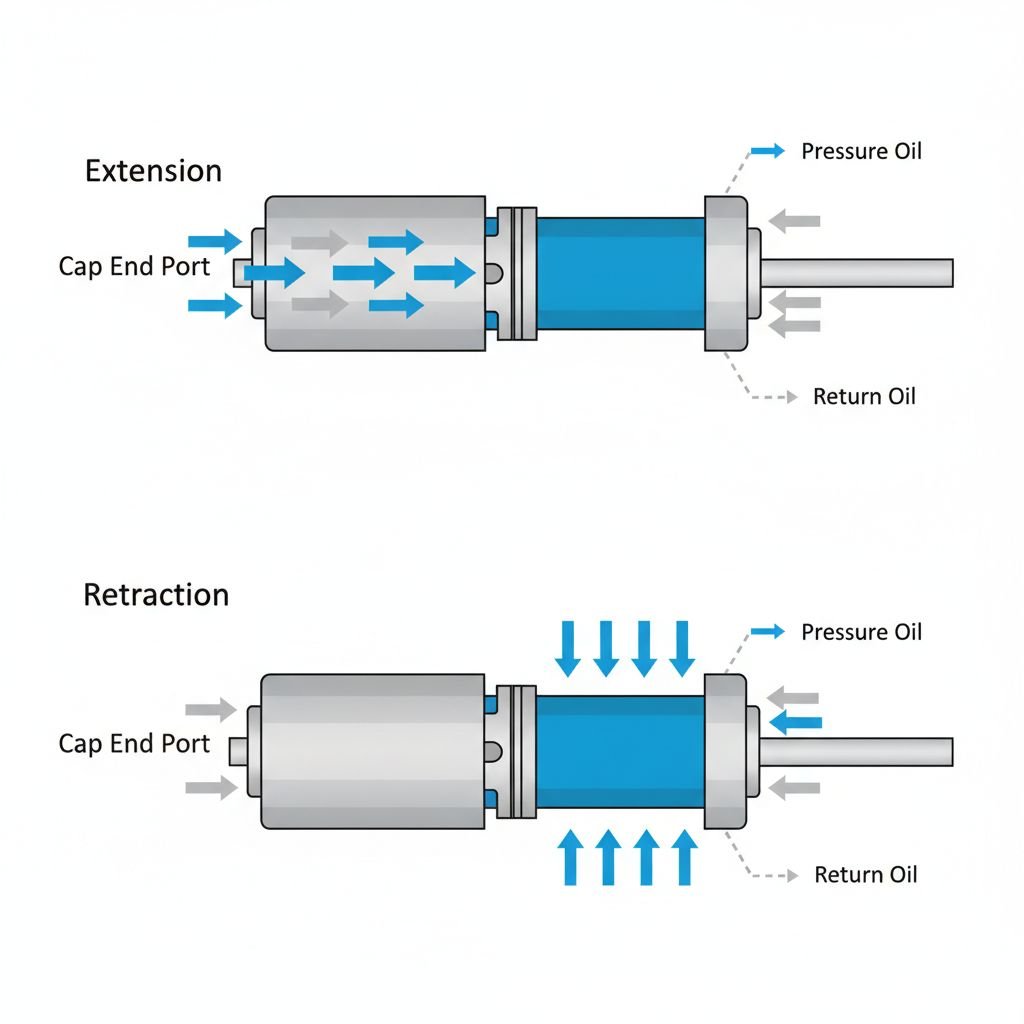
The double acting cylinder operates in two strokes, controlled by a 4-way directional control valve.
Extension Stroke
- Pressurized oil enters the cap end port (behind the piston)
- Oil pushes the piston and rod outward
- Oil on the rod side exits through the rod end port back to tank
Retraction Stroke
- Pressurized oil enters the rod end port (in front of the piston)
- Oil pushes the piston and rod back inward
- Oil on the cap side exits through the cap end port back to tank
3. Types of Double Acting Hydraulic Cylinders
Differential Cylinder (Most Common)
The rod side has less area than the cap side due to the rod occupying space. This creates a natural force difference — extension force is higher than retraction force at the same pressure.
Synchronous Cylinder
Used when two cylinders must move in perfect synchronization. Often uses flow dividers or series plumbing.
Tandem Cylinder
Two or more cylinders stacked in series to generate higher force without increasing bore size. Common in heavy industrial presses.
Position Sensing Cylinder (with Magnet/Sensor)
Integrated magnetic piston or external sensors for electronic position feedback. Used in automation and robotic applications.
4. Key Components of a Double Acting Cylinder
- Barrel – Cylindrical housing (seamless steel tube)
- Piston – Moves inside the barrel; sealed on both sides
- Piston Rod – Transmits force; chrome-plated for wear resistance
- Cap End Port – Oil inlet for extension stroke
- Rod End Port – Oil inlet for retraction stroke
- Piston Seals – Prevent oil bypass between cap and rod sides
- Rod Seal & Wiper – Prevent external leakage and contamination ingress
- Gland / Head – End closure that guides and seals the rod
5. Double Acting vs Single Acting Hydraulic Cylinder
Understanding the differences helps you select the right cylinder type for your application. For detailed information on single acting designs, see our Complete Guide to Single Acting Hydraulic Cylinders.
| Feature | Double Acting | Single Acting |
|---|---|---|
| Direction of force | Both directions (push and pull) | One direction (push only) |
| Number of ports | 2 | 1 |
| Retraction method | Hydraulic pressure (active) | Spring, gravity, or load (passive) |
| Control valve | 4-way valve | 3-way valve |
| Position control | Precise (bi-directional) | Limited (one direction only) |
| Cost | Higher | Lower |
| Typical applications | Excavators, forklifts, steering, presses | Dump trucks, jacks, clamps |

6. Double Acting Hydraulic Cylinder Force Calculation
Unlike single acting cylinders, double acting cylinders have two different force outputs — extension force and retraction force. The rod reduces effective area on the rod side, making retraction force lower.
Extension Force Formula
F_ext = P × (π × D² / 4)
- F_ext = Extension force (lbs or N)
- P = Hydraulic pressure (psi or Pa)
- D = Bore diameter (in or m)
Retraction Force Formula
F_ret = P × (π × (D² – d²) / 4)
- F_ret = Retraction force (lbs or N)
- P = Hydraulic pressure (psi or Pa)
- D = Bore diameter (in or m)
- d = Rod diameter (in or m)
Calculation Example
Given:
- Pressure = 2500 psi
- Bore diameter = 3 inches (radius = 1.5 in)
- Rod diameter = 1.5 inches
Extension Force:
Area = π × (1.5)² = 7.07 in²
F_ext = 2500 × 7.07 = 17,675 lbs
Retraction Force:
Area = π × (3² – 1.5²) / 4 = π × (9 – 2.25) / 4 = π × 6.75 / 4 = 5.30 in²
F_ret = 2500 × 5.30 = 13,250 lbs
Force difference: Retraction force is 25% lower than extension force for this bore/rod ratio.
Extension vs Retraction Force Table (Typical Values @ 2500 psi)
| Bore (in) | Rod (in) | Extension Force (lbs) | Retraction Force (lbs) | Difference |
|---|---|---|---|---|
| 2 | 1.0 | 7,854 | 5,890 | -25% |
| 3 | 1.5 | 17,671 | 13,252 | -25% |
| 4 | 2.0 | 31,416 | 23,562 | -25% |
| 5 | 2.5 | 49,087 | 36,815 | -25% |
Note: Force difference varies with rod-to-bore ratio. Typical industrial cylinders use a 0.5 rod/bore ratio, resulting in ~25% lower retraction force.
7. How to Choose the Right Double Acting Hydraulic Cylinder
Bore Size
Determines extension force. Larger bore = higher force but larger footprint.
Rod Diameter
Affects retraction force and buckling resistance. Use larger rods for long strokes or high push forces.
Stroke Length
Travel distance from fully retracted to fully extended. Consider buckling risk for long strokes.
Working Pressure
Match cylinder rating to your system pressure. Common ratings: 1500 psi, 3000 psi, 5000 psi (35 MPa).
Mounting Styles
- Clevis – Pivot mounting
- Trunnion – For heavy or long cylinders
- Flange (front/rear) – Rigid mounting
- Foot mount – Standard industrial cylinders
Seal Material
- Nitrile (NBR) – Standard mineral oils, -20°F to +200°F
- Viton (FKM) – High heat, chemicals
- Polyurethane – High wear resistance
Cushioning (Optional)
Built-in cushions at end of stroke reduce shock and noise. Recommended for high-speed applications.
8. Common Applications of Double Acting Hydraulic Cylinders
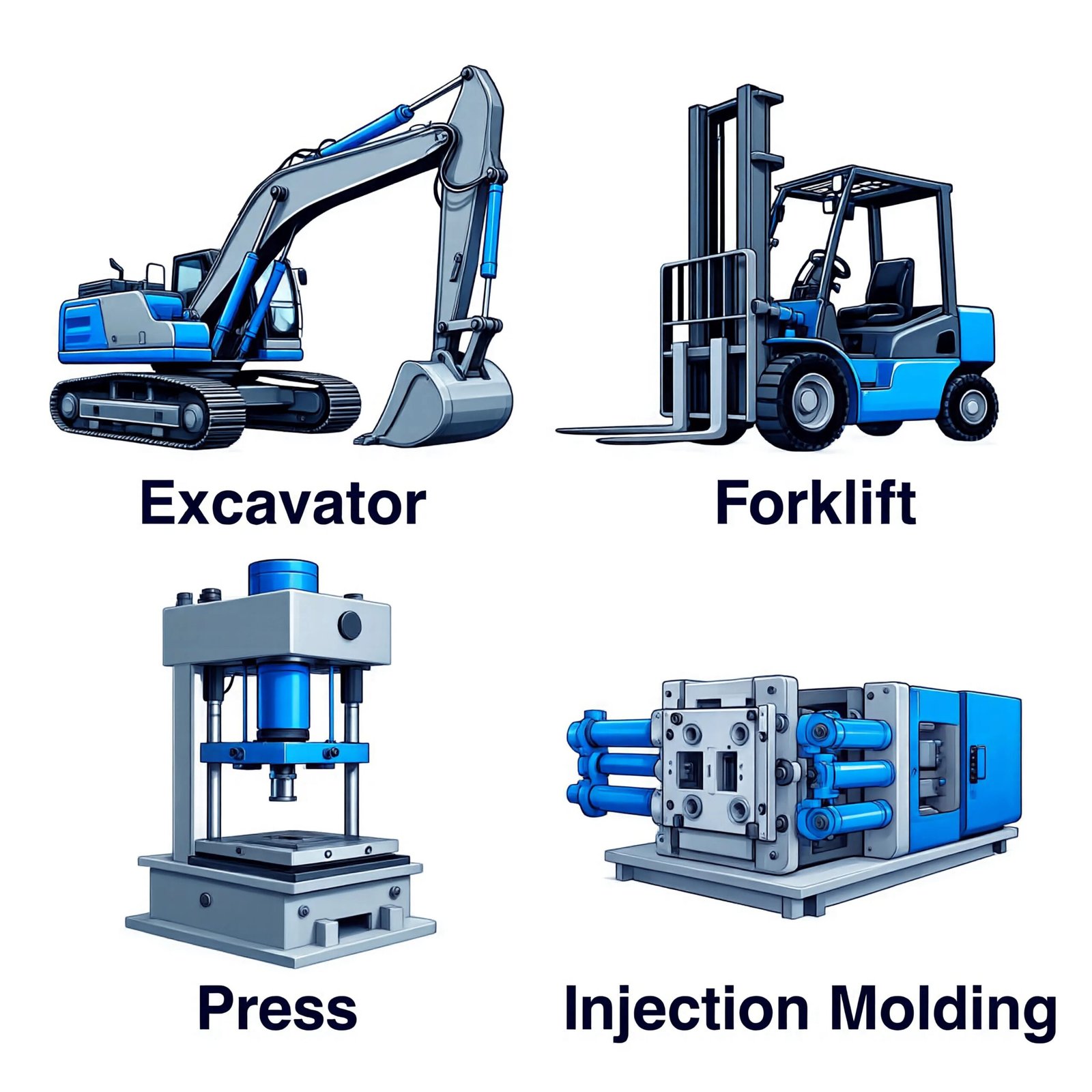
Construction Equipment
Excavator arms, loader buckets, bulldozer blades, backhoe stabilizers — anywhere push-pull control is needed.
Industrial Machinery
Injection molding machines (mold open/close), hydraulic presses (return stroke), metal forming equipment.
Mobile Hydraulics
Forklift masts, aerial work platforms, crane booms, steering systems.
Marine and Offshore
Steering gear, hatch covers, winch controls.
Agricultural Equipment
Combine headers, baler gates, planter folding sections.
9. Troubleshooting Double Acting Hydraulic Cylinders
Cylinder Won’t Extend or Retract
- Check system pressure and pump output
- Verify directional valve is shifting correctly
- Check for blocked or crushed hydraulic lines
- Inspect for severe internal leakage (piston seal failure)
Slow or Erratic Movement
- Low pump flow or undersized lines
- Partially blocked control valve or port
- Cold, high-viscosity oil
- Air in system (bleed required)
Cylinder Drift (Unexpected Rod Movement)
- Internal drift – Piston seal leaking (oil bypasses from cap to rod side)
- External drift – Valve spool wear or external leakage
- Fix: Replace piston seals or repair control valve
External Leakage
- Rod seal worn – replace gland seals
- Scored or pitted rod – replace rod or re-chrome
- Loose gland nut – torque to specification
Excessive Noise or Vibration
- Air in system
- Loose mounting bolts
- Cavitation (restricted pump suction)
10. Maintenance Tips for Double Acting Cylinders
- Inspect rod surface weekly – Nicks or scratches will damage seals
- Monitor for drift – Indicates internal seal wear
- Keep oil clean – Contamination is the #1 cause of seal failure
- Check mounting bolts – Loose mounts cause misalignment and seal wear
- Replace seals at first sign of leakage – Don’t wait for catastrophic failure
- Store with rod retracted – Protects rod from corrosion and damage
11. Custom Double Acting Hydraulic Cylinders from Toleng Hydraulic
Toleng Hydraulic manufactures custom double acting hydraulic cylinders for demanding applications across construction, industrial, and mobile equipment.
Available specifications:
- Bore sizes: 25 mm to 500 mm (1″ to 20″)
- Stroke lengths: up to 6000 mm (236″)
- Working pressure: up to 35 MPa (5000 psi)
- Rod diameters: custom ratios for force optimization
- Mounting styles: clevis, trunnion, flange, foot, cross tube
- Seal options: NBR, Viton, PTFE, polyurethane
- Cushioning: adjustable or fixed cushions available
- Position sensing: magnetic piston or external sensors
Industries served: Construction equipment, agricultural machinery, industrial automation, material handling, marine, and custom machinery builders.
12. Frequently Asked Questions (FAQs)
What is the difference between single acting and double acting hydraulic cylinder?
A single acting cylinder uses hydraulic pressure for extension only and relies on spring, gravity, or load for retraction. A double acting cylinder uses hydraulic pressure for both extension and retraction, requiring two ports and a 4-way control valve. See our detailed single acting vs double acting comparison.
How do you calculate retraction force for a double acting cylinder?
Retraction force = Pressure × (π × (Bore² – Rod²) / 4). Because the rod takes up area on the rod side, retraction force is approximately 20-25% lower than extension force for the same pressure.
Can a double acting cylinder be used as a single acting?
Yes, by connecting only one port and leaving the other vented to atmosphere or tank. However, this is not cost-effective since you’re paying for unused capability. A dedicated single acting cylinder is usually cheaper.
What causes cylinder drift in double acting cylinders?
Cylinder drift (unexpected rod movement) is typically caused by piston seal leakage (internal bypass), worn control valve spool, or external leakage. Replace seals or repair the valve to fix drift.
How many ports does a double acting cylinder have?
A double acting hydraulic cylinder has two ports: one at the cap end (for extension) and one at the rod end (for retraction).
Which applications require double acting cylinders?
Double acting cylinders are required whenever you need powered movement in both directions, such as excavator arms, forklift masts, steering systems, injection molding machines, and hydraulic press return strokes.
Why is retraction force lower than extension force?
On the rod side, the piston rod occupies space that would otherwise be available for oil. This reduces the effective area, so at the same pressure, force is proportionally lower.
13. Conclusion
The double acting hydraulic cylinder provides bidirectional force control, making it the standard choice for applications requiring active push-pull capability, precise positioning, or controlled retraction. Understanding the force difference between extension and retraction — driven by the rod area — is critical for proper sizing.
When selecting a double acting cylinder, consider bore size, rod diameter, stroke, mounting style, and seal material. For applications needing only single-direction force, a single acting hydraulic cylinder may offer a more cost-effective solution.
For custom cylinder requirements, Toleng Hydraulic provides engineering support and manufacturing for OEM and replacement applications.
Related articles:
- Single Acting Hydraulic Cylinder: Complete Guide
- How to Calculate Hydraulic Cylinder Force
- Custom Hydraulic Cylinder Manufacturing Guide

