
What Are Hydraulic Cylinder Seals?
Hydraulic cylinder seals are precision components designed to contain pressurized fluid, prevent leaks, and exclude contaminants. They are the dynamic interface between moving parts—primarily the rod and piston—and the static interface between the gland, barrel, and end cap. Without reliable seals, even the most precisely machined hydraulic cylinder parts cannot maintain pressure or motion.
A typical hydraulic cylinder seal system includes:
-
Dynamic Seals: Rod seal, piston seal, wiper/dust seal
-
Static Seals: Gland O-ring, end cap O-ring, port seals
-
Guiding Elements: Wear rings (guide bands) that support radial loads
When any of these seals degrades, the consequences range from minor oil weepage to complete cylinder failure.
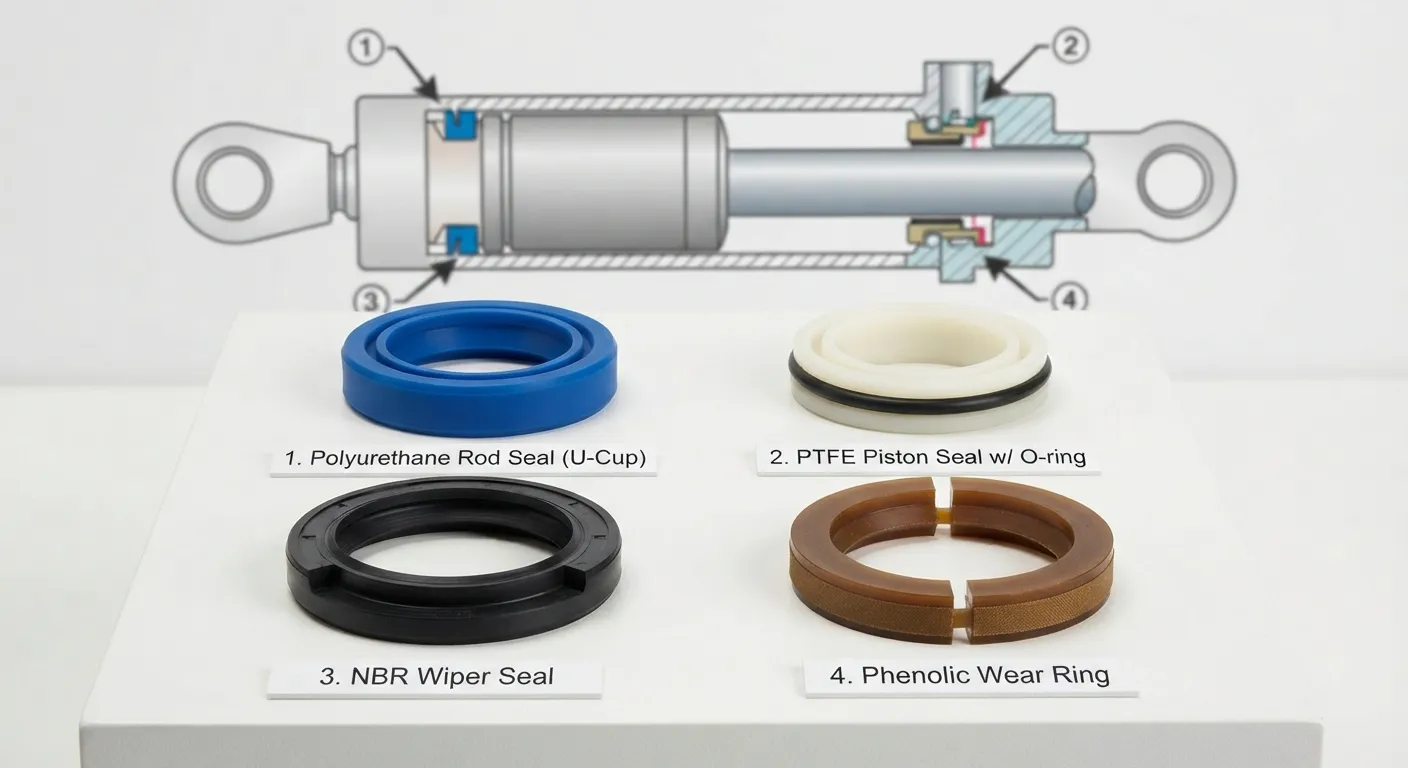
Hydraulic Cylinder Seal Location Diagram
Refer to this cutaway view to identify where each seal sits within a standard welded hydraulic cylinder.

Types of Hydraulic Cylinder Seals & Their Functions
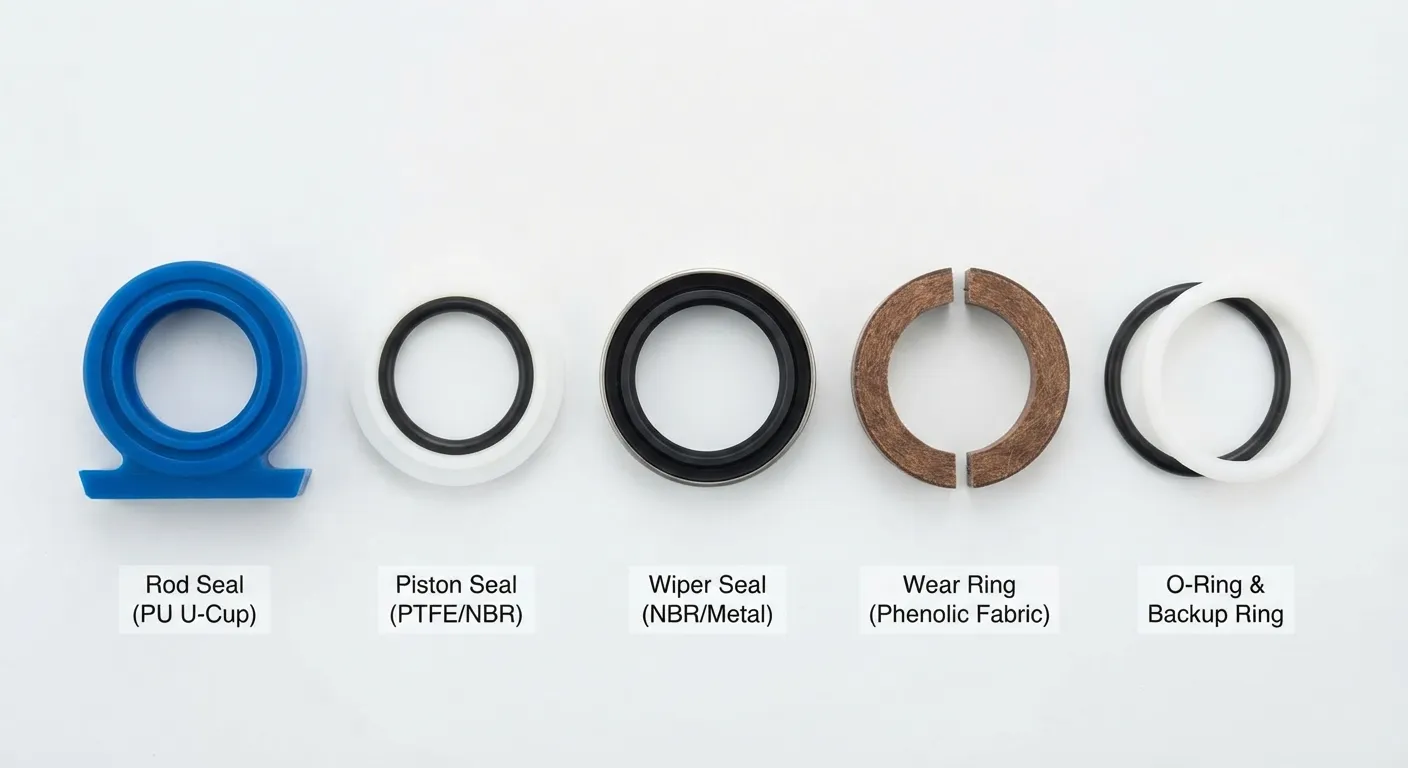
1. Rod Seal
The rod seal is the most critical dynamic seal. It is installed in the gland and seals against the reciprocating piston rod, preventing high-pressure oil from escaping the cylinder.
-
Function: Retains system pressure inside the cylinder during rod extension and retraction.
-
Common Materials: Polyurethane (PU), PTFE with energizer, fabric-reinforced rubber.
-
Failure Symptoms: Visible oil leakage around the rod, oil mist, or dampness on the rod surface.
-
Inspection Tip: A constant film of oil is not “normal weepage”—it’s a leak that will accelerate seal wear and allow contamination entry.
2. Piston Seal
The piston seal is mounted on the piston and seals against the cylinder barrel bore. It separates the extend and retract chambers, allowing pressure to build.
-
Function: Prevents internal fluid bypass, maintaining the pressure differential needed for force generation.
-
Common Materials: PTFE with rubber energizer, polyurethane U-cups, nylon composites.
-
Failure Symptoms: Cylinder drift under load, slow operation, excessive heat build-up due to internal leakage.
-
Inspection Tip: Pressurize the cylinder and check for rod movement when stopped; any drift indicates piston seal bypass.
3. Wiper Seal (Dust Seal)
The wiper seal is fitted at the outer face of the gland, directly in contact with the environment. It scrapes dirt, dust, moisture, and debris off the rod as it retracts.
-
Function: Protects the rod seal and entire hydraulic system from contamination.
-
Common Materials: Nitrile rubber (NBR), polyurethane with a metal or plastic shell.
-
Failure Symptoms: Embedded dirt on the rod, scratched rod surface, rapid deterioration of the rod seal.
-
Inspection Tip: Inspect the wiper lip for cracks, hardening, or gaps. A failed wiper seal is the primary cause of rod damage.
4. Wear Ring (Guide Band)
While not a fluid seal, wear rings are essential guiding elements that absorb radial loads and prevent metal-to-metal contact between the piston and barrel, and between the rod and gland.
-
Function: Centralizes the piston and rod, protecting seals from excessive side loading.
-
Common Materials: Phenolic resin fabric, PTFE composite, nylon.
-
Failure Symptoms: Scoring on the piston OD or gland bore, uneven seal wear, jerky cylinder movement.
-
Inspection Tip: Measure residual thickness; if below manufacturer’s minimum, replace immediately to avoid hard-part damage.
5. Static Seals (O-Rings & Backup Rings)
Static seals are used in non-moving joints: between the gland and barrel, end cap and barrel, and around ports.
-
Function: Prevent external leakage at fixed connections.
-
Common Materials: Nitrile (NBR) O-rings, with PTFE backup rings for high-pressure applications.
-
Failure Symptoms: External oil seepage around the gland threads or end cap joint.
-
Inspection Tip: Always replace static O-rings when disassembling a cylinder. They take a set over time and may not re-seal effectively.
Hydraulic Seal Materials: What to Choose & Why
| Material | Key Properties | Best For | Temperature Range |
|---|---|---|---|
| Polyurethane (PU) | High abrasion resistance, excellent elasticity, good tear strength | Rod seals, wiper seals in mobile equipment, high-cycle applications | -30°C to +100°C |
| PTFE (Teflon) | Very low friction, wide chemical compatibility, high temperature resistance | Piston seals, rod seals in high-temperature or low-friction applications | -200°C to +260°C |
| Nitrile Rubber (NBR) | Good oil resistance, economical, wide availability | Static O-rings, wiper seals in moderate conditions | -40°C to +120°C |
| Fabric-Reinforced Rubber | High strength, good extrusion resistance | Rod seals in heavy-duty, high-pressure applications | -30°C to +100°C |
| Phenolic Resin | High compressive strength, low wear | Wear rings, guide bands | Up to +120°C |
Material selection rule of thumb:
-
High speed and high pressure → PTFE
-
Heavy contamination and high side load → Polyurethane
-
Economical static sealing → Nitrile
-
Extreme temperatures → PTFE or specialized fluoroelastomers (FKM)
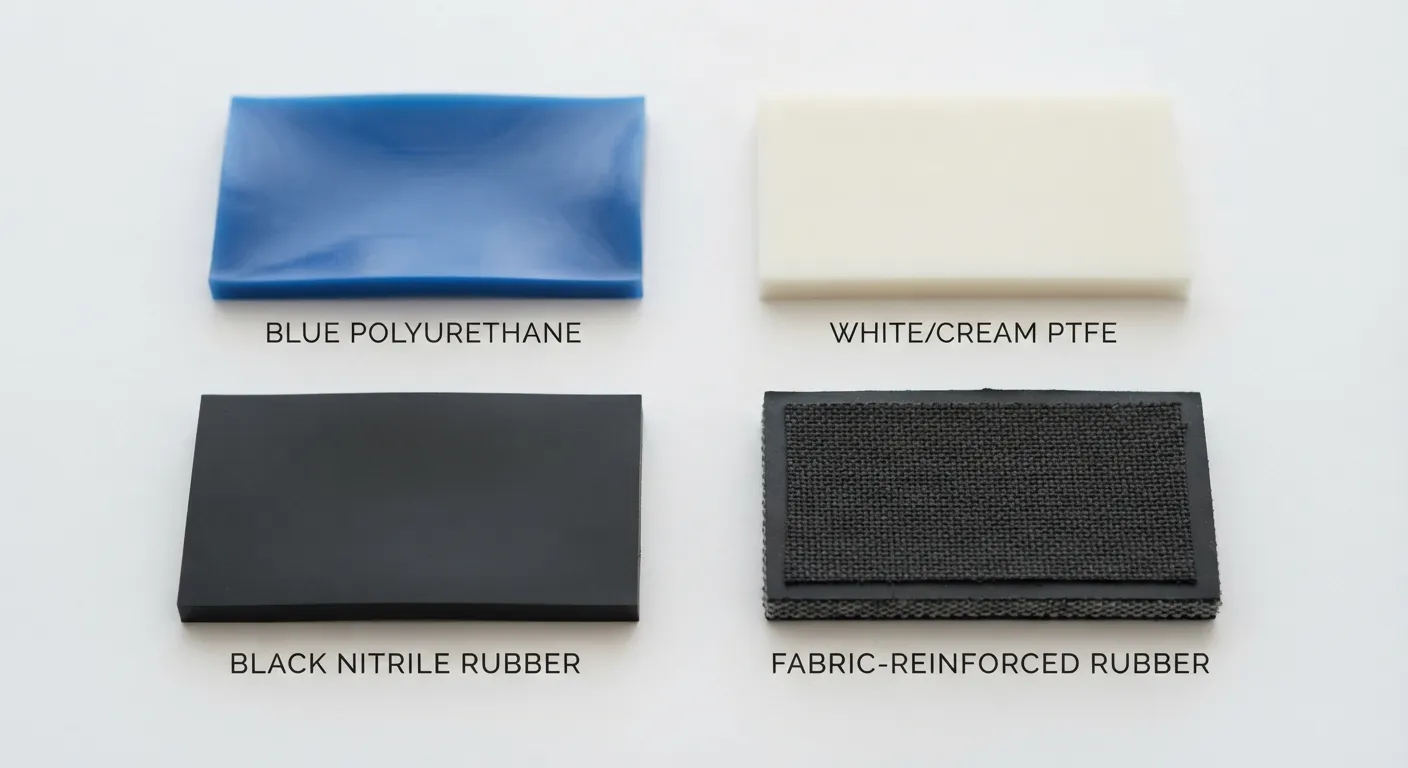
Our engineers at Toleng map your exact operating conditions—pressure, cycle rate, fluid type, and temperature—to the optimal seal material. Using the wrong material leads to premature hardening, extrusion, or chemical swelling.
Common Hydraulic Cylinder Seal Failures: Symptoms & Solutions
| Symptom | Likely Seal Failure | Action |
|---|---|---|
| External oil leak around rod | Worn rod seal | Replace rod seal; inspect rod surface |
| Cylinder creeps or drifts | Piston seal bypass | Replace piston seal; check barrel bore |
| Scratched or scored rod surface | Failed wiper seal allowing dirt ingress | Replace wiper seal; polish or re-chrome rod |
| Jerky, uneven rod movement | Damaged rod seal drawing air, or worn wear rings causing stick-slip | Inspect seals and wear rings; replace as needed |
| Oil leaking from gland-to-barrel joint | Static gland O-ring failure | Replace O-ring and backup ring |
| Milky or foamy hydraulic oil | Water ingress past wiper seal | Replace wiper seal; improve external shielding |
| Seal extrusion / nibbling | Excessive pressure or oversized seal groove | Upgrade to PTFE with backup ring; verify groove dimensions |
Industry insight: More than 70% of hydraulic cylinder seal failures are traced back to contamination ingress and improper installation. Clean assembly practices and correct seal sizing are your best defense.
How to Choose the Right Hydraulic Cylinder Seals
Follow this six-step process to ensure you order the correct seal kit every time.
Step 1: Identify Seal Location
Is it a rod seal, piston seal, wiper, or static O-ring? Each requires a different profile.
Step 2: Measure Rod Diameter
For rod seals and wipers, the rod outer diameter is the primary dimension. Use a calibrated micrometer.
Step 3: Measure Bore Diameter
For piston seals and wear rings, the barrel inner diameter is critical. Use a dial bore gauge.
Step 4: Determine Seal Groove Dimensions
Measure the groove depth, width, and the distance to the sealing surface. This dictates the seal cross-section and profile.
Step 5: Confirm Operating Conditions
-
Working pressure: High pressure (>250 bar) often requires PTFE seals with backup rings.
-
Temperature range: Determines material choice (PU for standard, PTFE or FKM for extremes).
-
Fluid type: Mineral oil, water-glycol, or biodegradable fluid—ensure material compatibility.
Step 6: Select Seal Profile & Material
Match the profile (U-cup, step seal, O-ring with backup) to your groove and operating demands. When in doubt, send us your old seals, cylinder model, or dimensions, and we’ll provide a direct OEM replacement.
Request Seal Identification & Quote
When to Replace Hydraulic Cylinder Seals: A Preventive Schedule
Scheduled preventive replacement:
-
Rod seals and wiper seals: Every 2,000–4,000 operating hours, or annually in heavy-duty use.
-
Piston seals: Every 4,000–6,000 hours, or when cylinder drift is detected.
-
Static O-rings: Replace every time the cylinder is disassembled.
Immediate replacement triggers:
-
Any visible external leakage
-
Cylinder drift affecting productivity or safety
-
Evidence of contamination on the rod (dirt ring, scratches)
-
After any rod re-chroming or barrel honing—always fit new seals
Pro tip: When you replace one seal in a cylinder, replace the entire seal kit. Mixing old and new seals almost always results in premature failure because the worn components increase clearances that overstress the new seal.
OEM Seal Kits vs. Generic Aftermarket Seals
| Criterion | Toleng OEM Seal Kits | Generic Aftermarket |
|---|---|---|
| Exact Fit | CAD-matched to groove dimensions | May require stretching or trimming |
| Material Quality | Premium PU, PTFE, certified materials | Unknown compound, may harden or swell prematurely |
| Performance Consistency | Tested for pressure and cycle life | Varies by supplier, high risk of early failure |
| Support | Engineering assistance for selection | Typically no technical backing |
| Long-Term Cost | Higher initial, lower life-cycle cost | Lower initial, higher risk of scoring rods and barrels |
The true cost of a cheap seal: A generic wiper seal that fails in six months can allow dirt to score a chrome rod. Replacing that rod costs 15–20 times the price of a quality OEM wiper seal. Invest in quality seals to protect your expensive hard parts.
Hydraulic Cylinder Seal Replacement: Step-by-Step Best Practices
-
Clean the work area thoroughly. Any dirt introduced during assembly will immediately damage new seals.
-
Inspect all hard parts: Rod surface for scratches, barrel for scoring, gland for bushing wear. Repair or replace damaged parts before installing new seals.
-
Lubricate new seals with clean hydraulic fluid before installation.
-
Use proper installation tools—seal picks, bullet-shaped sleeves for rod seals, and compression tools to avoid cutting or twisting the seal lip.
-
Pay attention to seal orientation. Asymmetrical seals have a specific sealing lip direction; reversed installation causes immediate leakage.
-
Pressurize and test: After assembly, run the cylinder at low pressure first, check for leaks, then test at full working pressure.
For a detailed visual walkthrough, see our How to Replace Hydraulic Cylinder Seals video guide.
Real-World Example: Reducing Seal Failures in a Loader Application
A construction equipment fleet was replacing rod seals on their wheel loader tilt cylinders every three to four months. Upon inspection, Toleng engineers found that the generic aftermarket rod seal was extruding under the frequent pressure spikes during breakout operations.
Our solution: We supplied a custom-fit seal kit that included a PTFE step seal with a nylon backup ring for the rod seal, and upgraded the wiper seal to a heavy-duty polyurethane profile with a metal retaining shell.
The result: Seal service life was extended significantly, with the cylinders operating leak-free through an entire construction season. Fleet maintenance costs decreased substantially. (Based on internal Toleng application data; customer identity withheld.)
Industries We Supply Seals For
Agriculture – Harsh dust and crop debris require rugged wiper seals.
Dump Trucks – High cycle rates demand abrasion-resistant polyurethane.
Construction – Pressure spikes from digging and lifting require PTFE-backed rod seals.
Forestry – Exposure to dirt and moisture needs robust sealing systems.
Marine – Saltwater environments require stainless-compatible seals and static O-rings with FKM.
Waste Management – Contaminant-heavy conditions demand premium wiper and rod seal combinations.
Industrial Presses – Long strokes and high temperatures often require PTFE piston seals.
Free Download: Seal Inspection & Replacement Checklist
Stay on top of seal condition with this practical field checklist.
Includes:
-
Daily visual leakage check
-
Weekly rod and wiper inspection
-
Seal replacement interval log
-
Groove measurement record
-
Material compatibility checklist
Download Free Seal Checklist PDF
Frequently Asked Questions
Q: What are the main types of hydraulic cylinder seals?
A: Rod seals, piston seals, wiper seals (dust seals), wear rings (guide bands), and static O-rings.
Q: Which seal fails most often?
A: The rod seal, because it is constantly exposed to the external environment and undergoes dynamic friction.
Q: Can I replace only the rod seal without changing the piston seal?
A: It is strongly recommended to replace the full seal kit. Worn piston seals can cause excessive clearance and overstress the new rod seal.
Q: How do I know if my seal is made of polyurethane or PTFE?
A: Polyurethane is typically colored (blue, red, orange) and feels rubbery. PTFE is usually white or cream-colored, feels harder and more slippery. When in doubt, consult the seal manufacturer.
Q: What size seal do I need?
A: You need the rod diameter, bore diameter, and groove dimensions. Best method: send us your old seals or cylinder model.
Q: Are hydraulic seals universal?
A: No. Seals must match exact dimensions and profiles. Even a 0.5 mm difference can cause leaks or extrusion.
Q: Can high temperature damage seals?
A: Yes. Temperatures above the seal material’s limit cause hardening, cracking, and permanent deformation. PTFE is suitable for high-temperature applications.
Q: How does contamination affect seals?
A: Dirt embeds in the seal lip, grinds against the rod surface, and creates scratches that lead to leakage and rod damage.
Q: Do you supply custom-sized seal kits?
A: Yes. We manufacture seal kits to match non-standard cylinders, including oversized seals for honed barrels.
Q: Can you provide material certificates for seals?
A: Yes, material certifications and compliance data are available upon request for production orders.
Q: What is your minimum order for seal kits?
A: We offer flexible quantities, supporting both single-kit prototypes and bulk production orders.
Q: Do you offer private labeling for seal kits?
A: Yes, custom packaging and branding are available for OEM customers and distributors.
Ready to Eliminate Cylinder Leaks with the Right Seals?
Whether you need a standard replacement seal kit or a custom-engineered sealing solution for demanding conditions, Toleng’s engineering team will ensure you get the exact components for a leak-free cylinder.
✔ Free application review
✔ Exact-fit OEM seal kits
✔ Rapid global shipping
Request Your Seal Kit Quote Today

