
How a Hydraulic Cylinder Works
Understanding the basic flow of energy helps you diagnose issues faster. In every hydraulic cylinder, the process follows this path:
Hydraulic Pump → Pressure Oil → Port → Piston → Piston Rod → Linear Force → Machine Movement
Pressurized oil enters the barrel through a port, pushes against the piston and seals, and drives the rod outward or retracts it. The gland supports the rod and retains the rod seal, while the wear rings keep metal surfaces apart, and the wiper seal prevents contaminants from being drawn inside. When any single part in this chain fails, the entire system’s reliability is compromised.
Industry maintenance guidance consistently identifies contamination and seal degradation as the leading causes of hydraulic cylinder failures. Effective filtration and preventive seal replacement can significantly extend cylinder service life.

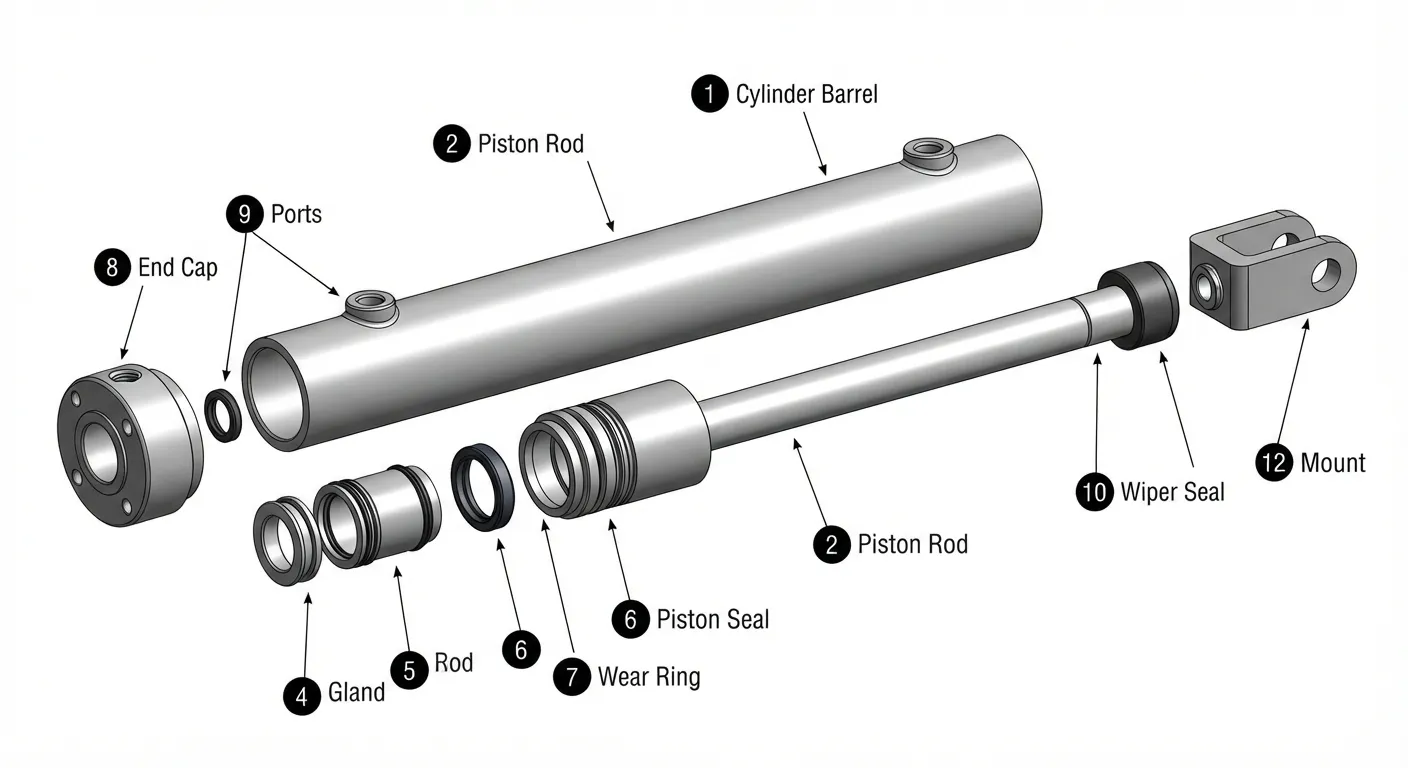
Visual Diagram: Hydraulic Cylinder Parts with Numbered Labels
Locate every component in one view. This numbered diagram corresponds directly to the table and detailed explanations below.
Identify Worn Parts Quickly: Symptoms, Causes & Actions
| Symptom | Possible Cause | Recommended Action |
|---|---|---|
| Oil leaking from rod end | Worn or cut rod seal | Replace rod seal; inspect rod surface for scratches |
| Cylinder drifts / load drops | Worn piston seal or scored barrel | Inspect piston seal and barrel bore; replace seals |
| Scratched or scored rod surface | Contamination ingress past wiper | Polish or re-chrome rod; replace wiper seal |
| End-of-stroke impact or hammering | Cushion spear/bushing wear | Inspect and replace cushion components |
| Jerky, uneven rod movement | Air in system or failing rod seal | Bleed system; check rod seal and fluid level |
| Rod moves slowly under load | Internal bypass across piston | Replace piston seal; check for barrel scoring |
| Gland area oil mist or dampness | Static gland seal or rod seal failure | Replace gland O-ring and rod seal; check bushing |
| Bent rod or uneven wear | Side load or misalignment | Replace rod; verify mounting alignment |
| Abnormal noise during operation | Wear ring failure or cavitation | Inspect wear rings; check fluid condition |
When Should You Replace Hydraulic Cylinder Parts? (And When to Repair)
-
Replace immediately: Bent piston rod, barrel scored deeper than 0.2 mm, cracked gland or end cap, stripped port threads beyond repair.
-
Repair/recondition: Rod with shallow scratches (<0.1 mm) can be ground and re-chromed. Barrel with light scoring can be honed to an oversize and fitted with oversized seals.
-
Preventive schedule: Seals and wear rings every 2,000–4,000 hours. Rod and piston rebuild typically at 10,000–15,000 hours in heavy-duty cycles.
Critical insight: If a seal failure is caused by a damaged rod or barrel surface, fitting new seals without reconditioning those surfaces will lead to another failure in a matter of weeks. Always inspect the mating hard parts.
Complete Hydraulic Cylinder Parts List & Detailed Explanation
| No. | Part | Function | Material | Replaceable |
|---|---|---|---|---|
| 1 | Cylinder Barrel | Pressure chamber | ST52 Seamless Steel | No (unless scored) |
| 2 | Piston Rod | Transmits linear force | Induction-hardened Chrome CK45 / 42CrMo | Yes |
| 3 | Piston | Divides barrel chambers | Ductile Iron / Steel | Yes |
| 4 | Gland | Rod support & seal housing | Ductile Iron with bronze bushing | Yes |
| 5 | Rod Seal | Prevents external leakage | PU (Polyurethane) | Yes (seal kit) |
| 6 | Piston Seal | Prevents internal bypass | PTFE / PU with energizer | Yes (seal kit) |
| 7 | Wear Ring | Guides piston & rod | Phenolic / PTFE composite | Yes |
| 8 | End Cap | Closes barrel base end | Steel, welded or threaded | No |
| 9 | Ports | Oil inlet/outlet | SAE O-ring boss / Flange | No |
| 10 | Cushion | Shock absorption | Machined steel sleeve/spear | Optional |
| 11 | Wiper Seal | Blocks contamination | NBR / PU | Yes (seal kit) |
| 12 | Mounts | Attachment points | Steel weldments / castings | Yes |
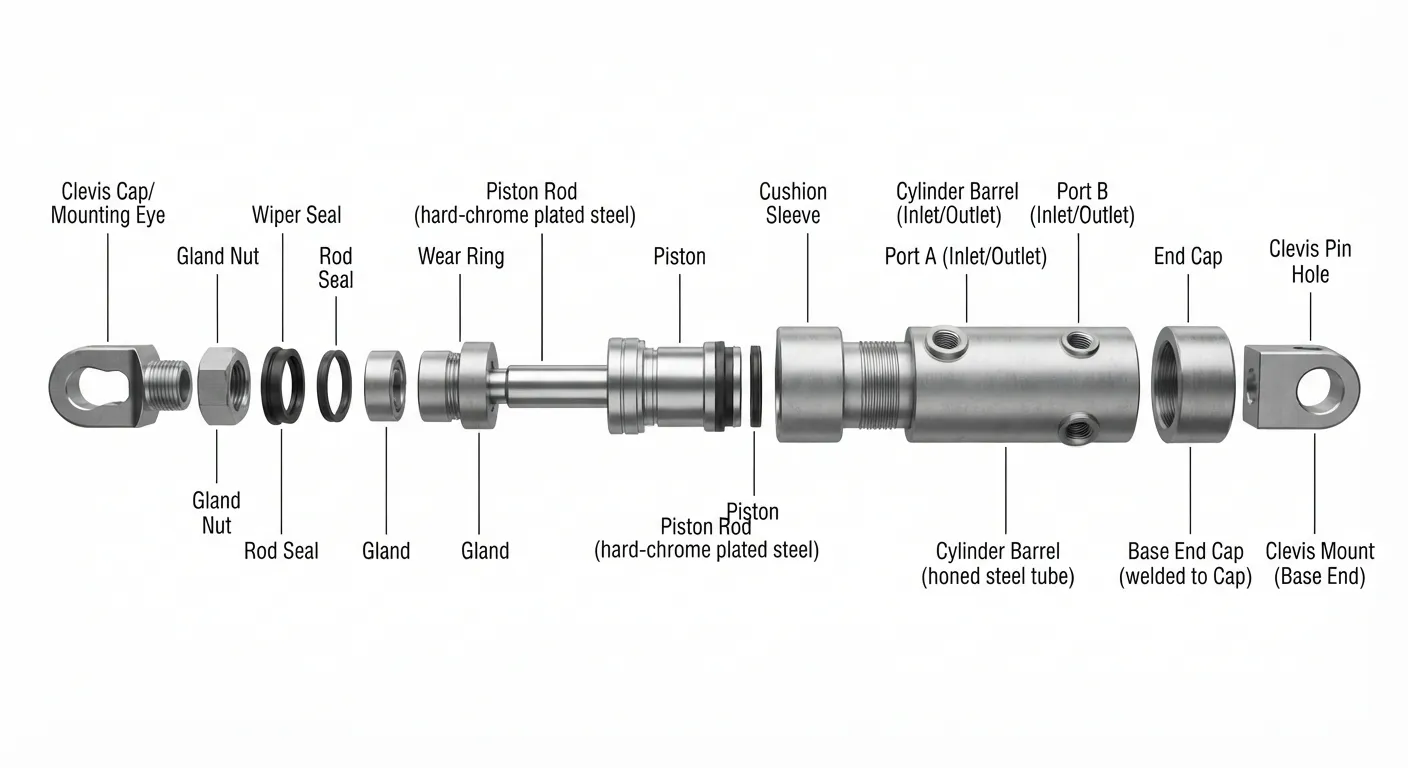
1. Cylinder Barrel
-
Function: Contains hydraulic pressure and provides a precision running surface for the piston.
-
Material: Honed ST52 seamless steel, finished to Ra 0.1–0.4 µm.
-
Common Failures: Internal scoring from contaminated oil, pitting corrosion, or bulging from overpressure.
-
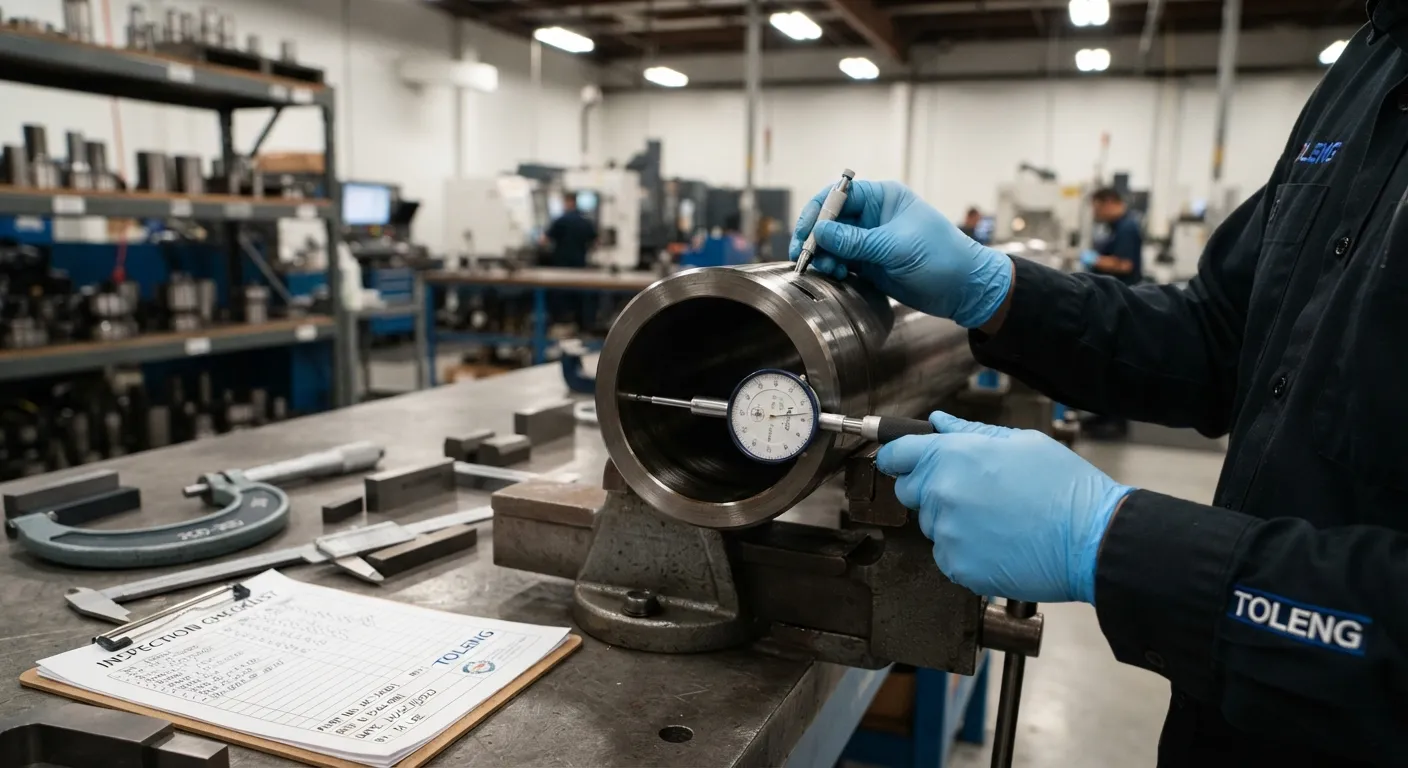
Inspection Tips: Measure bore ID with a dial gauge at three depths and two axes; ovality >0.05 mm or scoring >0.2 mm deep requires action.
-
Repair Option: Light scoring can be honed to the next oversize; bulging or deep scores require replacement.
-
Replacement Recommendation: If the barrel is bulged or deeply scored, replace it. Otherwise, honing and oversized seals are effective.
2. Piston Rod
-
Function: Transmits linear force and motion. Surface finish directly controls seal life.
-
Material: Induction-hardened CK45 with 20–50 µm hard chrome. Heavy-duty: 42CrMo. Corrosive environments: 304/316 stainless.
-
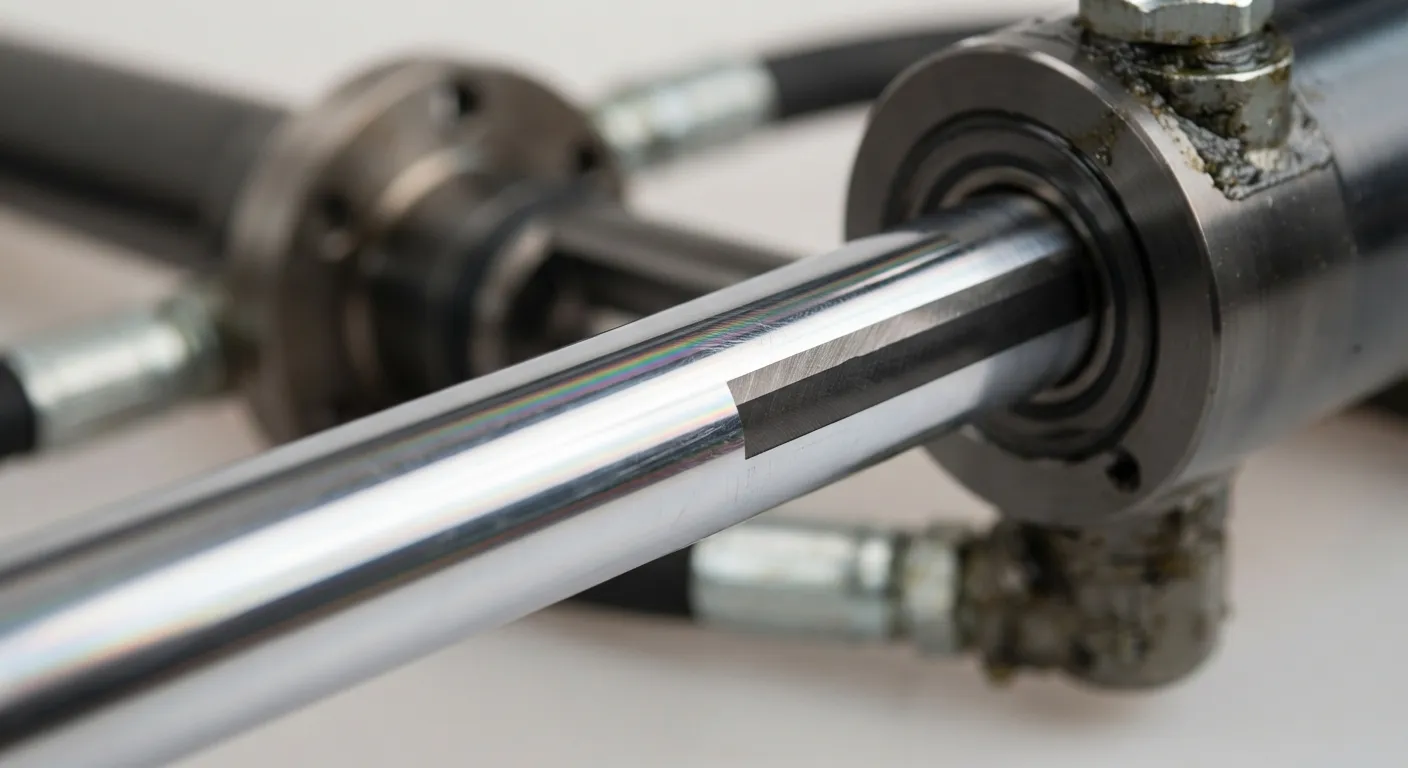
Common Failures: Scratches, chrome peeling, pitting, bending.
-
Inspection Tips: Check straightness (TIR <0.1 mm/m); use coating thickness gauge; inspect for any fingernail-catching defect.
-
Repair Option: Shallow scratches can be ground and re-chromed. Bent rods must be replaced.
-
Replacement Recommendation: A damaged chrome-plated rod will destroy new seals rapidly. Replace or recondition before fitting new seals.
3. Piston
-
Function: Threaded onto the rod, separates extend/retract chambers and carries seals and wear rings.
-
Material: Ductile iron or steel.
-
Common Failures: Worn O.D. causing bypass, seal groove deformation.
-
Inspection Tips: Check O.D. for scoring; verify groove side clearance (replace if >0.2 mm).
-
Repair Option: If grooves are intact, a new seal kit is sufficient.
-
Replacement Recommendation: Replace piston if rod connection threads are worn or O.D. is scored.
4. Gland
-
Function: Threads into barrel, guides rod via bushing, houses rod seal and wiper.
-
Material: Ductile iron with bronze/composite bushing.
-
Common Failures: Bushing wear, cracked threads, corroded seal cavities.
-
Inspection Tips: Rock rod by hand; play indicates excessive bushing clearance.
-
Repair Option: Replace bushing and seals first. If gland body is cracked, replace assembly.
-
Replacement Recommendation: Gland replacement is often more economical than machining a damaged body.
5. Rod Seal
-
Function: Prevents high-pressure oil from leaking externally along the rod.
-
Material: Polyurethane (PU) or PTFE-based step seals.
-
Common Failures: Wear, cuts from damaged rod, extrusion.
-
Inspection Tips: Look for external dampness or streaming oil. During teardown, check lip for hardening or nicks.
-
Repair Option: Seal replacement is always a repair action.
-
Replacement Recommendation: Always replace as part of a seal kit. Inspect rod surface carefully.
6. Piston Seal
-
Function: Seals between piston and barrel to prevent internal bypass.
-
Material: PTFE with energizer or PU U-cup.
-
Common Failures: Wear, extrusion, loss of elasticity causing drift.
-
Inspection Tips: Check for flat spots or permanent set. Perform bypass test if drift is reported.
-
Repair Option: Replace seal.
-
Replacement Recommendation: Always install new piston seal when cylinder is opened. Verify barrel bore.
7. Wear Ring
-
Function: Absorbs radial loads and prevents metal-to-metal contact.
-
Material: Phenolic resin fabric or PTFE composite.
-
Common Failures: Wear beyond minimum thickness, leading to scoring of piston or gland.
-
Inspection Tips: Measure residual thickness; replace if below kit manual minimum.
-
Repair Option: Replace wear rings with seal kit.
-
Replacement Recommendation: Worn rings quickly damage expensive hard parts; always replace proactively.
8. End Cap
-
Function: Closes base end of barrel, often serves as mount point.
-
Material: Steel, welded or threaded.
-
Common Failures: Weld cracks, deformed mounting eye.
-
Inspection Tips: Dye penetrant test on welds if suspect. Check pin bore elongation.
-
Repair Option: Weld repair by certified welders only, with post-weld heat treatment.
-
Replacement Recommendation: Replace cylinder or cap if structural cracks are present.
9. Ports
-
Function: Fluid inlet and outlet.
-
Material: Machined SAE O-ring boss or flange.
-
Common Failures: Stripped threads, cracked bosses.
-
Inspection Tips: Thread gauge inspection; visual for cracks.
-
Repair Option: Thread inserts can fix minor damage.
-
Replacement Recommendation: Cracked bosses require barrel or gland replacement.
10. Cushion
-
Function: Decelerates piston at stroke end to reduce shock.
-
Material: Machined steel spear and sleeve.
-
Common Failures: Worn spear/bushing, clogged orifice.
-
Inspection Tips: Cycle and listen for hammering; disassemble and check clearances.
-
Repair Option: Clean orifice and replace cushion components if worn.
-
Replacement Recommendation: Necessary when end-stroke impact persists after cleaning.
11. Wiper Seal
-
Function: Blocks external contaminants from entering cylinder.
-
Material: NBR or polyurethane.
-
Common Failures: Hardening, cracking, embedded debris.
-
Inspection Tips: Visual check for gaps or debris.
-
Repair Option: Replace wiper seal.
-
Replacement Recommendation: Always replace with every rod seal change.
12. Mounts
-
Function: Attach cylinder to equipment, transferring load.
-
Material: Structural steel weldments or castings.
-
Common Failures: Elongated pin bores, weld cracks.
-
Inspection Tips: Measure pin bore diameters; check alignment.
-
Repair Option: Re-bush pin bores or re-weld (certified process).
-
Replacement Recommendation: For critical safety applications, replace mount or entire cylinder.
Materials: What We Use & Why It Matters
| Component | Material | Why It Matters |
|---|---|---|
| Barrel | ST52 / 27SiMn | Excellent weldability and pressure containment |
| Rod (Standard) | CK45 + Chrome | Good balance of strength, cost, corrosion resistance |
| Rod (Heavy-Duty) | 42CrMo + Chrome | Higher fatigue strength for high-pressure cylinders |
| Stainless Rod | 304 / 316 | Superior corrosion resistance for marine/chemical environments |
| Piston | Ductile Iron / Steel | High compressive strength and wear resistance |
| Gland | Ductile Iron + Bronze | Toughness with excellent bushing-bearing properties |
| Dynamic Seals | PU / PTFE | Low friction, high extrusion resistance |
| Wear Ring | Phenolic / PTFE | High load capacity, prevents metal contact |
| Mounts | Structural Steel | Reliable load transfer |
Manufacturing & Quality Control Timeline
-
Raw Material Inspection – Chemistry & ultrasonic testing
-
CNC Turning – Precision machining of barrels, pistons, glands
-
CMM Measurement – In-process dimensional verification
-
Deep Hole Boring & Honing – Surface finish Ra 0.1–0.4 µm
-
Induction Hardening & Chrome Plating – Rod surface integrity
-
Chrome Thickness Test – Eddy current or microscopic measurement
-
Heat Treatment – Quenching/tempering for critical parts
-
Precision Grinding – Final tolerances (IT7)
-
Surface Roughness Inspection – Confirming seal running surface
-
Clean-Room Assembly – Contamination-free seal fitting
-
100% Hydrostatic Pressure Test – 1.5× rated working pressure
-
Final Inspection & Packaging – Documentation and safe shipping
OEM Parts vs. Aftermarket: Comparison for Smart Procurement
| Criteria | Toleng OEM Parts | Generic Aftermarket | Best Use |
|---|---|---|---|
| Dimensional Fit | Exact CAD/CAM match | May require modification | Critical, safety-related equipment |
| Material Certification | Traceable mill test reports | Often unknown | High-pressure, high-cycle applications |
| Seal Quality | Premium PU/PTFE | Varies widely | Severe duty, wide temperature range |
| Engineering Support | Full application review | Limited or none | OEM replacement, custom projects |
| Service Life | Designed to original spec | May require more frequent replacement under demanding conditions | Long-term cost reduction |
Choosing OEM quality helps prevent cascade damage: a damaged rod caused by a failed seal can cost many times more than the seal itself.
How to Choose Hydraulic Cylinder Parts – Step-by-Step Guide
Step 1: Identify Bore Size – Measure barrel ID with a dial bore gauge.
Step 2: Measure Rod Diameter – Use a micrometer; determines seal kits and load capacity.
Step 3: Determine Stroke Length – Fully retracted to fully extended.
Step 4: Identify Mount Type – Clevis, cross-tube, trunnion, flange. Measure pin diameter and width.
Step 5: Confirm Operating Pressure & Duty Cycle – Dictates material and seal profile.
Step 6: Select Material & Seal Type – Based on environment: indoors, outdoors, marine, temperature extremes.
Can’t Identify Your Hydraulic Cylinder Parts?
Send us a photo, nameplate, drawing, sample, or key dimensions. Our engineering team will recommend a compatible OEM replacement within 24 hours.
Request Identification & Quote
Common Failures & How to Fix Them
| Problem | Cause | Solution |
|---|---|---|
| Rod scratches / scoring | Dirt ingress past worn wiper | Polish/re-chrome rod; replace wiper seal |
| External oil leakage | Cut or worn rod seal | Replace rod seal; inspect rod surface |
| Bent piston rod | Side load, overload, impact | Replace rod; check alignment |
| Cylinder drifts / load drops | Worn piston seal or scored barrel | Replace piston seal; hone barrel if needed |
| Jerky operation | Air in system / failing rod seal | Bleed, check fluid, replace rod seal |
| Internal barrel scoring | Contaminated fluid | Hone or replace barrel; flush system |
| Gland bushing failure | Excess side load | Replace gland assembly; add wear rings |
| Cushion not damping | Worn cushion parts or clogged orifice | Replace cushion components; clean system |
Inspection Guide & Recommended Frequency
Daily:
-
Visual check for external leaks, rod condition, mount tightness
Weekly:
-
Rod surface scan for scratches, chrome peeling, or pitting
-
Wiper seal integrity
Monthly:
-
Mount bolt torque check
-
Port tightness and crack inspection
During Rebuild / Every 2,000–4,000 hours:
-
Dial bore gauge measurement of barrel
-
Rod straightness (TIR <0.1 mm/m)
-
Piston and gland groove dimensional check
-
Wear ring thickness measurement
After Repair:
-
Hydrostatic pressure test at 1.5× rated pressure
-
Drift and cycle test under load
Replacement Strategy: Get Maximum Life at Minimum Cost
| Component | Repair Option | Replace When |
|---|---|---|
| Seal Kit | Always replace | Every teardown or 2,000–4,000 hours |
| Rod | Re-chrome / grind | Deep pits, bend >0.2 mm/m, chrome worn through |
| Barrel | Hone to oversize | Scoring >0.2 mm deep, or bulging |
| Gland | Replace bushing & seals | Cracked body, damaged seal grooves |
| Piston | Replace seals & rings | Groove dimensions out of tolerance |
Real-World Example: Extending Dump Truck Cylinder Seal Life
A fleet operator running articulated dump trucks was experiencing frequent rod seal failures, leading to repeated downtime. Toleng engineers inspected a failed cylinder and found fine linear scratches on the chrome rod caused by contamination ingress past a hardened wiper seal. The damaged rod surface was destroying new seals within weeks.
Our solution: Re-chromed and ground the rod, upgraded the wiper seal to a premium polyurethane profile, and recommended improving hydraulic system filtration. The seal kit was also enhanced with a PTFE backup ring.
The result: Cylinder service intervals were significantly extended, and unplanned maintenance costs were substantially reduced. (Results based on internal application data; customer identity withheld.)
Video: See Our Manufacturing & Testing
-
Hydraulic Cylinder Assembly Process – Clean-room practices and seal fitting.
-
CNC Machining in Action – Turning a piston rod from 42CrMo bar.
-
Hydrostatic Pressure Testing – Verifying zero leakage at 1.5× working pressure.
-
How to Replace Hydraulic Cylinder Seals – Step-by-step field guide.
Why Choose Toleng as Your OEM Hydraulic Cylinder Parts Manufacturer
✔ Precision CNC Machining Centers
✔ 100% Hydrostatic Pressure Testing
✔ Material Traceability (mill certs on request)
✔ OEM & Custom Engineering, including reverse engineering
✔ ISO 9001:2015 Certified
✔ Flexible Production – low MOQ for prototypes
✔ Export Experience across multiple industries
✔ Full Engineering Support
Industry Applications
Agriculture – Loaders, harvesters, sprayers
Dump Trucks & Trailers – Hoist and ejector cylinders
Construction – Excavator, dozer, backhoe cylinders
Forestry – Log splitters, delimbers, feller bunchers
Marine & Offshore – Hatch covers, cranes, stabilizers
Waste & Refuse – Compactor and ejector cylinders
Snow & Ice Control – Plow lift, angle, wing cylinders
Industrial Machinery – Presses, injection molding, material handling
Related Resources
Products
Technical Guides
Articles & Case Studies
-
Chrome Rod vs. Stainless Rod for Marine Use
-
Reducing Hydraulic System Contamination
Frequently Asked Questions
Q: What are the main parts of a hydraulic cylinder?
A: Barrel, piston rod, piston, gland, end cap, ports, seals (rod, piston, wiper), wear rings, cushion (optional), and mounts.
Q: Which part wears out first?
A: Dynamic seals and wear rings. The rod seal and wiper seal typically need replacement every 2,000–4,000 hours.
Q: Can I replace just the seals?
A: Yes, if the hard parts are within specification. Always inspect mating surfaces first.
Q: How long do chrome-plated rods last?
A: In clean, well-filtered systems, over 15,000 hours. In dirty environments, failure occurs much sooner.
Q: What causes a hydraulic cylinder to drift?
A: Internal leakage past the piston seal, or a scored barrel.
Q: Can OEM parts fit non-OEM cylinders?
A: If dimensions match, we manufacture direct replacements. We often reverse-engineer from a sample.
Q: How do I identify the correct seal kit?
A: Measure rod diameter, bore, and groove widths, or send us the old seals or cylinder model.
Q: How does contamination damage cylinders?
A: Particles embed in seals, score rods and barrels, and cause leakage. Good filtration is key.
Q: Do you support OEM and ODM projects?
A: Yes. We manufacture to your specifications and can engineer custom solutions.
Q: Can you manufacture from drawings or samples?
A: Absolutely. Provide a drawing, sample, or key dimensions, and we will produce a matching OEM component.
Q: What information is required for a quotation?
A: Bore, rod diameter, stroke, mount type, working pressure, and material/coating preferences.
Q: What is your minimum order quantity (MOQ)?
A: We offer flexible MOQ, supporting both prototype orders and mass production. Contact us with your requirement.
Q: Can you provide private labeling or laser engrave our logo?
A: Yes. We support custom branding and permanent laser marking on components.
Q: Can you supply PPAP (Production Part Approval Process) documentation?
A: Yes, PPAP Level 3 documentation is available for production orders. Please specify during inquiry.
Q: Do you provide material certificates and inspection reports?
A: Mill certificates, dimensional reports, pressure test records, and FAI (First Article Inspection) reports are available on request.
Q: Do you offer annual supply contracts?
A: Yes. We work with OEMs and distributors on long-term agreements with scheduled deliveries and fixed pricing.
Q: What certifications do your products comply with?
A: Our factory is ISO 9001:2015 certified. Products meet international standards for hydraulic safety and pressure vessels.
Ready to Source Reliable Hydraulic Cylinder Parts?
Whether you need standard replacement parts or fully customized OEM hydraulic cylinder components, Toleng’s engineering team is ready to help.
✔ Fast quotation with drawing review
✔ Expert material recommendation
✔ Global shipping and logistics support

