
Cylinder drift—the slow, uncontrolled movement of a raised load—is one of the most common and frustrating hydraulic failures. This step-by-step guide shows you how to quickly test for internal bypass, isolate the root cause, and decide whether to repair or replace your hydraulic cylinder components.
✔ Step-by-Step Drift Diagnosis
✔ Piston Seal Bypass Test Procedure
✔ Barrel & Valve Isolation Checks
✔ Repair vs. Replace Decision Guide
✔ OEM Seal Kits & Cylinder Repair Solutions
Quick Answer
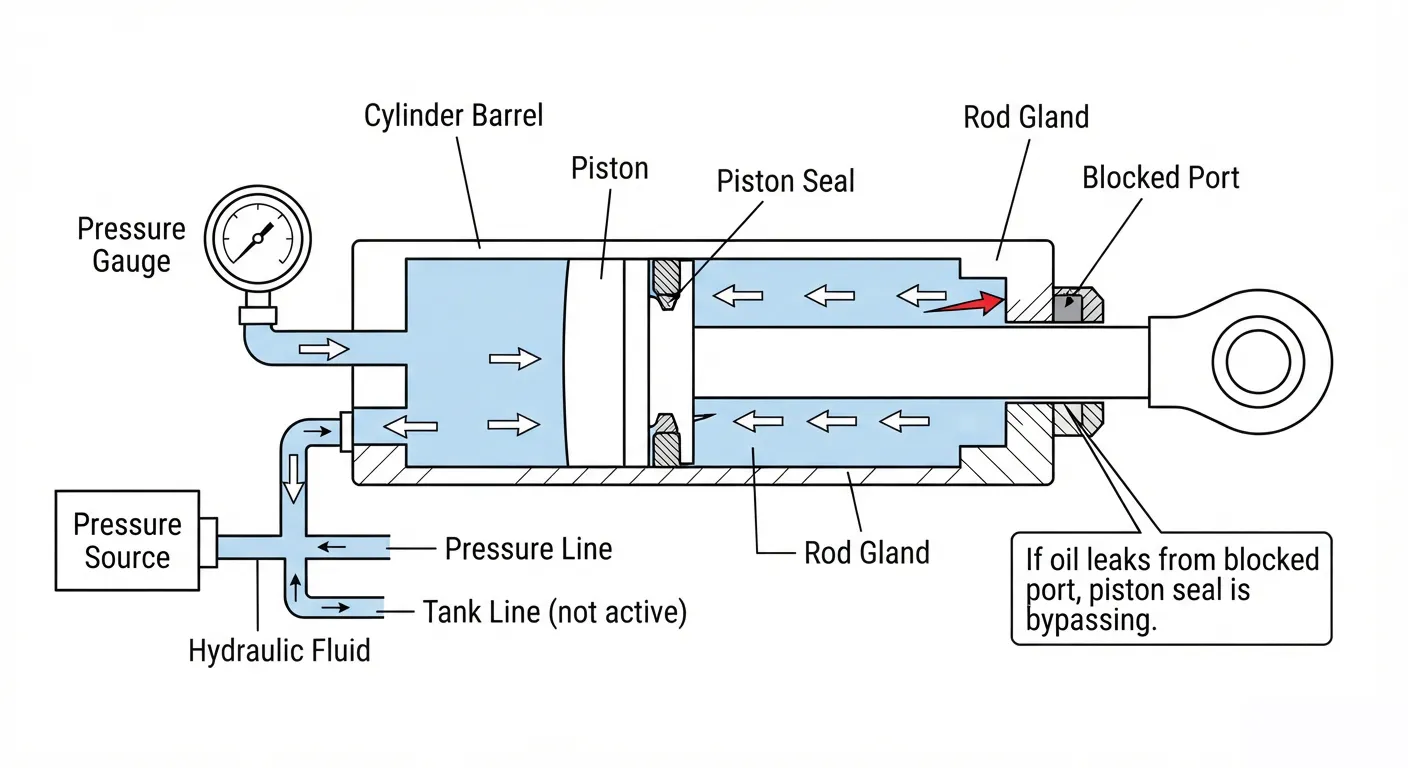
Hydraulic cylinder drift typically occurs when the piston seal fails to hold pressure, allowing oil to bypass internally. Less commonly, a leaking control valve or a scored barrel can also cause load sinking. The most reliable field test is the “blocked-cylinder” or bypass test: isolate the cylinder, apply pressure, and check for rod movement. If the rod moves with the ports sealed, the piston seal is leaking and must be replaced. If the cylinder holds, the fault lies upstream in the valve or hydraulic circuit.
Key Takeaways
-
80% of uncommanded cylinder drift is caused by a worn or damaged piston seal.
-
A simple bypass test can confirm a piston seal leak in minutes without disassembly.
-
Never install a new piston seal on a scored barrel; the new seal will fail rapidly.
-
Always check for external leaks at the rod seal and fittings before internal diagnostics.
-
If the cylinder holds under blocked pressure, the problem is in the directional control valve, load-holding valve, or cylinder circuit.
Who Should Read This Guide?
✔ Hydraulic repair technicians diagnosing “sinking” booms or implements
✔ Fleet maintenance managers tracking unplanned downtime
✔ Equipment owners evaluating whether to repair or replace a cylinder
✔ Engineers specifying load-holding requirements for new designs
✔ Anyone who has seen a raised loader bucket slowly drop overnight
What Is Hydraulic Cylinder Drift?
Cylinder drift is the unintended movement of a hydraulic cylinder rod under load when no operator command is given. You may notice:
-
A raised excavator boom that slowly lowers itself.
-
A dump truck bed that sinks while the driver is waiting.
-
A press platen that creeps downward during a cycle.
-
A forklift mast that tilts forward under load without input.
Drift is not just an inconvenience—it is a safety hazard, a productivity killer, and a sign that critical sealing components are wearing out. In load-holding applications, excessive drift can lead to dropped loads and catastrophic accidents.
Drift is almost always a symptom of internal oil bypass. The high-pressure oil in one chamber leaks past the piston seal into the low-pressure chamber, allowing the rod to move. Much less frequently, it may be caused by an external leak at the rod seal or a faulty control valve.
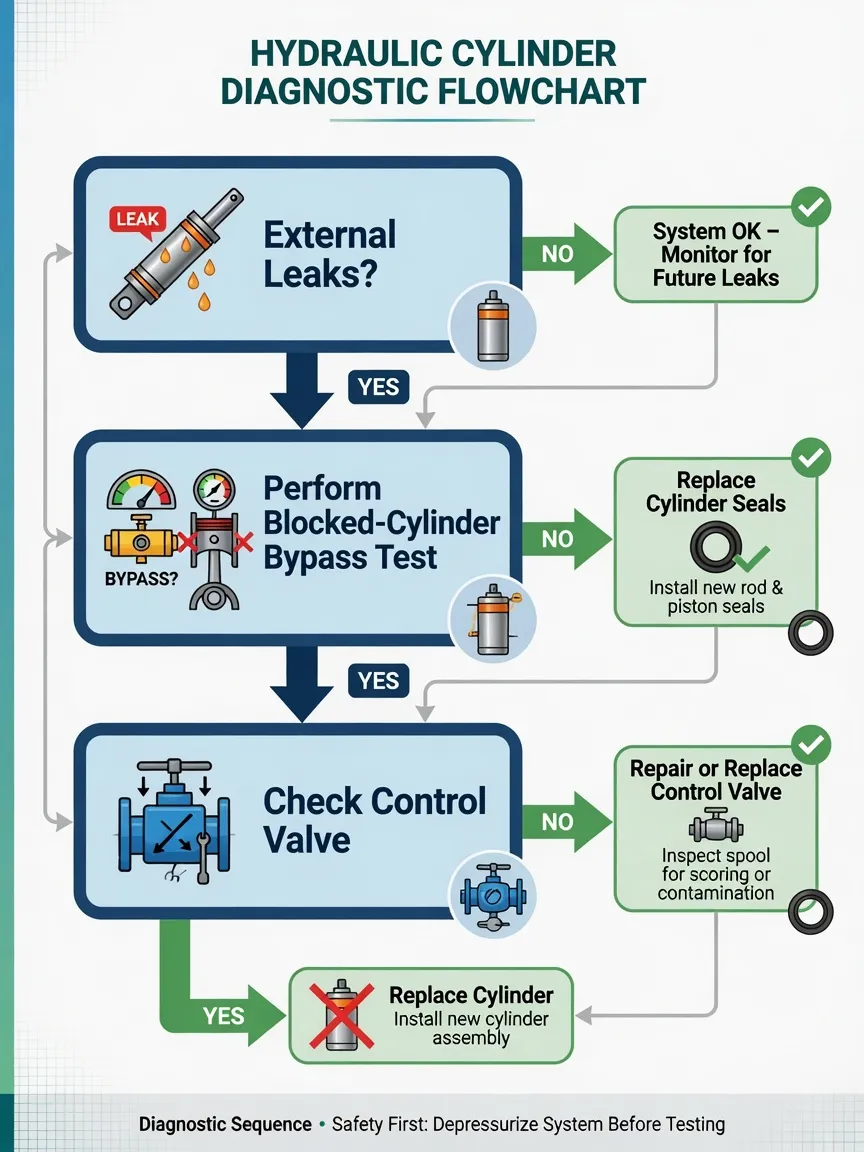
Drift Diagnostic Flowchart
Follow this decision path to isolate the root cause quickly.
Step 1: External Visual Check
↓
Any oil leaking from rod or fittings? → Yes: Repair external leak (rod seal, fittings, gland O-ring). Check rod surface for damage.
↓ No
Step 2: Blocked-Cylinder Bypass Test
↓
Does the rod move with cylinder ports blocked? → Yes: Piston seal is leaking internally. Go to Step 4.
↓ No
Step 3: Check Control Valve & Circuit
↓
Suspect directional valve spool leakage, load-holding valve failure, or hose/cylinder thermal expansion. Test valves separately.
↓
Step 4: Piston Seal Leak Confirmed
↓
Disassemble cylinder. Inspect piston seal, barrel bore, and piston. Replace seals and repair hard parts as needed.
Step 1: External Visual Inspection
Before performing any internal test, eliminate the obvious: external leaks.
-
Rod seal area: Check for any visible oil, dampness, or dust accumulation forming a wet ring on the rod. Even a slow rod seal leak can cause drift over time as the total fluid volume decreases.
-
Gland-to-barrel joint: Look for oil seepage indicating a failed static O-ring.
-
Hose fittings and port connections: Ensure all connections are tight and dry.
-
Welds and barrel: Inspect for hairline cracks that could leak under pressure.
If you find an external leak, repair it first. Replace the rod seal or gland O-ring, and carefully check the rod surface for scratches. Only after all external leaks are eliminated should you proceed to internal diagnostics.
Step 2: The Blocked-Cylinder Bypass Test (Most Important)
This test directly isolates the cylinder from the rest of the hydraulic system to confirm or rule out internal piston seal bypass.
Procedure:
-
Raise the load or fully extend the cylinder. Use a safety stand or mechanical lock to support the load before starting work. Never rely on hydraulics alone.
-
Stop the engine and relieve all system pressure according to the machine manufacturer’s instructions.
-
Disconnect the hose from the cylinder’s rod-end port (the port on the side that would extend the rod). Immediately plug or cap the cylinder port and the hose end. Use steel JIC/SAE plugs with O-rings—never rely on a rag or your thumb, as residual pressure can cause serious injury.
-
Reconnect any other hoses and restart the machine, or use an auxiliary power unit, to apply pressure to the piston-side port only. The rod end is now blocked and cannot receive fluid.
-
Watch the rod and the plugged port.
-
If the rod extends or retracts, or oil flows out of the blocked rod-end port, the piston seal is bypassing. The high-pressure oil is leaking past the piston into the rod-end chamber and trying to escape through your plug.
-
If the rod stays absolutely stationary and no oil escapes, the piston seal is holding. The drift problem is not in the cylinder.
-
Safety Warning: This test involves working with potentially trapped high-pressure oil. Only personnel trained in hydraulic safety should perform it. Use appropriate PPE, rated plugs, and mechanical load supports at all times.
Interpreting the Results
-
Bypass confirmed: Proceed to Step 4 (Internal Inspection and Seal Replacement).
-
No bypass: The cylinder is mechanically sound. Your drift is caused by the directional control valve spool leaking internally, a failed counterbalance/load-holding valve, or thermal contraction of oil. Test the valve by blocking it in a similar manner or by using a flow meter.
Step 3: Investigating Valve & Circuit Drift
If the cylinder passed the bypass test, focus your attention on the control system.
-
Directional control valve: Spool leakage in the neutral position is a common cause of drift. Even new valves have a specified leakage rate; as they wear, this leakage increases. Swap the valve with a known good one, or test the cylinder on a different valve section, to confirm.
-
Load-holding valves (counterbalance, pilot-operated check valves): These are designed to prevent drift. A damaged seat, weak spring, or contamination trapped in the valve will cause load sinking. Remove, clean, and inspect these valves. Replace if any seat damage is visible.
-
Thermal contraction: Oil cools and contracts, especially after a hot operational cycle. This can cause a slight rod retraction that is not a mechanical fault. If the drift occurs only after the machine cools down, thermal effects may be the cause. Measure the drift rate when oil temperature is stable.
-
Hose expansion: Under high pressure, hoses can expand slightly and then contract when the pump stops, causing minimal movement. This is normal and usually not a safety concern.
Once the valve or circuit issue is identified, repair or replace the faulty component and re-test.
Step 4: Internal Inspection & Seal Replacement
When the bypass test confirms a piston seal failure, disassemble the cylinder carefully.
-
Remove the cylinder from the machine and secure it in a clean work area.
-
Disassemble the gland and rod assembly. Note the orientation of all seals.
-
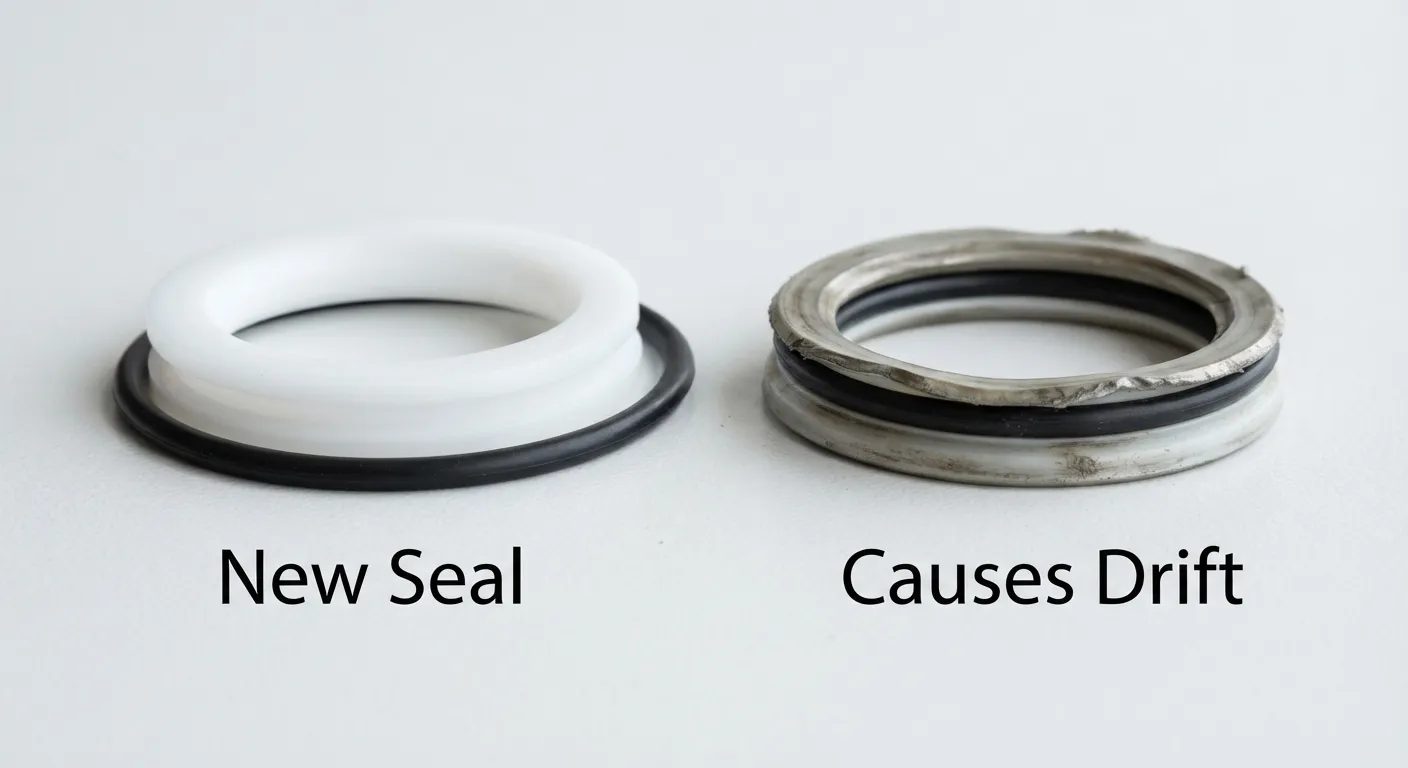
Inspect the piston seal. Look for:
-
Flattened or worn sealing lips
-
Cuts, nicks, or extrusion
-
Hardening or loss of elasticity
-
Embedded debris
-
-
Inspect the piston grooves. Any side wear beyond 0.2 mm indicates that the piston body needs replacement, not just the seal.
-
Inspect the barrel bore. This is critical. A scored barrel will destroy a new piston seal in a matter of hours. Use a bore gauge to measure for scoring, ovality, or a wear step. If scoring is deeper than 0.2 mm, the barrel must be honed to an oversize, and an oversized piston seal and wear ring must be fitted. If the barrel is bulged or deeply scored, the entire cylinder may need replacement.
-
Inspect the rod and rod seal surfaces. While the cylinder is open, this is the perfect time to check the rod for scratches and the gland bushing for wear. Replace any worn components.
Repair or Replace?
-
If only the piston seal is worn and the barrel is in good condition: replace the complete seal kit and reassemble.
-
If the barrel is scored: hone the barrel and fit an oversized seal kit. Toleng supplies precision-oversized seal kits for commonly re-honed bores.
-
If the barrel is badly damaged or the rod is bent: a complete new cylinder or a full overhaul with a new barrel may be more economical long-term. Contact our team for an evaluation.
Common Causes of Drift & Their Solutions
| Symptom | Most Likely Cause | Solution |
|---|---|---|
| Load sinks, bypass test confirms leak | Worn piston seal | Replace piston seal; inspect and hone barrel if scored |
| Drift + external oil on rod | Rod seal leak | Replace rod seal; check rod surface |
| Drift, but cylinder holds under blocked test | Valve spool leakage | Repair or replace directional control valve |
| Load drops rapidly when spool is in neutral | Failed load-holding valve | Clean or replace counterbalance valve |
| Drift only after machine cools down | Thermal contraction of oil | Normal; verify drift rate within specification |
| Drift + jerky movement | Worn wear rings causing piston misalignment | Replace wear rings along with seal kit |
Preventing Drift: Maintenance Best Practices
-
Replace hydraulic filters at recommended intervals. Contaminated oil is the #1 cause of seal and barrel wear.
-
Use OEM-quality seals. Cheap aftermarket seals made from inferior materials lose elasticity and extrude under pressure much faster. See our OEM vs. Aftermarket Seal comparison.
-
Conduct regular bypass tests on critical cylinders during scheduled downtime. Catching a worn piston seal early prevents barrel scoring.
-
Maintain correct hydraulic oil viscosity and cleanliness. Oil that is too thin at operating temperature can increase internal leakage.
Real-World Example: Diagnosing Forklift Mast Drift
A warehouse fleet manager reported that several electric forklifts were experiencing mast tilt-forward drift while carrying loads at height—a serious safety concern. Initial suspicion fell on the tilt cylinders.
Diagnostic process: Toleng’s engineering support team guided the on-site technician through the blocked-cylinder bypass test on one forklift. The cylinder held pressure with the port blocked, ruling out the piston seal. Attention shifted to the directional control valve. A valve spool leak test confirmed excessive leakage past the spool lands due to wear.
Solution: The valve was rebuilt, and the drift immediately stopped. The cylinders, which had been flagged for potential replacement, were in perfect condition and required no work. This diagnostic step saved the fleet thousands in unnecessary cylinder rebuild costs.
(Case details based on Toleng application support records; customer identity withheld.)
Frequently Asked Questions
Q: What is the most common cause of hydraulic cylinder drift?
A: Internal leakage past the piston seal accounts for approximately 80% of cylinder drift cases. A blocked-cylinder bypass test can confirm this quickly.
Q: Can a cylinder drift without any visible external leak?
A: Yes. Piston seal bypass is an internal leak and shows no external signs until the cylinder is disassembled.
Q: How do I test if my piston seal is bad without disassembling the cylinder?
A: Perform the blocked-cylinder bypass test described above. If the rod moves with one port blocked, the piston seal is leaking.
Q: Can a worn barrel cause drift even with a new piston seal?
A: Absolutely. A scored or oval barrel will allow fluid to bypass the seal immediately. Always inspect the bore and repair as necessary before installing new seals.
Q: Is it safe to use a machine with a drifting cylinder?
A: No. Drift indicates a loss of load-holding capability. It is a safety hazard and should be diagnosed and repaired immediately.
Q: Does Toleng supply oversized seal kits for honed barrels?
A: Yes. We manufacture precision-oversized seal kits to match commonly re-honed barrel diameters, allowing you to repair rather than replace a barrel with minor scoring.
Q: Can you help me diagnose a drift problem remotely?
A: Yes. Send us a description of the symptom, the machine model, and cylinder specifications, and our engineering team will guide you through the appropriate diagnostic steps.
Stop Cylinder Drift with the Right Parts & Support
Whether you need a seal kit for an emergency repair, a custom oversized kit for a honed barrel, or engineering support to diagnose a recurring problem, Toleng’s team is ready to help.
✔ Same-day seal kit availability for common sizes
✔ Custom oversized kits for re-honed bores
✔ Remote troubleshooting assistance
Request Your Repair Quote Today

