
Compare hard chrome-plated steel rods and 316/304 stainless steel rods for marine hydraulic cylinders. Understand pitting, crevice corrosion, mechanical strength, seal compatibility, and total cost of ownership to make the right specification for ship deck equipment, offshore cranes, and coastal machinery.
✔ Chrome vs. Stainless Corrosion Mechanism Breakdown
✔ Strength, Hardness & Fatigue Life Comparison
✔ Seal Compatibility & Life in Saltwater Environments
✔ Application-Specific Selection Criteria
✔ OEM Marine Cylinder Rod Manufacturing
Quick Answer
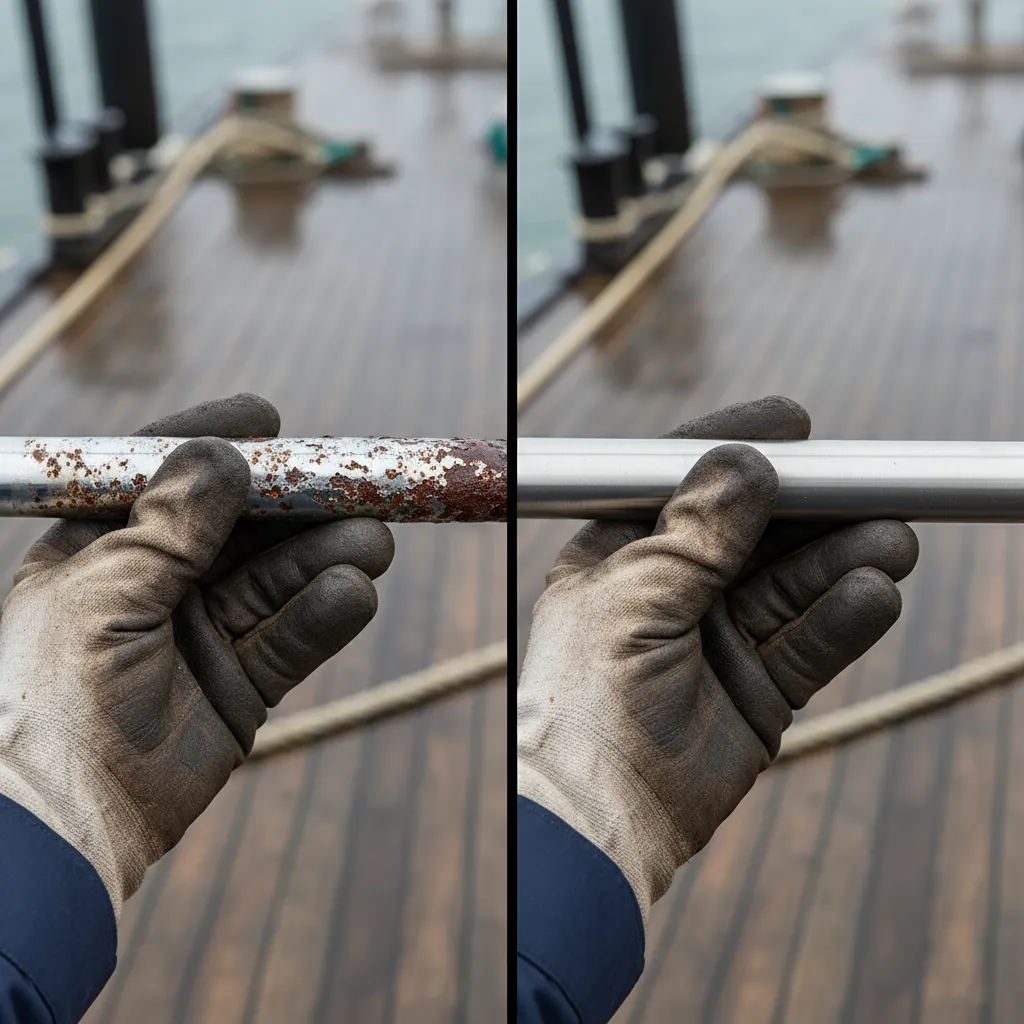
For most marine hydraulic cylinders exposed to salt spray, 316 stainless steel rods offer the best combination of corrosion resistance and acceptable mechanical properties, eliminating the risk of chrome peeling and rust bleed that plague chrome-plated carbon steel rods. However, in high-cycle, heavy-load applications such as active heave compensation systems or large offshore crane luffing cylinders, induction-hardened 42CrMo steel with a specialized nickel-chrome (NiCr) coating or ultra-thick hard chrome (≥ 80 µm) may provide superior fatigue strength and wear life if combined with rigorous freshwater washdowns and preventive maintenance. For submerged or continuously wet parts, 316 with high-hardness surface treatment (such as Kolsterising or HVOF) is typically the safest choice.
Key Takeaways
-
The dominant failure mode of chrome rods in marine environments is pitting corrosion starting at microscopic chrome porosity or scratches, not mechanical wear.
-
316 stainless steel rods will not rust or pit in salt spray, but they have lower surface hardness than hardened chrome-plated steel, which can reduce seal life in high-cycle applications.
-
A single deep rust pit on a chrome rod can destroy a rod seal in a matter of hours; a pitted rod usually requires replacement or re-chroming.
-
Proper material selection must balance corrosion resistance, mechanical strength, wear resistance, seal compatibility, and total maintenance cost.
-
Toleng manufactures both high-integrity chrome-plated rods and 304/316 stainless steel rods for OEMs worldwide.
Who Should Read This Guide?
✔ Marine hydraulic system designers and naval architects
✔ Shipyard and port equipment maintenance managers
✔ Offshore platform equipment engineers
✔ OEMs of deck machinery, cranes, winches, and hatch cover systems
✔ Any engineer experiencing premature rod corrosion in coastal or saltwater environments
Understanding the Marine Environment Challenge
Hydraulic cylinders on vessels, docks, and offshore platforms face one of the most aggressive corrosion environments on earth. The combination of saltwater spray, high humidity, temperature cycling, and often direct seawater immersion creates severe conditions that standard industrial chrome-plated rods were never designed to withstand.
The primary corrosion mechanism is chloride-induced pitting. Seawater contains approximately 19,000 ppm of chloride ions. When salt spray deposits on a rod surface and the cylinder retracts, the wiper seal can push salty moisture into microscopic pores or scratches in the chrome layer, where it attacks the base carbon steel. Once a pit forms, it grows rapidly, causing:
-
Seal damage: A sharp-edged pit cuts the rod seal lip almost immediately.
-
Further corrosion: The pit creates a crevice that traps moisture, accelerating the attack.
-
Chrome peeling: Undercutting corrosion lifts the chrome layer, creating razor-sharp edges.
Understanding this mechanism is essential for choosing between a chrome-plated rod—which relies on a continuous, impermeable coating—and a solid stainless rod, which resists corrosion throughout its entire cross-section.
Option 1: Hard Chrome-Plated Steel Rods (CK45 or 42CrMo)
Construction
-
Base material: CK45 carbon steel or 42CrMo (4140) alloy steel, induction-hardened to HRC 55–60 surface hardness.
-
Coating: Electrolytically deposited hard chrome, typically 20–50 µm thick (up to 100 µm for heavy-duty), polished to Ra ≤ 0.2 µm.
Advantages
-
Excellent mechanical strength and fatigue resistance: 42CrMo rods can handle high tensile and cyclic bending loads far better than standard 300-series stainless steels.
-
Superior surface hardness: Hard chrome typically exceeds HV 850, providing outstanding wear resistance against polyurethane and PTFE seals. This translates to longer seal life in high-cycle applications.
-
High tolerance to side loads and impacts: The hardened case resists dents and scratches from external mechanical contact better than softer stainless steel.
-
Lower material cost than stainless steel: For non-marine or freshwater applications, chrome-plated CK45 is the most economical high-performance rod material.
-
Repairable: Scratched chrome can be ground and re-plated.
Disadvantages in Marine Use
-
Vulnerable to pitting corrosion: Chrome is not perfectly impermeable. Microscopic pores, cracks, or mechanical scratches expose the base steel. Once a pit starts, it’s difficult to stop.
-
Chrome peeling risk: Chloride undercutting at the pit edge causes the chrome layer to detach, creating a sharp edge that rapidly destroys seals.
-
High maintenance requirement: Marine chrome rods must be rinsed with fresh water frequently—ideally after every use. The wiper seal must be in perfect condition to prevent salt ingress. Any scratch must be addressed immediately.
When Chrome Can Work in Marine Settings
Chrome-plated rods are still used successfully in marine applications where:
-
The cylinder is in a protected location (e.g., inside a machinery space) with limited direct salt spray.
-
The rod is protected by a bellows or continuous wiper system and is washed down daily with fresh water.
-
An upgraded coating, such as nickel-chrome (NiCr) duplex plating, is used. The nickel underlayer provides a sacrificial barrier that significantly improves corrosion resistance compared to direct chrome-on-steel.
-
A thick chrome layer (≥ 80 µm) combined with rigorous maintenance extends life to acceptable intervals, especially on large, expensive cylinders where stainless is cost-prohibitive.

Option 2: Stainless Steel Rods (304 & 316)
Construction
-
304 Stainless Steel: Austenitic stainless, ~18% chromium, 8% nickel. Good general corrosion resistance. Not recommended for continuous chloride exposure due to susceptibility to pitting and crevice corrosion.
-
316 Stainless Steel: Contains 2–3% molybdenum, dramatically increasing resistance to pitting by chlorides. The preferred material for marine hydraulic rods.
Advantages
-
Inherent corrosion resistance throughout the entire cross-section: Even if the surface is scratched, the exposed metal will not rust (it will passivate). No chrome to peel.
-
Zero chrome porosity problems: There’s no coating to fail. The material is homogeneous.
-
Dramatically lower maintenance: Stainless rods survive extended periods without freshwater washdown and tolerate wiper seal imperfections that would destroy a chrome rod.
-
Long-term reliability in wet, salty conditions: Ideal for exposed deck equipment, splash zones, and intermittently submerged applications.
Disadvantages
-
Lower surface hardness: Typical annealed 316 has a Rockwell B hardness of ~79 (roughly equivalent to HV 155), far softer than induction-hardened chrome (HV 850+). This results in a higher rate of abrasive wear and, critically, a higher risk of scoring if hard particles (sand, metal) contaminate the wiper seal area.
-
Lower yield strength: 316 has a yield strength around 205 MPa, versus 500–700 MPa for hardened CK45 and 900+ MPa for 42CrMo. A 316 rod must have a larger diameter to handle the same load, increasing cylinder size and cost.
-
Galling risk: Stainless steel sliding against a stainless gland bushing can gall (cold weld) under high load and slow speed, causing catastrophic seizure. This must be mitigated by using a dissimilar bushing material (bronze, composite) and proper lubrication.
-
Higher material cost: 316 stainless bar stock is significantly more expensive than CK45 or 42CrMo.
Surface Hardening for Stainless
To address the hardness limitation, specialized treatments are available:
-
Kolsterising® (Hardiff): A low-temperature diffusion process that hardens the surface of austenitic stainless steels to HV 1000–1200 without reducing corrosion resistance. Ideal for high-performance marine rods.
-
HVOF (High Velocity Oxygen Fuel) Coatings: Thermal-sprayed tungsten carbide or chromium carbide coatings can be applied over 316 to create an extremely hard, wear-resistant surface while the substrate remains corrosion-proof.
-
Nitriding: Not recommended for 304/316, as it forms chromium nitrides that reduce corrosion resistance significantly.
Toleng can manufacture rods from 316 stainless and arrange specialized surface hardening according to your performance requirements.
Head-to-Head Comparison: Chrome-Plated 42CrMo vs. 316 Stainless Steel
| Property | 42CrMo + Hard Chrome | 316 Stainless Steel |
|---|---|---|
| Corrosion Resistance (Salt Spray) | Poor to moderate (depends on chrome integrity) | Excellent |
| Pitting Resistance | Low (chrome porosity) | High (molybdenum content) |
| Surface Hardness | HV 850–1100 | HV ~155 (annealed), up to HV 1000+ if surface treated |
| Tensile / Yield Strength | High (≥900 MPa tensile) | Moderate (≥515 MPa tensile, ~205 MPa yield) |
| Fatigue Strength | Excellent | Good (lower, requires larger diameters for same load) |
| Seal Life (Clean) | Excellent (low friction, hard surface) | Good (may be shorter due to lower hardness) |
| Seal Life (Contaminated) | Poor (pitting destroys seals) | Good (no pitting, but susceptible to scoring) |
| Maintenance Requirement | High (frequent freshwater wash, immediate scratch repair) | Low (tolerates neglect, occasional wash) |
| Galling Risk | Low (chrome on bronze) | High if paired with stainless bushing; low with bronze |
| Repairability | Excellent (re-chrome) | Moderate (scratches can be polished; no plating needed) |
| Material Cost | $$ | $$$$ |
| Lifecycle Cost in Marine | Can be lower if well-maintained; high if neglected | Usually lower overall due to reduced maintenance and downtime |
Application-Specific Selection Guide
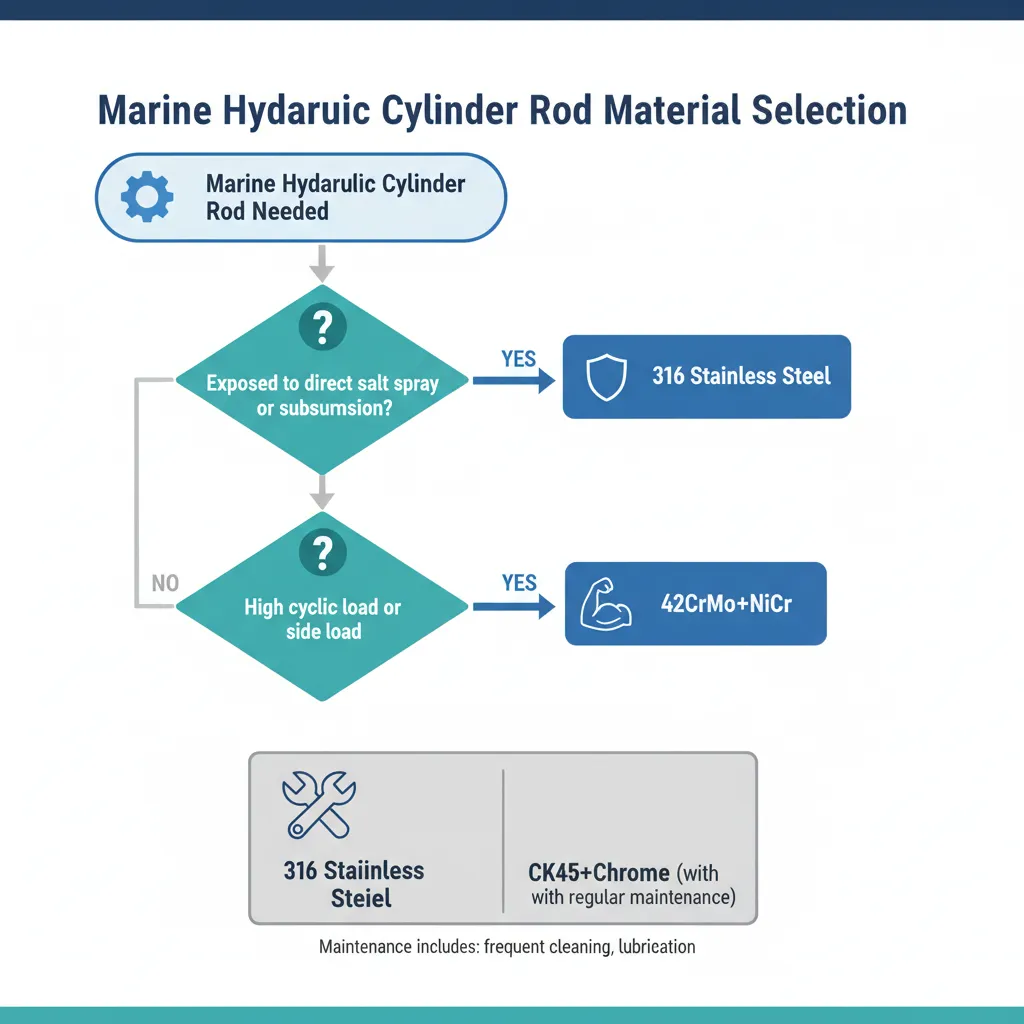
| Marine Application | Recommended Rod Material | Reasoning |
|---|---|---|
| Ship hatch cover cylinders | 316 Stainless Steel | Exposed to direct salt spray, low-moderate cycle rate, high cost of rod replacement due to deck disassembly. |
| Deck crane luffing cylinders | 42CrMo + NiCr or 316 (surface hardened) | High loads, moderate cycles. If washdown is reliable, NiCr can work. If maintenance is irregular, 316 is safer. |
| Active heave compensation cylinders | 42CrMo + thick NiCr/Cr | Extremely high cycle rates and fatigue loads. 316 not suitable without heavy over-sizing. Requires rigorous filtration and washdown. |
| Steering gear cylinders (below deck) | CK45 + Chrome (if protected) or 316 | Protected location. Chrome is acceptable if minimal salt exposure. 316 for safety-critical systems. |
| Stern ramp / RoRo equipment | 316 Stainless Steel | Frequently submerged or heavily splashed. Corrosion resistance is paramount. |
| Winch tensioner cylinders | 316 Stainless Steel | Constant exposure on deck, often neglected. Low maintenance is key. |
| Dredging actuators (submerged) | 316 + HVOF ceramic coating | Submerged in saltwater with abrasive sand. Corrosion resistance plus extreme wear resistance needed. |
| Coastal construction equipment | 42CrMo + Chrome with daily freshwater wash | High cycle, high side load, but operating in air with salt mist. Daily washdown protocol can make chrome viable. |
Real-World Example: Converting a Coastal Crane Fleet from Chrome to Stainless
A port authority operating mobile harbor cranes on a tropical coast was experiencing chrome rod pitting and seal failure on their luffing and telescoping cylinders within 12–18 months of rebuild. Despite daily freshwater rinsing, pits would form at scratch sites from wind-blown sand and minor impacts.
Toleng’s recommendation: The fleet’s most corrosion-exposed cylinders were upgraded from 42CrMo chrome-plated rods to 316 stainless steel rods. Due to the increased rod diameter needed to match the strength of the original 42CrMo rods (approximately 15% larger), the cylinder design was slightly modified. A bronze-filled PTFE gland bushing was specified to prevent galling.
Result: After two full years in service, the stainless rods showed no pitting or measurable corrosion. Seal life improved because there was no longer a source of sharp-edged pits to cut the seal lips. The increased material cost was offset within 18 months by the elimination of rod replacement and the reduction in unplanned downtime.
(Case study based on Toleng application engineering records; customer identity withheld.)
Maintenance Recommendations by Rod Type
| Maintenance Action | Chrome Rod (Marine) | Stainless Rod (Marine) |
|---|---|---|
| Freshwater washdown | Daily, after every operation | Weekly or after heavy salt buildup |
| Rod surface inspection | Weekly (check for pits, scratches) | Monthly (check for scratches) |
| Wiper seal replacement | Every 2,000 hours or immediately if damaged | Every 3,000 hours |
| Rod polishing / repair | At first sign of scratch or pit | Only if deep mechanical scratch occurs |
| Rod replacement trigger | Any pit deeper than chrome layer | Deep gouge >0.1 mm |
Frequently Asked Questions
Q: Can’t I just use a stainless steel rod and hard chrome plate it for extra hardness?
A: Chrome plating over stainless is technically possible but rarely recommended for marine use. The chrome adhesion is often less reliable, and any porosity in the chrome will allow chlorides to attack the stainless underneath, negating the primary benefit of the stainless substrate. A solid 316 rod with Kolsterising or a ceramic coating is typically a better solution.
Q: Is 304 stainless steel ever acceptable for marine hydraulic rods?
A: Generally no. 304 is susceptible to pitting and crevice corrosion from chlorides, especially in warm seawater. If a cylinder is continuously washed down and only occasionally near salt air, it might survive, but 316 is the minimum safe specification for marine service.
Q: How can I protect a chrome rod on a vessel without replacing it with stainless?
A: Implement a rigorous daily freshwater washdown protocol, use an enhanced wiper seal (metal-shelled polyurethane), inspect the rod weekly for the smallest pits, and immediately address any scratches. Consider applying a corrosion-inhibiting spray when the equipment is idle. These measures can significantly extend chrome rod life.
Q: Is the extra cost of stainless worth it for a small coastal excavator?
A: It depends on utilization and downtime costs. If the excavator is used daily and a cylinder failure means losing a full day or more of work, the reduced downtime and maintenance of stainless can provide a strong return on investment, even for mobile equipment.
Q: Can Toleng supply 316 rods with Kolsterising or HVOF coatings?
A: Yes. We work with specialized surface treatment partners to deliver hardened 316 stainless rods for the most demanding marine applications. Contact our engineering team to discuss your requirements.
Get the Right Rod for Your Marine Application
Whether you need corrosion-proof 316 stainless rods for a deck machinery OEM contract, heavy-duty 42CrMo rods with marine-grade NiCr coating, or a complete re-engineering of your marine cylinders for longer service life, Toleng delivers precisely manufactured components with full material traceability.
✔ Free material selection consultation
✔ Custom rod manufacturing to your drawings or samples
✔ Surface hardening and coating options available
✔ Global shipping to shipyards and equipment builders
Request Your Marine Rod Quote Today

