
Learn to identify the most frequent hydraulic cylinder problems—from external leaks and internal bypass to bent rods and cushion failure—and apply proven repair or replacement solutions that minimize downtime.
✔ Symptom-to-Cause Diagnostic Table
✔ Rod, Seal, Barrel & Mount Failure Analysis
✔ Step-by-Step Repair Recommendations
✔ When to Repair vs. Replace Components
✔ OEM Parts & Engineering Support
Quick Answer
The most common hydraulic cylinder failures include external oil leaks (rod seal failure), internal bypass causing drift (piston seal wear), bent or scored piston rods, scored cylinder barrels, gland bushing wear, and cushion failure. Contamination and side loading are the two biggest root causes. A structured diagnostic approach—starting with external inspection and moving to blocked-cylinder bypass tests—isolates the failed component quickly, enabling a targeted repair that prevents repeat failures.
Key Takeaways
-
Over 70% of hydraulic cylinder failures are related to seal degradation and contamination ingress.
-
A scratched rod will destroy a new rod seal within hours—always inspect and recondition the rod surface.
-
Cylinder drift is almost always a piston seal problem; confirm with a blocked-cylinder bypass test.
-
Worn wear rings cause metal-to-metal contact that scores expensive barrels and pistons.
-
Proper filtration and preventive seal replacement reduce total cost of ownership significantly.
Who Should Read This Guide?
✔ Hydraulic repair technicians troubleshooting cylinder issues
✔ Fleet maintenance managers reducing equipment downtime
✔ Equipment operators reporting hydraulic problems
✔ OEM design engineers seeking to understand field failure modes
✔ Procurement specialists evaluating repair vs. replacement costs
Hydraulic Cylinder Failure Overview
Hydraulic cylinders operate under extreme pressure, in dirty environments, and are subjected to shock loads, side loads, and millions of cycles. Failures fall into three broad categories:
-
Seal-related failures (external leaks, internal bypass) – most common, often caused by contamination or worn mating surfaces.
-
Hard-part failures (bent rod, scored barrel, cracked gland) – usually the result of overload, side load, or long-term wear.
-
Mounting and structural failures – misalignment, elongated pin bores, weld cracks.
This guide addresses the most frequent failure modes, their root causes, diagnostic steps, and proven solutions.

Quick Diagnostic Table: Symptom → Cause → Solution
| Symptom | Most Likely Cause | Solution |
|---|---|---|
| Oil leaking from rod end | Worn or cut rod seal | Replace rod seal; inspect and recondition rod surface if scratched |
| Cylinder drifts / load sinks | Internal bypass past piston seal | Test with blocked-cylinder method; replace piston seal; inspect barrel bore |
| Rod surface scratched or scored | Contamination ingress past failed wiper seal | Polish or re-chrome rod; replace wiper seal and rod seal |
| Chrome peeling or pitting on rod | Corrosion, poor plating adhesion, or impact damage | Re-chrome or replace rod; improve environmental protection |
| Bent piston rod | Overload, side load, or impact | Replace rod; correct mounting alignment and check pressure settings |
| Barrel bore scored | Abrasive particles in hydraulic fluid | Hone barrel to oversize or replace; flush system; replace filters |
| Jerky, uneven movement | Air in system, worn wear rings, or failing seals | Bleed air; inspect and replace wear rings; check rod seal |
| Knocking at stroke end | Cushion spear or sleeve worn, cushion orifice clogged | Inspect and replace cushion components; clean hydraulic system |
| Oil leaking at gland-to-barrel joint | Static gland O-ring failure | Replace O-ring and backup ring; verify gland thread condition |
| Mounting pin bore elongated or weld cracked | Side load, misalignment, fatigue | Re-bush pin bores; repair or replace mount; align cylinder |
| Overheating cylinder | Internal bypass (piston seal), excessive friction | Diagnose bypass; replace seals and wear rings; check fluid viscosity |
| Rod moves slowly under load | Piston seal bypass or pump/valve issue | Isolate cylinder with bypass test; repair cylinder or valve as indicated |
Failure 1: External Oil Leakage (Rod Seal Failure)
What It Looks Like
Oil film, dampness, or streaming oil visible on the piston rod or dripping from the gland area. A wet ring of dust and oil accumulates around the rod.
Root Causes
-
Worn rod seal lip – normal end-of-life wear after thousands of cycles.
-
Cut or nicked seal lip – caused by a scratched or pitted rod surface.
-
Hardened seal – overheating or incompatible hydraulic fluid.
-
Contamination ingress – dirt embeds in the seal and abrades the rod.
Diagnostic Steps
-
Wipe the rod completely dry.
-
Cycle the cylinder several times.
-
Observe if new oil appears on the rod surface. A light lubrication film is normal; dripping or streaming is not.
-
Inspect the rod surface carefully for scratches or pits. Any defect you can feel with a fingernail will damage a new seal.
Solution
-
Replace the rod seal (as part of a complete seal kit).
-
If the rod is scratched, polish or re-chrome it before installing a new seal. Installing a new seal on a damaged rod guarantees immediate re-failure.
-
Replace the wiper seal simultaneously—it is the first line of defense.
Pro Tip: Always replace the static gland O-ring when replacing the rod seal. A disturbed O-ring may not re-seal.
Failure 2: Cylinder Drift (Internal Piston Seal Bypass)
What It Looks Like
A raised load slowly sinks with no operator command. The cylinder rod retracts or extends under load when the control valve is in neutral.
Root Causes
-
Worn piston seal – sealing lip flattened, extruded, or hardened.
-
Scored barrel bore – provides a leak path around the piston seal.
-
Worn piston OD – allows fluid bypass even with a new seal.
Diagnostic Steps
Perform the blocked-cylinder bypass test (detailed in our Troubleshooting Cylinder Drift guide):
-
Raise the load and mechanically lock it.
-
Remove and cap the rod-end port line.
-
Apply pressure to the piston side.
-
If oil flows from the blocked port or the rod moves, the piston seal is bypassing.
Solution
-
Replace the piston seal. Inspect the barrel bore and piston OD.
-
If the barrel is scored, hone to the next oversize and fit an oversized seal kit.
-
If the piston OD or seal grooves are worn, replace the piston.
Note: If the cylinder holds during the bypass test, drift originates in the control valve or load-holding valve. Test and repair the valve accordingly.
Failure 3: Scratched or Scored Piston Rod
What It Looks Like
Visible linear grooves along the chrome-plated rod surface. May be accompanied by external oil leakage.
Root Causes
-
Failed wiper seal allowing dirt and debris into the cylinder.
-
Contaminated hydraulic fluid circulating abrasive particles.
-
External impact damage (tools, rocks, debris).
Diagnostic Steps
-
Visual inspection under bright light at a shallow angle.
-
Fingernail test: if you can feel the scratch, it is too deep to leave unaddressed.
-
Measure scratch depth with a depth micrometer if available.
Solution
-
Shallow scratches (<0.1 mm): Polish the rod with fine abrasive cloth (crocus cloth) in a circumferential motion, never axially.
-
Deep scratches (< chrome thickness): Grind and re-chrome the rod to original specification.
-
Deep scratches into base metal: Replace the rod.
-
Always replace the wiper seal and rod seal after any rod reconditioning.
Prevention: Upgrade wiper seal material for harsh environments. Toleng offers heavy-duty polyurethane wipers with metal retaining shells for extreme contamination.
Failure 4: Bent Piston Rod
What It Looks Like
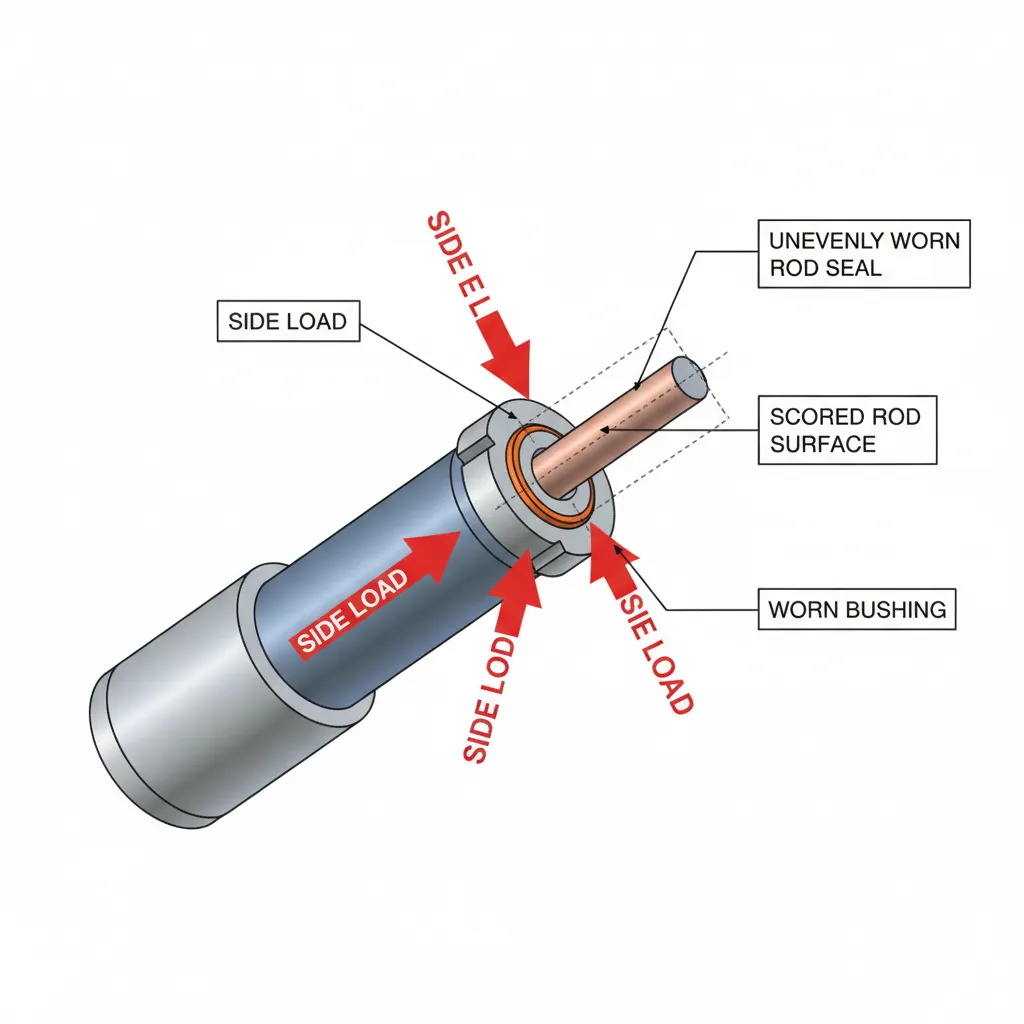
The rod is visibly bowed when extended. Uneven wear on one side of the rod surface. The cylinder may bind during operation or leak persistently on one side.
Root Causes
-
Excessive side loading from misaligned mounts.
-
Overload beyond the rod’s buckling strength.
-
Impact damage during operation or transport.
Diagnostic Steps
-
Extend the rod fully.
-
Rotate the rod (if possible) and observe runout.
-
Measure straightness with a dial indicator on V-blocks. Total Indicator Reading (TIR) should be ≤0.1 mm per meter.
Solution
-
Replace the rod. Do not attempt to straighten a hardened rod. Straightening introduces micro-cracks that can lead to sudden fatigue failure under load.
-
Investigate the root cause: check mount alignment, verify operating pressure, and ensure the cylinder is correctly sized for the load.
-
Replace the gland bushing and all seals, as the bent rod will have worn them unevenly.
Failure 5: Scored Cylinder Barrel
What It Looks Like
Upon disassembly, the internal bore shows linear scratches, galling, or a wear step. Often accompanied by internal bypass (drift) and metal particles in the hydraulic oil.
Root Causes
-
Contaminated oil – abrasive particles circulate and score the bore.
-
Worn wear rings – piston metal contacts barrel directly.
-
Cavitation damage – imploding air bubbles erode the bore surface.
Diagnostic Steps
-
After draining and cleaning the barrel, inspect with a borescope or bright inspection light.
-
Measure the bore with a dial bore gauge at multiple positions. Look for ovality >0.05 mm or scoring depth >0.2 mm.
Solution
-
Light scoring (<0.2 mm): Hone the barrel to the next standard oversize (typically +0.5 mm or +1.0 mm). Fit an oversized piston seal and wear rings.
-
Deep scoring or bulging: Replace the barrel or the entire cylinder.
-
Flush the entire hydraulic system and replace all filters to remove the contamination source.
Failure 6: Gland Bushing Wear
What It Looks Like
Excessive radial play of the rod within the gland. The rod can be rocked by hand. Uneven seal wear, often with the rod seal worn more on one side.
Root Causes
-
High side loads over an extended period.
-
Inadequate lubrication (some bushings rely on a thin oil film).
-
Contamination embedding in the bushing material.
Diagnostic Steps
-
With the cylinder at rest, attempt to move the rod laterally by hand. Any noticeable play indicates bushing wear.
-
During disassembly, measure bushing ID and compare to rod OD. Clearance exceeding 0.5 mm for mid-size cylinders is usually unacceptable.
Solution
-
Replace the gland bushing (if the gland design allows separate replacement).
-
If the gland body is also worn, replace the complete gland assembly.
-
Investigate and correct the side-loading condition. Consider adding a spherical bearing in the mount to accommodate misalignment.
Failure 7: Cushion Failure (End-of-Stroke Hammering)
What It Looks Like
A loud metallic knock when the cylinder reaches the end of its stroke. Can be felt as vibration through the machine structure.
Root Causes
-
Worn cushion spear (the tapered pin on the rod or piston that enters the cushion cavity).
-
Worn cushion sleeve/bushing in the gland or end cap.
-
Clogged cushion metering orifice, preventing oil from being trapped and metered.
-
Incorrect cushion adjustment (if adjustable).
Diagnostic Steps
-
Cycle the cylinder slowly and listen for the knock. It will be most noticeable at higher speeds.
-
Disassemble and measure the clearance between the cushion spear and its mating sleeve. A loose fit = reduced cushion effect.
-
Check the metering orifice for debris.
Solution
-
Replace the cushion spear and/or sleeve if worn.
-
Clean the orifice thoroughly.
-
If cushion is adjustable, follow the manufacturer’s adjustment procedure.
-
Toleng can supply replacement cushion components or integrate upgraded cushion designs into new cylinders.
Failure 8: Mounting Failures (Elongated Pin Bores, Weld Cracks)
What It Looks Like
Excessive play at the cylinder pivot points, visible cracks around the end cap or mount welds, or broken mounting bolts.
Root Causes
-
Chronic misalignment placing bending stress on mounts.
-
Overload causing deformation of the pin bore.
-
Fatigue cracking of welds due to cyclic loading and vibration.
-
Improper welding during manufacture or repair.
Diagnostic Steps
-
Measure pin bore diameters with calipers and compare to the original pin OD. Elongation is typically visible as an oval bore.
-
Perform dye penetrant inspection on suspect welds.
-
Check bolt torque regularly.
Solution
-
Elongated bores: Re-bush the bore to original size, or replace the mount. Ensure proper pin fit.
-
Cracked welds: Only certified welders should perform repairs, with appropriate pre-heat and post-weld stress relief. In many cases, replacing the mount or cylinder is safer and more cost-effective.
-
Misalignment: Correct the mounting geometry. Consider using spherical rod eyes or trunnion mounts that tolerate some angular misalignment.
Failure 9: Overheating Cylinder
What It Looks Like
The cylinder barrel is abnormally hot to the touch during operation. The hydraulic oil may degrade, and seals may harden and crack prematurely.
Root Causes
-
Internal bypass (piston seal leaking) generating heat as oil is forced through a small leak path.
-
Excessive friction from tight seals, worn wear rings, or a bent rod.
-
Insufficient hydraulic oil cooling or low oil level.
Diagnostic Steps
-
Measure the cylinder’s surface temperature with an infrared thermometer. Compare to system normal.
-
Perform a bypass test to check for internal leakage.
-
Check hydraulic oil level and cooler function.
Solution
-
Repair internal leaks (replace piston seal).
-
Ensure wear rings and seals are correctly sized—not too tight.
-
Verify the hydraulic system’s cooling capacity is adequate for the duty cycle.
Preventing Failures: Proactive Maintenance Tips
-
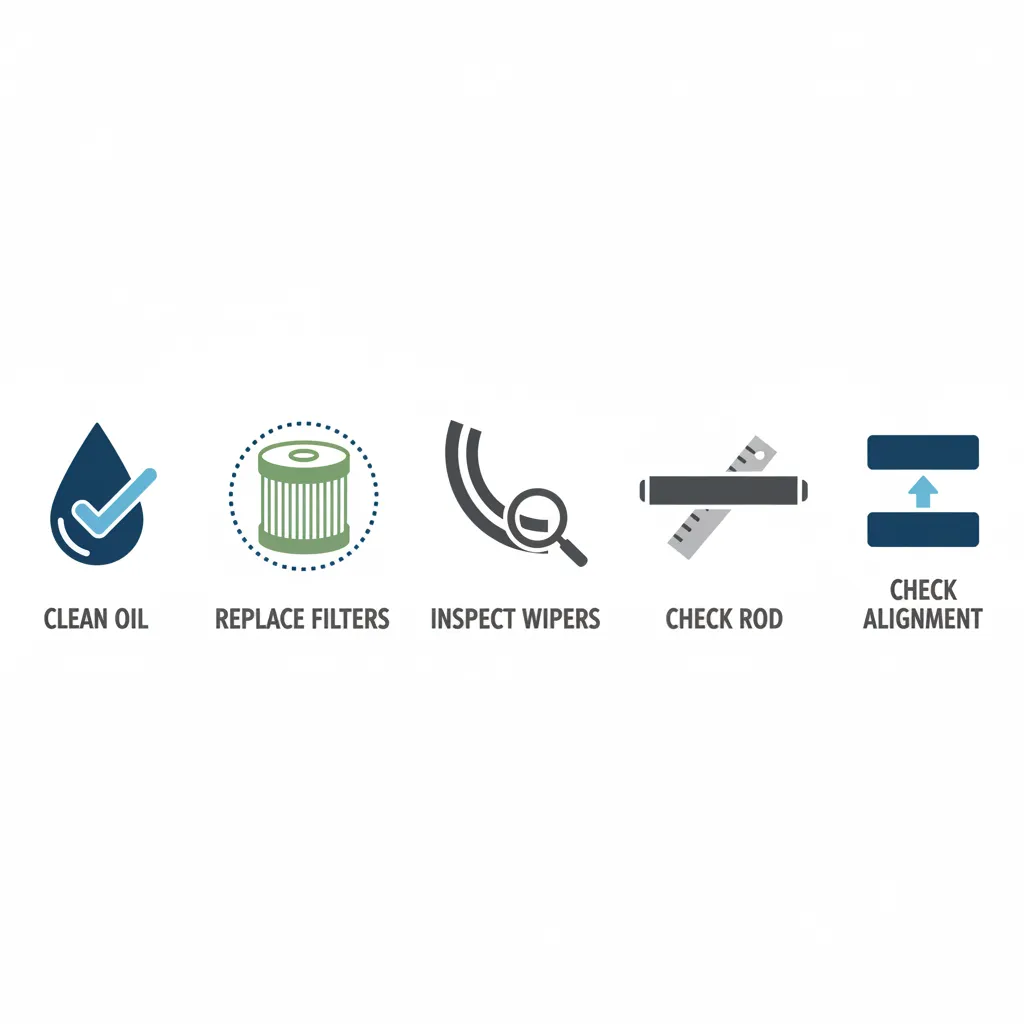
Maintain hydraulic fluid cleanliness at ISO 4406 levels appropriate for your system (typically 18/16/13 or better for high-pressure cylinders).
-
Replace filters on schedule.
-
Use OEM-quality seals that match the cylinder’s pressure, temperature, and fluid specifications. Generic seals may use inferior materials.
-
Inspect rods and wipers weekly for early signs of damage. See our full Inspection Guide.
-
Ensure correct mounting alignment during installation.
-
Do not exceed the cylinder’s rated pressure or side-load capacity.
Real-World Example: Solving Repeated Seal Failures on a Forestry Delimber
A forestry equipment fleet experienced rod seal failures every 2–3 months on the delimber’s main hydraulic cylinder. The working environment was severe: high cycle rates, wood debris, and constant moisture.
Diagnosis: Toleng engineers inspected a failed cylinder and found that the standard NBR wiper seal was hardening and losing contact with the rod after a few weeks, allowing fine wood dust to enter. The rod had begun developing shallow scratches, which accelerated the rod seal failure.
Solution:
-
The rod was polished to remove minor scratches.
-
The wiper seal was upgraded to a heavy-duty polyurethane profile with a metal retaining shell for better dirt exclusion.
-
The rod seal material was changed from standard NBR to a high-grade polyurethane with better abrasion resistance.
-
The fleet implemented weekly rod wipe-downs and wiper inspections.
Result: Cylinder seal life was extended significantly, with the upgraded cylinders running the entire logging season without failure. Annual hydraulic maintenance costs decreased notably.
(Results based on Toleng internal application data; customer identity withheld.)
Frequently Asked Questions
Q: What is the number one cause of hydraulic cylinder failure?
A: Contamination and seal degradation, accounting for over 70% of failures. Keeping oil clean and changing wiper seals preventatively is the most effective strategy.
Q: Can I just replace a leaking rod seal without inspecting the rod?
A: No. If the rod is scratched, it will cut the new seal immediately. Always inspect the rod surface and recondition it if necessary.
Q: How do I know if my cylinder drift is a piston seal or a valve problem?
A: Perform the blocked-cylinder bypass test. If the cylinder holds with ports blocked, the problem is in the valve.
Q: Is it worth re-chroming a scratched rod, or should I replace it?
A: Re-chroming is cost-effective for rods with shallow damage and no bending. Deep pits, bends, or fatigue cracks warrant replacement.
Q: Can I hone a scored barrel myself?
A: Honing requires specialized equipment to achieve the correct cross-hatch finish and straightness. It’s best performed by a hydraulic repair shop with experience.
Q: Does Toleng supply oversized seal kits for honed barrels?
A: Yes. We manufacture precision-oversized seal kits to match commonly re-honed bore diameters.
Q: How can I prevent side-load damage to my cylinders?
A: Ensure correct mounting alignment, use spherical bearings where misalignment is unavoidable, and never side-load a cylinder beyond its design limits.
Stop Hydraulic Cylinder Failures Before They Stop You
Whether you need a seal kit for an emergency repair, a custom oversized kit for a re-honed barrel, a replacement rod or barrel, or a complete new cylinder built to your specifications, Toleng’s engineering team is ready to help.
✔ Rapid diagnostics support
✔ OEM-quality replacement parts
✔ Custom engineering and manufacturing
Request Your Repair Solution Today

